
Today, if people can’t find you, your business practically does not exist –digital visibility is everything!
Every business, small or big, uses Search Engine Optimization to become more visible than their competitors. In fact, 68% of all online experiences begin with a search engine, making the battle for top rankings more critical than ever. But an SEO strategy is incomplete without proper cross-linking if you own multiple domains.
Cross linking helps connect pages across related websites to improve visibility, authority, and user experience. When done strategically, it helps search engines understand your content and boosts overall rankings.
This article explores what crosslinking exactly is, its functions and how it can help a brand rank higher on search engines organically.
What is Cross Linking in SEO

When it comes to SEO, cross linking is considered a powerful tactic to boost rankings and user experience. Cross-linking is the practice of creating links between two or more related websites that are owned or managed by the same entity or partners, to share authority, improve visibility, and enhance user navigation.
It differs from internal linking, which connects pages within the same website. Cross-linking, on the other hand, connects separate domains that are topically relevant to each other.
The main objective behind cross linking is to share link authority. That means when two related websites link to each other, the stronger one passes some of its SEO strength to the weaker one. This helps both the sites perform better in search results. This authority transfer from one website to another is called “link juice” in colloquial SEO language.
The concept of link juice comes from Google’s PageRank system. It is an algorithm that Google uses to calculate the authority and credibility of web pages based on the quality and number of links they receive. In other words, PageRank and trust form the foundation of link authority that determine how valuable the passed “link juice” actually is.
However, cross-linking involves controlled links, it must be handled very carefully. Overdoing it or linking irrelevant pages can backfire. It gives Google a signal of manipulation of search engines to rank unethically that may result in manual or automated penalties.
Therefore, cross-links should only be added when they genuinely help users by leading them to useful and related information.
Functions of Cross-Linking in SEO
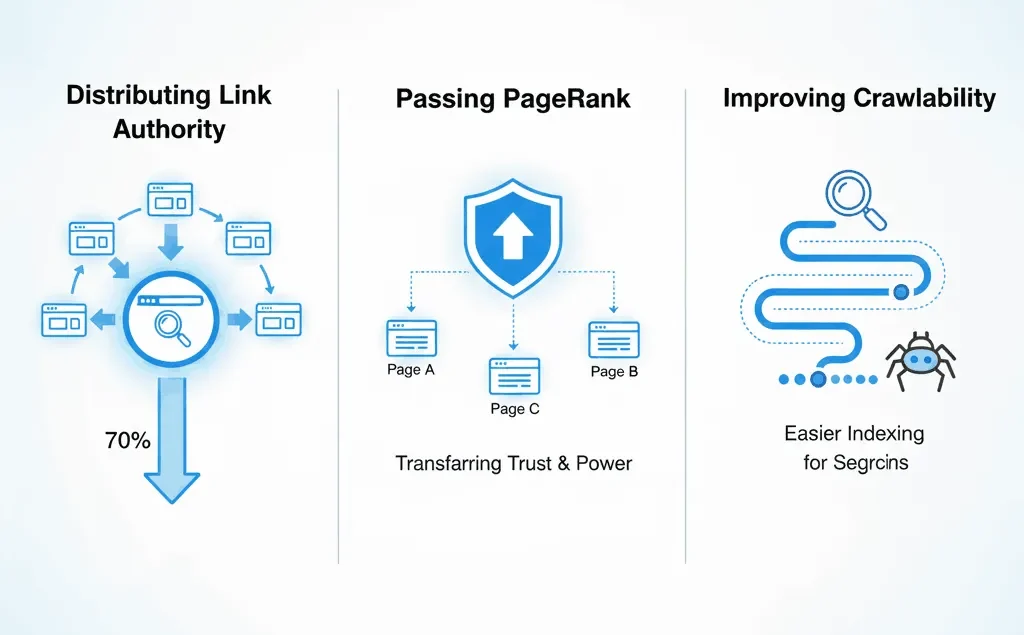
The main function of cross-linking is to strategically distribute link equity, the “link juice”. It helps boost rankings. Moreover, it extends this flow beyond a single domain, connecting authority across multiple sites.
1. Distributing Link Authority (Link Juice)
Every website earns a certain level of authority through backlinks, quality content, and user engagement. However, that authority often remains confined to one domain. Cross-linking changes that by redistributing link equity across multiple related websites. This link authority or link juice shows the total SEO value passed through hyperlinks. This helps pages build relevance and ranking potential.
Internal links distribute this value within a single site. However, cross-links push it beyond domain boundaries and allows connected sites to share ranking power. This helps newer or smaller domains gain momentum from the authority of well-established ones. Using this approach creates a balanced network where each property strengthens the other.
2. Transferring PageRank and Trust
Google’s ranking system is based on an algorithm called PageRank. Google evaluates the importance of a page by understanding its link structure. Though Google does not publish PageRank scores like before, its logic still drives how authority flows online.
This means when a reputed or trusted site links to another, it transfers part of its reliability and credibility to that site. In SEO language, it refers to as “trust signals”
When it comes to cross-linking, a high authority website can channel part of its PageRank and trust to an affiliated or a newly launched website. This approach helps it establish a good reputation faster.
3. Improving Crawlability and Indexing
Google’s programs known as “crawlers” follow links to discover new pages and index them. When websites are interconnected through links, they form a clear, logical map for the crawlers to navigate.
For example, if you interlink two or more of your own websites, cross linking helps ensure every site in your portfolio is indexed efficiently. It also helps Google understand their relationship and relevance. This means a unified online visibility with no hidden or under indexed websites in search results.
Benefits of Cross Linking in SEO
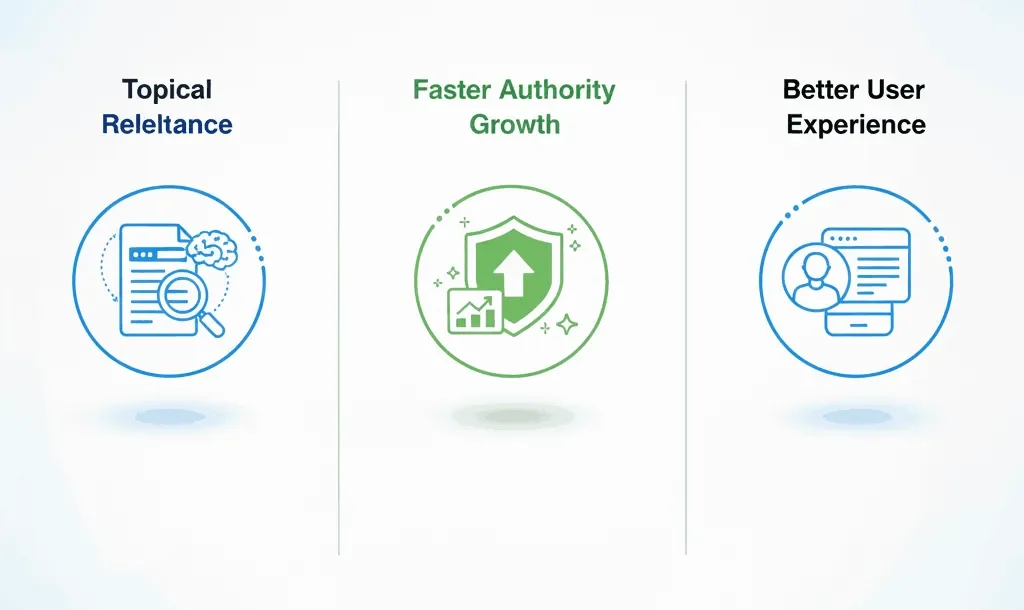
When implemented correctly, cross-linking can do far more than transferring authority. It can enhance visibility, strengthen thematic relevance and create a smooth user experience across the network of your sites. Here are some key benefits of cross-linking.
1. Reinforcement of Topical Relevance
Linking highly relevant content across different websites helps a webmaster improve the site’s overall topical footprint. It means search engines recognize when several authoritative sources, even if they are affiliated, provide in-depth information on the subject.
This consistency reinforces the site’s perceived topical authority that signals Google that your network covers the topic comprehensively. To get this benefit, every cross-link must lead to contextually related, value-adding content that helps both users and search engines understand your expertise.
2. Accelerated Site Authority
In most cases, new or smaller sites struggle to build PageRank and trust from scratch. With the help of cross-linking, established and high authority sister websites pass some of their credibility to newer sites. These contextual and relevant links help the new site improve its authority quicker and gain visibility in SERPs more efficiently. This approach helps create a healthy authority distribution across the brand’s whole web ecosystem.
3. Improved User Experience (UX)
Thoughtful cross linking is not just useful to get search engines attention but also improve user journey. With useful and related content across your network, you encourage users to explore more pages, stay longer, and engage deeply within your brand ecosystem. This seamless navigation not only reduces bounce rates but also increases user satisfaction, provided the links are relevant and really useful.
4. Semantic Mapping and Contextual Understanding
Cross-linking also plays a critical role in semantic SEO. By using descriptive and relevant anchor text, search engines can better interpret what the linked page is about. This practice helps Google map topic relationships between pages and domains and improve how it understands your content’s overall context. Over time, this leads to stronger topic associations and higher rankings for related search queries.
Though the benefits of cross-links are obvious, the real impact depends on how well the links balance authority, relevance, and context. It is because poorly placed or over optimized links can weaken SEO instead of improving it.
The Right Balance of Authority, Relevance, and Context
For effective cross linking, it is not enough to link high authority websites, the link should also be topically relevant. When a strong site links to an unrelated page, search engines consider it manipulative, which can reduce overall SEO. To get the best results, the linking site must align naturally with the topic of the destination page.
Another very important factor is the anchor text or the clickable words in a link. Search engines use this anchor text to understand the topic of the linked page. It is usually safe to use exact keywords for internal linking within the domain but doing so for external links can appear unnatural and often result in penalties. So, it is smarter to use natural, descriptive phrases which explain the content being linked. This approach helps keep the link genuine and pass value safely.
Difference Between Cross-Linking, Internal Linking, and Backlinking
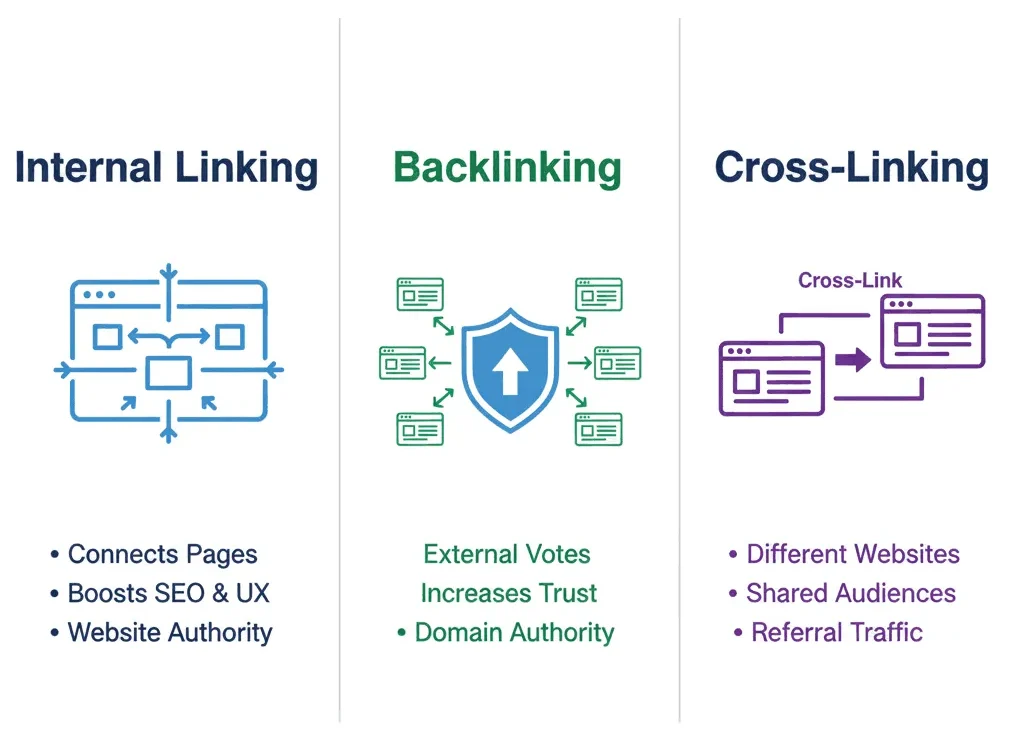
To execute a successful linking strategy it is important to understand the difference of purpose and risk associated with each type of connection. In fact, cross-links inhabit a regulatory gray area and require precise understanding.
| Link Type | Origin/Destination | Primary SEO Purpose | Control Level | Associated Risk |
| Internal Link | Connects pages within the same domain. | Improves user navigation, boosts crawling/indexing efficiency, distributes internal equity. | Total (Webmaster controls source and destination content). | Low (Risk is mainly structural, affecting indexing). |
| Backlink | Links from an unrelated external domain to your site. | Accrues Domain Credibility, acts as an independent “editorial vote” to increase ranking potential. | Low (External site controls the link). | Variable (Quality is more important than quantity; low-quality links hurt ranking). |
| Cross-Link | Mutual linking between affiliated, separate domains. | Strategic mutual authority reinforcement, ensuring search engines map the “full chain of sites”. | High (Webmaster controls both domains). | High (Risk of being flagged as a link scheme or link farm if not differentiated and moderated). |
Controlled vs. Uncontrolled Links: What It Means for SEO
Internal links connect different pages of the same website and are the safest, most predictable type. They improve user flow and help search engines understand your site’s structure.
Meanwhile, backlinks are the independent “ votes of confidence” from other websites. As they come outside of your control, they are more valuable for higher rankings. However, it is harder to earn high quality backlinks.
When it comes to cross links, they sit between the two. Technically, they are external links but often managed by the same webmaster or company. This makes them useful as well risky. Search engines particularly evaluate whether these links are genuinely helpful or created to manipulate search engines rankings.
Cross-Linking as a High-Control, High-Reward Strategy
As cross linking is under the control of a brand, it provides brands a chance to strategically transfer authority and guide users between related websites. However, careful consideration is required while linking because a small mistake can appear manipulative. If a brand uses cross linking responsibly, they can build topical depth that drives conversions.
Why Cross-Linking Still Matters in Modern SEO
Nowadays, SEO is not about targeting specific keywords, it’s more about building topical authority. Search engines are smart enough to reward websites that show deep, interconnected expertise on a subject. It highlights the importance of topic clusters or pillar and cluster pages.
Cross linking connects related content across different domains, strengthening this structure. In this way, content does not remain isolated but gets connected with strategic cross linking. It not only reinforces brand expertise on a specific subject but also improves how search engines perceive its overall authority.
How Cross-Linking Supports Semantic SEO
Internal links connect pillar and cluster pages within one domain and cross-links take this concept a step further by linking thematic content across multiple sites you own.
- Pillar-to-Pillar Links: Connect foundational pages from different domains e.g., “E-Commerce Strategy” on Domain A to “Payment Solutions” on Domain B to reinforce the broader topic of Digital Commerce.
- Cluster-to-Pillar Links: Link detailed supporting content from one domain to a major resource on another to efficiently share link authority and guide search engines through your topic network.
These connections help Google understand the relationship between sites and boost the credibility of your entire content ecosystem. By adding structured data or Schema markup you can further enhance how these relationships are interpreted and displayed in search results.
The Importance of Context and Differentiation
For effective cross-linking, it is necessary for each domain to offer a unique value. It is because Google’s algorithms can identify repetitive or duplicate content. And filter it out of search results.
So, if you are managing multiple sites, each website should have its own purpose, audience and content identity. For example, a consulting firm or Domain A that links to an industry research blog or Domain B offers a meaningful, value-driven connection. On the other hand, linking two identical sites can appear manipulative.
Last but not least, context is everything. The words around your link, not just the anchor text help search engines interpret its meaning. A cross-link should feel like a natural part of the narrative. It should seamlessly guide users to deeper, relevant information rather than appearing forced or artificial.
Smart Ways to Cross-Link Your Web Pages for Better Rankings
Here are some smart ways you can use to cross-link your website for better visibility and authority.
Contextual Placement
The placement of the link matters a lot for both search engines and visitors. The right position ensures the accurate perception and increased click-through potential. Cross-links should be placed naturally within the body of the content. These should fit contextually as well as guide users to valuable, relevant information.
Avoid Link Chaining and Over-Linking
Search engines caution against clustering too many links in one location or placing them next to each other. It makes it harder for readers to differentiate between them and also reduces the contextual text around each link. On the other hand, excessive linking, especially in non-content areas like footers or sidebars, reduces link equity and risks overwhelming visitors.
Focus On User Intent
Strategic linking should focus on high-intent pages that align with conversion goals. For example, linking from a high-authority introductory guide on Domain A to a “Solutions” page or a “Case Studies” page on Domain B provides genuine value that impacts conversion metrics.
Descriptive Anchor Texts
Anchor text must clearly describe the content of the linked page. Use comprehensive phrases instead of abbreviated keywords to help both Google and users to understand the relevance of the linked resource.
Internal Cross-Linking vs. External Cross-Linking: Which Is Better?
People usually get confused with the terminology. In general, internal links connect different pages of the same website. However, the external links link pages between different websites. In SEO, cross- linking usually refers to links between affiliated yet different websites e.g., sites owned by the same organization.
No linking is better or worse than the other as they serve different, complementary purposes.
1. The Foundation or Internal Linking
Effective internal linking is the foundation of SEO. It enhances crawlability, strengthens topic clusters and ensures efficient distribution of link equity within the same domain.
2. The Authority Extension or External Cross-Linking
Once the internal structure is optimized, the next step is to strategically cross link between related websites. These links help transfer accumulated PageRank, authority, and trust from one high-performing website to another within the same brand web ecosystem.
In simple words, internal links help improve site structure and indexing efficiency. On the other hand, external cross links enhance authority and trust across different owned domains. Both play distinct yet crucial roles for holistic SEO performance.
Compliance and Technical Mistakes
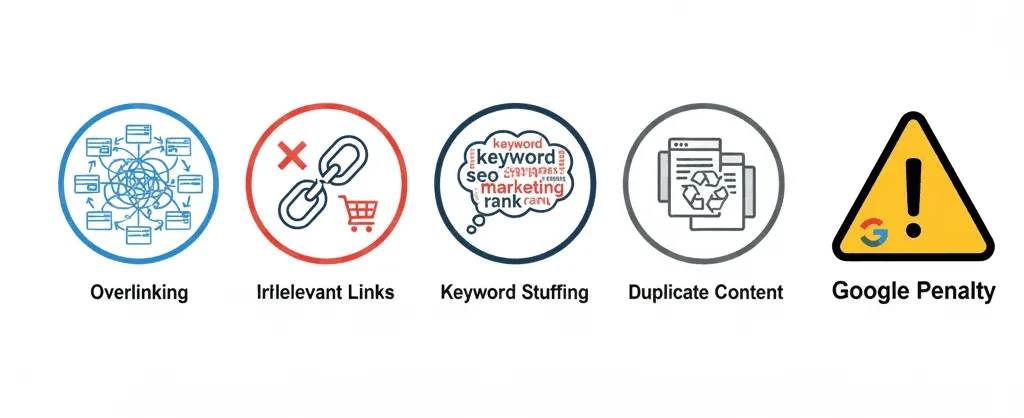
Cross linking is a powerful tool but it is also important to understand the risks associated with them. As it involves controlled linking, a little mistake can make Google perceive manipulation to influence rankings. It can lead to penalties or devaluation of the sites.
Common Cross-Linking Mistakes That Hurt SEO
- Too many links: excessive use of cross links across different domains can make your network look like a link farm. Always keep the cross links minimal and purposeful
- Irrelevant Links: Links unrelated topics can put you in trouble. Both search engines and visitors get confused by irrelevant linking. It can reduce your SEO value
- Keyword Stuffed Anchor Text: Using keywords in internal linking is fine, but its repeated use in cross linking may cause you penalties. Always use descriptive, natural phrases instead.
- Technical Overlap: Don’t use shared hosting or CMS for different sites. Google treats them as one entity and may nullify the cross-link value.
Avoiding Technical Red Flags
Google usually identifies affiliations through technical signals. It is necessary to maintain separation between two websites.
- Hosting/IP Address: Use different hosts or IP ranges for each site. It is because shared hosting can quickly indicate common ownership.
- Contact Details & Admin Accounts: Do not use the same contact information or Google accounts, Search console or Analytics for multiple domains
- Unique Content & Purpose: Do not use duplicate content on different domains. Every website should have its own niche, tone, and goal. It helps stay credible and compliant.
Wrapping Up
Cross-linking can be a great way to build strong topical authority across connected websites. It helps brands share PageRank, trust and topic relevance across the entire online ecosystem.
However, its success depends on various factors. It is necessary to keep links relevant, limited and natural. Each link must guide users to genuinely useful and related information. The purpose should not just to boost rankings.
With thoughtful cross-linking brands can strengthen their website’s credibility, build lasting authority, and achieve higher ranking without risking penalties. In short, smart cross-linking connects valuable content in a natural way that benefits both search engines and users.