
SEO has come a long way from the days when sprinkling the same keyword endlessly across a page was enough to rank. Today, Google reads and understands content almost like a human, focusing on meaning rather than just matching exact words. This shift has made synonyms more important than ever.
Why? About 15% of the searches made every day on Google are completely new, phrases that have never been searched before. To handle this, Google relies on understanding context and semantics. Using synonyms lets you write naturally while helping search engines grasp the full scope of your topic.
In this guide, we’ll explore why synonyms matter, how Google interprets them, and practical ways to use them to boost your rankings.
The Role of Synonyms in Modern SEO
In the early days of the internet, SEO was strictly about “exact match” keywords. If you wanted to rank for “cheap running shoes,” you had to write “cheap running shoes” as many times as possible. This led to content that was repetitive, robotic, and difficult to read.
In modern SEO, the role of synonyms is to bridge the gap between what users type and what they actually mean.
1. Enhancing User Experience (UX)
Google’s primary goal is to serve the user. When a user lands on a page that repeats the same phrase endlessly, they bounce (leave the site). Synonyms allow you to write content that flows naturally.
- Without Synonyms: “This laptop is the best laptop. If you want a fast laptop, buy this laptop.”
- With Synonyms: “This laptop is the best machine on the market. If you want a fast computer, buy this notebook.”
The second sentence keeps the reader engaged, which increases “dwell time” (time spent on page), a positive ranking signal.
2. Capturing Long-Tail Traffic
Different people use different words to describe the same object or problem based on their location, age, or background.
- One person might search for “Soda.”
- Another might search for “Pop.”
- A third might search for “Soft drink.”
If your article only uses the word “Soda,” you might miss the traffic from the “Pop” searchers. By using synonyms, you cast a wider net, allowing your single page to rank for hundreds of different keyword variations without needing to write a separate article for each one.
3. Preventing “Over-Optimization” Penalties
Google has strict penalties for “Keyword Stuffing”, the act of using a keyword unnaturally often. If your keyword density is too high, Google may flag your site as spam. Synonyms are the antidote to keyword stuffing. They allow you to stay on topic without triggering spam filters.
How Search Engines Understand Synonyms
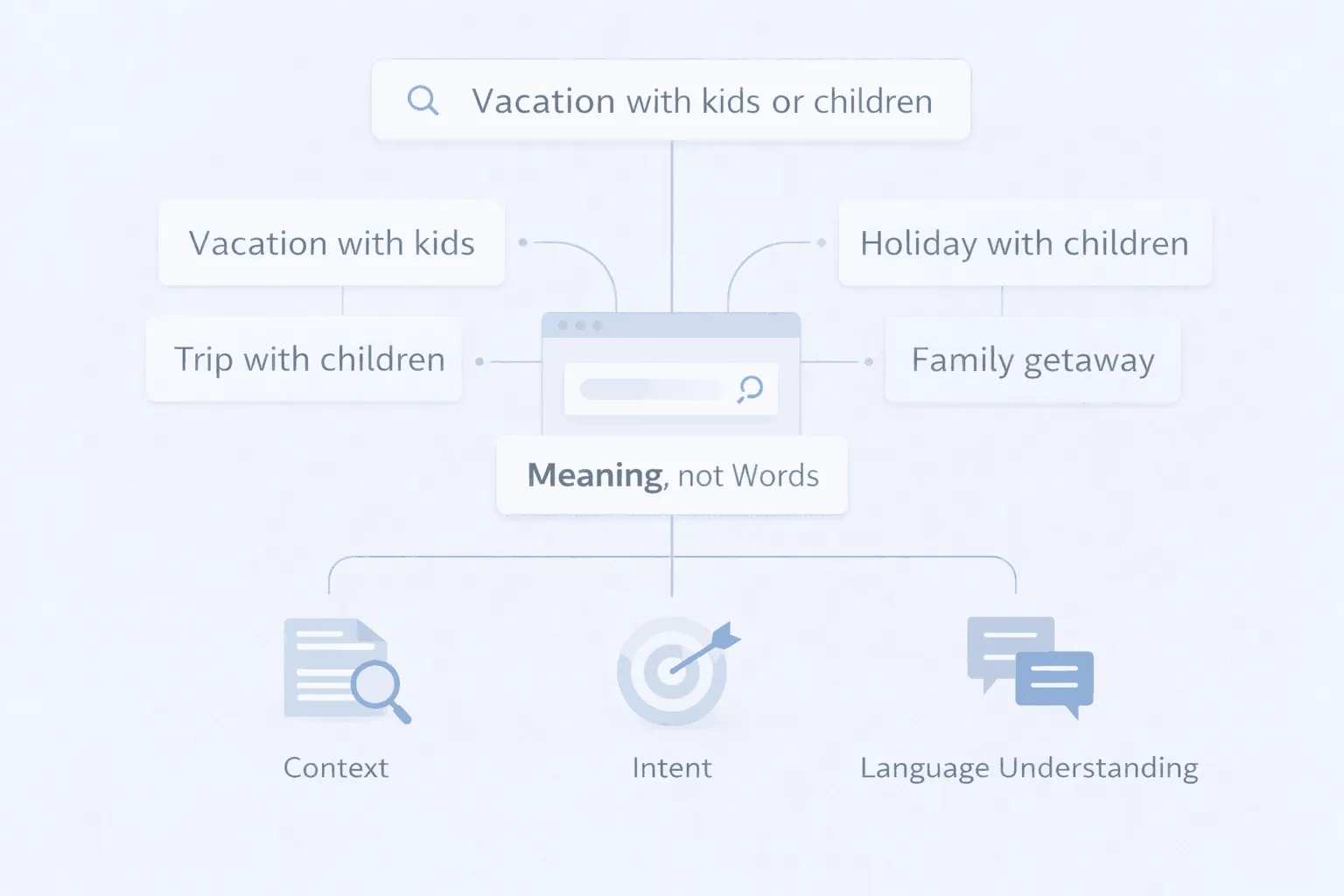
You might be wondering, “How does a machine know that ‘vacation’ and ‘holiday’ mean the same thing?”
It wasn’t always this way. Google has spent the last decade rolling out massive algorithm updates designed to understand human language. Here are the key technologies that make synonym detection possible:
Google Hummingbird (2013)
Before Hummingbird, Google looked at words individually. If you searched “Best place for pizza,” it looked for “Best,” “Place,” and “Pizza.”
Hummingbird changed Google from a keyword-matching engine to a “semantic” engine. It started looking at the entire query to understand the intent. It realized that “place” in this context likely meant “restaurant.”
RankBrain (2015)
RankBrain is a machine-learning artificial intelligence system. It helps Google interpret new or ambiguous searches.
- How it works: If RankBrain sees a user search for “The grey console with the controller,” and that user clicks on a result about “PlayStation,” RankBrain learns that “Grey console” is a synonym/related term for “PlayStation.”
- This allows Google to rank pages that contain the answer, even if they don’t contain the exact words used in the query.
BERT (2019)
BERT (Bidirectional Encoder Representations from Transformers) was a massive leap forward. While previous updates looked at words, BERT looks at the nuance and context of words in a sentence.
- Context matters: BERT ensures Google knows the difference between “running a business” and “running a marathon,” even though the word “running” is the same. It understands that “managing” is a synonym for the first, and “jogging” is a synonym for the second.
The Knowledge Graph
Google maintains a massive database called the Knowledge Graph. This connects facts, people, and places. It knows that “Barack Obama” is connected to “US President.” Because of this, it understands that if you write “The 44th US President,” you are referring to Obama, effectively treating the title as a synonym for his name.
Synonyms vs Exact Keywords in SEO

A common question beginners ask is: “Should I stop using my main keyword and only use synonyms?”
Absolutely not. It is about balance.
Your Exact Match Keyword is usually the term with the highest search volume. It is the anchor of your strategy. You should still use it in critical places (like your main title). Synonyms support that main keyword by providing context.
Here is a breakdown of how to balance the two:
| Feature | Exact Match Keywords | Synonyms & Variations |
| Primary Goal | To target the highest search volume term. | To capture broader traffic and prove context. |
| Best Location | Page Title (H1), URL, First Paragraph. | H2/H3 Subheadings, Body Content, Alt Text. |
| Risk | High risk of “Keyword Stuffing” if overused. | Very low risk; looks natural to readers. |
| User Intent | Targets a specific query. | Targets the topic as a whole. |
| Frequency | Use sparingly (1-3% density). | Use liberally throughout the text. |
The Strategy: The “Hub and Spoke” Approach
Consider your main keyword as the hub of a wheel, and synonyms as the spokes.
- Hub (Main Keyword): “Digital Marketing“
- Spokes (Synonyms): “Online Marketing,” “Internet Advertising,” “Web Promotion.”
If you remove the hub, the wheel falls apart. If you remove the spokes, the wheel is weak. You need both to roll forward in the search rankings.
Synonyms, Entities, and Topic Coverage in SEO
To truly master modern SEO, you need to move beyond “keywords” and start thinking about Entities.
In the eyes of Google, an “Entity” is a thing, a person, place, concept, or object, rather than just a string of text. Google wants to know that your article covers the entity comprehensively.
“Things, Not Strings”
When you write about the entity “Apple” (the brand), Google expects to see related words and synonyms that confirm you are talking about the tech company, not the fruit.
- If your article contains words like “iPhone,” “Mac,” “Tech Giant,” “Cupertino,” and “Tim Cook,” Google knows you are discussing the Corporate Entity.
- If your article contains words like “Pie,” “Fruit,” “Orchard,” “Granny Smith,” and “Red,” Google knows you are discussing the Food Entity.
How Synonyms Build Authority
Using a rich vocabulary signals to Google that you are an authority on the subject. An expert on coffee doesn’t just say “coffee” twenty times. They use words like:
- Brew
- Roast
- Beans
- Java
- Espresso
- Caffeine fix
By using these synonyms and related terms naturally, you are telling Google’s algorithm: “I know this topic deeply. I am using the language that experts use.”
Broadening Topic Coverage
Google prefers “comprehensive” content. They want to send users to the one page that answers all their questions.
If you are writing about “How to lose weight,” using synonyms helps you cover different angles of the topic:
- “Slim down” (Casual intent)
- “Reduce body fat” (Technical intent)
- “Drop pounds” (Quick fix intent)
By weaving these variations into your headings and text, you signal that your guide is useful for everyone, regardless of exactly how they phrase their problem.
Common Mistakes When Using Synonyms for SEO

While synonyms are a powerful tool, using them incorrectly can actually confuse search engines or hurt your rankings. It is not as simple as right-clicking a word and selecting a replacement from a thesaurus.
Here are the most common traps to avoid:
1. Using Synonyms That Change Intent
Not all synonyms are interchangeable in every context. In SEO, “Intent” is king.
- Example: You are selling “Cheap laptops.”
- Thesaurus suggestion: “Poor quality laptops.”
- Why it fails: Technically, “cheap” can mean “poor quality,” but in SEO, a user searching for “cheap” wants a low price, not a broken computer. If you optimize for “poor quality,” you will ruin your brand reputation.
2. Forcing Unnatural Words (The “SAT Word” Problem)
Don’t use a thesaurus just to find a fancy, complex word that no one actually uses in daily conversation.
- Bad: “The automobile was positioned in the subterranean structure.”
- Good: “The car was parked in the basement garage.”
Always write for humans first. If the synonym sounds robotic or pretentious, delete it. Google’s natural language processors prefer language that sounds like a real human speaking.
3. Diluting Your Main Keyword
While we want to avoid stuffing, we also don’t want to disappear. If you have a high-value keyword (e.g., “Divorce Lawyer”), don’t replace it every single time with “Marriage Dissolution Attorney.”
- The Rule: Ensure your exact main keyword appears in the most important places (Title, URL, Introduction). Use synonyms in the body text. If you replace the keyword in the Title tag with a synonym, you might lose rank for the main term.
4. Ignoring Regional Differences
Synonyms often vary by geography.
- US: “Apartment” / UK: “Flat”
- US: “Truck” / UK: “Lorry”
- US: “Sneakers” / UK: “Trainers”
If you are targeting a US audience, using “Lorry” as a synonym for “Truck” will confuse your readers and tell Google you might be relevant to the UK, not the US. Know your target audience before selecting synonyms.
Synonyms vs LSI Keywords: What’s the Difference?
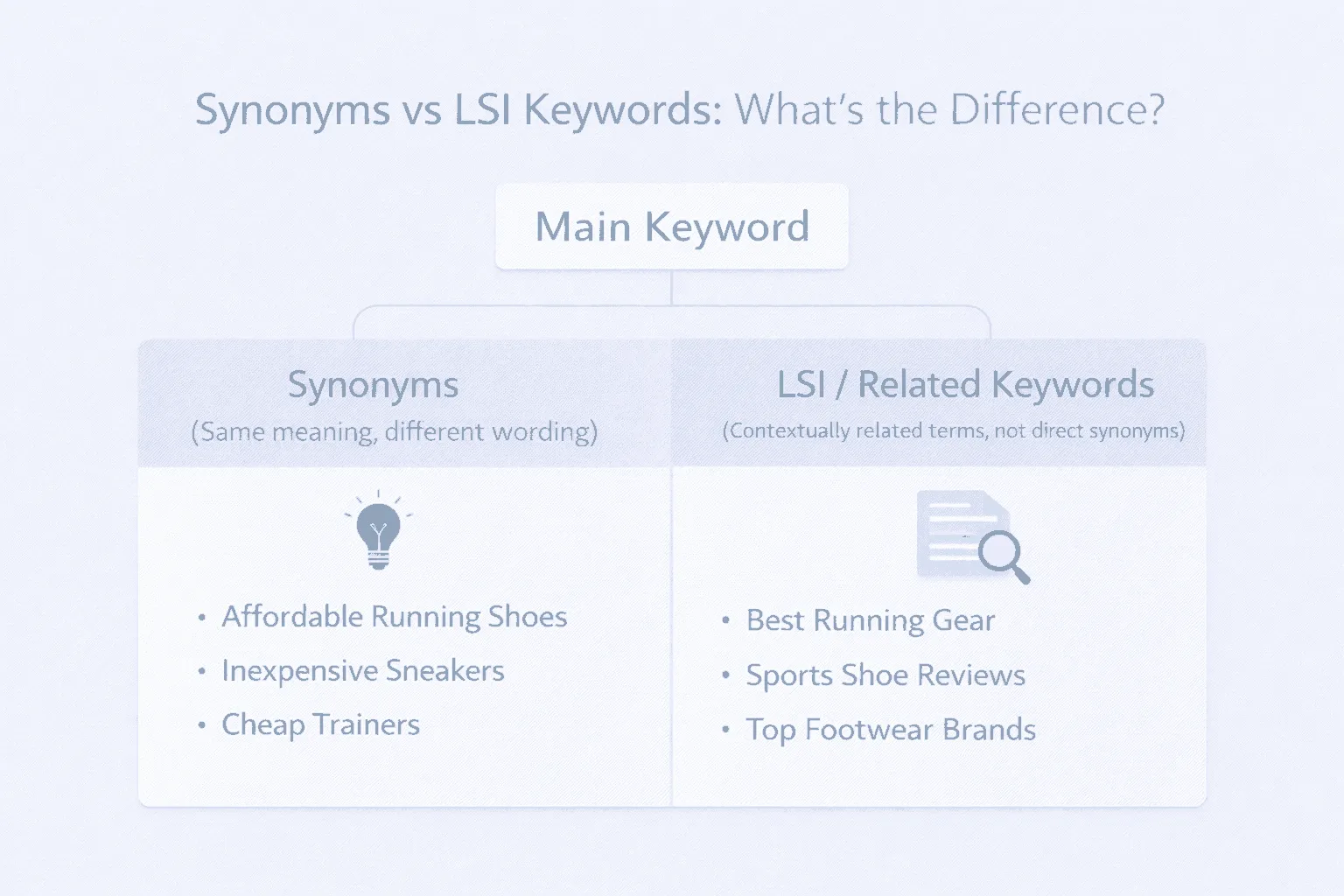
You will often hear the term “LSI Keywords” (Latent Semantic Indexing) thrown around in the SEO world. It is easy to confuse them with synonyms, but they are technically different concepts, and understanding the difference will make you a better writer.
1. Synonyms
Synonyms are words that mean the exact same thing (or nearly the same). They can be swapped one-for-one in a sentence.
- Example: “Shop” and “Store.”
- Example: “Big” and “Large.”
2. LSI (Related) Keywords
LSI terms are words that are conceptually related to the topic but are not direct replacements. They provide context to the main topic.
- Example: If the topic is “Cars,” LSI keywords would be “Tire,” “Engine,” “Speed,” “Fuel,” “Driver,” and “Highway.”
- Note: You cannot say “I drove my tire to work.” Therefore, “tire” is not a synonym for car, but it is an LSI/related keyword.
Why the Distinction Matters
Google technically doesn’t use the old LSI technology (which is from the 1980s), but the concept remains valid. Google looks for “semantically related terms.”
- Synonyms help you avoid repetition and capture variations of the main search.
- LSI/Related Terms help you prove depth and context.
How to use them together:
If you are writing an article about “Cold Brew Coffee,” you should use:
- Synonyms: Iced coffee, cold press, chilled coffee.
- LSI Keywords: Steep, grounds, acidity, refrigerator, filter, concentrate.
By combining both, you create a “content cloud” that completely satisfies Google’s algorithms.
Conclusion
So, are synonyms helpful for SEO? Yes, they are essential.
Gone are the days of stuffing your content with a single keyword until it becomes unreadable. Modern SEO is about communication. It is about proving to Google that you understand a topic deeply and can explain it in a way that helps users, regardless of exactly which words they type into the search bar.
Using synonyms effectively allows you to:
- Rank for more keywords (long-tail variations).
- Avoid penalties (no keyword stuffing).
- Improve readability (better user experience).
- Demonstrate authority (comprehensive topic coverage).
Key Takeaways for Your Strategy:
- Write for Humans: If your content flows naturally, you will likely use synonyms automatically.
- Don’t Abandon Keywords: Keep your main keyword in your Title and H1, but use variations in the rest of the text.
- Think in Concepts: Focus on covering the “Entity” or topic as a whole, rather than just hitting a keyword count.
By diversifying your language, you make your content future-proof, user-friendly, and ready to rank for hundreds of search queries you hadn’t even thought of.