
Article Submission was one the most common SEO tactics in the past. But now it is outdated and can even harm a site. SEO experts had used this technique to build links that majorly relied on posting bulk, low quality or spun content across irrelevant directories. Nowadays, it is classified as a link scheme.
Modern SEO requires a completely different approach. Today, quality is more important than quantity. The goal is to earn links that bring authority, relevance and trust. One can achieve this by selective guest posting, Digital PR, and genuine content partnerships. Moreover, it is necessary to follow Google’s link guidelines if someone wants to avoid penalties.
With this core shift, links are no longer cheap transactions, these high value endorsements must be earned. SEO efforts without this mindset can result in short term failure and long term damage to visibility.
What is Article Submission in SEO?

Traditionally, article submission meant the manual or automated uploading of generic articles to low quality, open access directories. The main goal was to get backlinks.
However, this tactic lost its value when in 2011, several such directories were penalized and devalued by Google’s Panda Update. It made this old method risky and outdated.
In modern SEO, the term Article Submission has been redefined by the industry. Now, it’s more about Content Contribution or Guest Posting. The modern approach is more strategic and mainly focuses on publishing high quality, original content on high-authority, trusted websites.
This approach involves two major goals:
- Referral Traffic & Brand Awareness: To make the brand visible and attract potential customers/ qualified visitors to the website.
- SEO Authority Transfer: To enhance credibility and improve E-E-A-T by gaining strong and relevant backlinks from reliable host domains.
In contrast to the old method, modern SEO requires careful evaluation of the host website. The host website must have strong authority, good editorial standards, and real audience. It is necessary to adopt this approach as search engine algorithms look for transparency and relevance. The on page content, keywords, and links must be genuinely helpful for readers while enhancing user experience. However, if the content is created to manipulate ranking like with anchor text stuffing, search engines can ignore the links or even perish the site.
In short, article submission these days is about creating original, valuable, and relevant content rather than just placing links.
The Evolution of Article Submission Over the Years
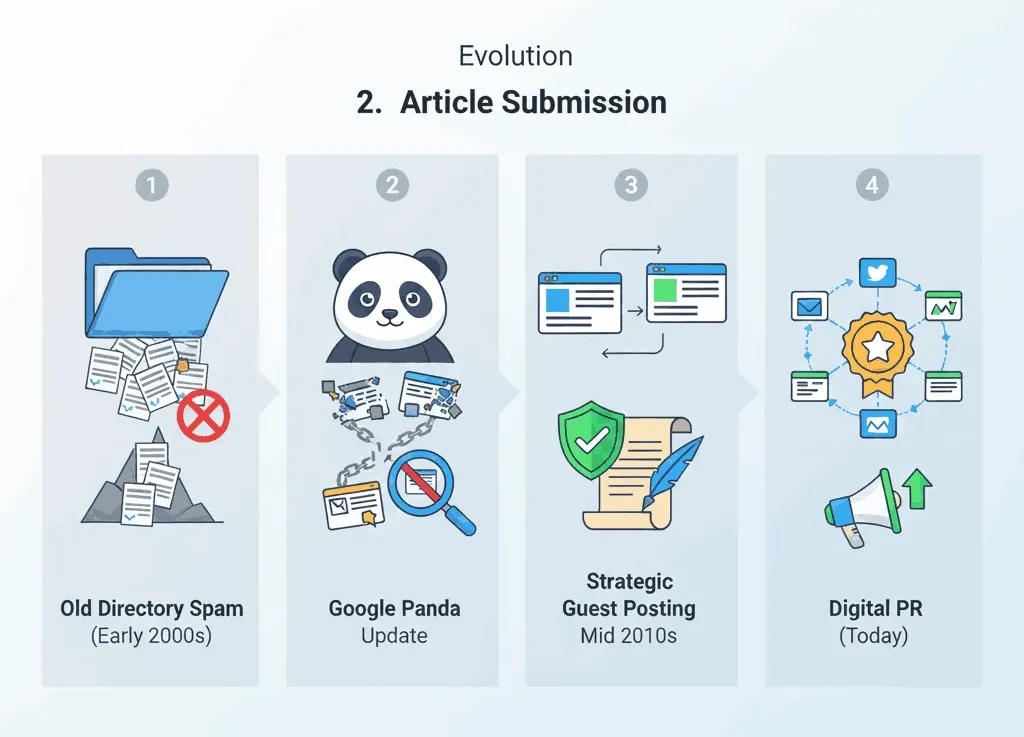
Link building has changed over the years. Today, search engines reward real value and penalize manipulation. It has moved from submitting generic articles to directories to Digital PR where links are earned through real authority.
The Pre-Panda Era: Volume and Directory Spam
In the initial days of SEO, rankings depended on the number of links a site had. It offered a chance to mass article directories and content farms to grow. These platforms accepted huge volumes of duplicate or low quality content which resulted in search engines loaded with irrelevant and low-value information.
The Panda Update (2011) and the Devaluation of Low-Quality Content
Recognizing this issue, In February 2011, Google shared an algorithm update, known as Google Panda. It was designed in a way to systematically reduce the visibility of low quality or duplicate content. It immediately affected around 12% of U.S. search results.
The impact on article directories was also devastating. Panda downgraded websites that provided little user value or used manipulative ways in order to rank on the search engine. Businesses that were dependent on this traffic also collapsed.
It is important to understand that Panda was an algorithm change and not a manual penalty. Hence, systems that are built on poor quality content will always be at risk from future updates.
The Rise of Strategic Guest Posting
After Panda, guest posting became the new safer strategy. Its main focus was to publish high quality, relevant content on niche specific websites. In fact, the intent moved from just “getting links” to “creating strong brand awareness” to attract qualified traffic. This changed the standard from submission to partnership where higher content standard and professional outreach methods were required to be employed.
The Digital PR Mandate: Earning Authority and Trust (E-E-A-T)
Today, Digital PR is considered the most effective link-building strategy. This approach helps earn mentions and links from trusted new outlets, reputed publications, and respected blogs. It is achieved by offering real value such as newsworthy stories, original data, or unique expertise.
The Digital PR links are the strongest ones because they bring genuine trust and authority signals. They help boost a site’s E-E-A-T (Expertise, Experience, Authoritativeness, Trustworthiness).
Looking back, the pattern is clear:
- Mass directories failed and were devalued by Panda.
- This led to strategic guest posting.
- But even guest posting can be filtered if it looks transactional.
- Which is why the industry has now shifted to earned media through Digital PR
Free vs Paid Article Submission Sites: Which Is Better?
The main difference between free (earned ) and paid ( transactional) article submission depend on compliance and risk.
Earned (Free) Guest Posting
Free or earned guest posting occurs when the content is published on the basis of its quality and relevance instead of money. It comes with a few benefits and drawbacks as well.
Benefits:
- Builds brand authenticity and audience trust
- Delivers strong SEO benefits from authority sites
- Creates long-term brand value
Drawbacks:
- Requires high-quality content and effort
- Outreach can be slow and time-consuming
- Less control over anchor text and link placement (final say is with the editor)
Compliance:
As long as the content is original, helpful, and non-manipulative, it is a White- Hat SEO practice. Links are usually rel= “dofollow”, unless the site’s policy uses rel= “nofollow”.
Paid (Transactional) Submissions
Paid or transactional submissions usually include exchange of money, services, or products for placements. It also has some benefits and drawbacks too.
Benefits:
- Offer more control over anchor text and placement
- publication process is faster than earned submissions
- It does add credibility if done on high quality, relevant sites.
Compliance Risks:
- High risk. Google has a clear policy. It treats paid guest posts or advertorials as link spam.
- Trigger Algorithm: It can also trigger algorithm devaluation or manual penalty
Mitigation Strategy:
Any paid placement must include either rel=”sponsored” or rel=”nofollow” in the link tag. Paying for placement isn’t automatically black-hat. However, if one fails to disclose this transactional relationship, it is considered a direct violation of Google’s spam policies.
Link Qualification Requirements for Submission
| Acquisition Method | Purpose | Compliance Risk | Required Link Attribute |
| Earned Guest Post | Brand building, content sharing, referral traffic | Low (if content is high-quality) | Default (rel=”dofollow”), or rel=”nofollow” if site policy requires |
| Paid Advertorial/Guest Post | Advertising, brand promotion, link acquisition | High (if ranking credit is passed) | MUST use rel=”sponsored” or rel=”nofollow” |
| Link Buying/Selling (for ranking only) | Manipulating SEO signals | Extreme (Google Link Spam) | MUST use rel=”sponsored” or rel=”nofollow” |
While investing in paid submissions, one’s focus should still be on content quality and audience relevance. Strong, valuable content minimizes risk even if the placement itself is transactional.
How Does Article Submission Help SEO?
Nowadays, compliant article submission via guest posting and Digital PR supports SE in three ways.
1. Transfer of Link Equity and Authority
One of the biggest benefits is acquisition of quality backlinks. These are links from most trusted and high authority websites. The authority of a website is measured through metrics like Domain Rating and Domain Authority. These signal credibility to search engines and help improve rankings in the return.
On the other hand, an over optimized or manipulative anchor text is treated as spam. Therefore, it is necessary to use natural and descriptive anchor texts within an article. It provides search engines the context about the linked page and reinforces relevance.
2. Driving Qualified Referral Traffic
Other than rankings, guest posts on sites with strong organic traffic bring in direct, relevant visitors. This referral traffic boosts visibility as well as shows search engines that users engage with your content. It enhances positive user signals and overall site credibility.
3. Building E-E-A-T and Brand Trust
Digital PR placements on authoritative news sites or niche platforms help build brand authority. These earned mentions are like online endorsements that show both readers and search engines that your brand is credible, trustworthy, and expert in its field.
The most effective strategy combines these three:
- Link equity improves search engine rankings.
- Referral traffic proves user value.
- E-E-A-T signals future-proof your authority.
To get the best results, target sites with high authority and strong organic traffic. A site with high DA but little traffic may pass link equity but won’t offer much audience value. The strongest impact happens when all three benefits work together.
How to Do Article Submission in SEO (Modern Link Acquisition Workflow)
As it has been discussed earlier, modern article submission does not involve mass posting anymore. It is a step-by-process focused on finding the right sites, evaluating them and building real partnerships.
Step 1: Identify High-Quality Targets
The first step is to build a list of websites that accept contributions. Some common methods include.
- Search with terms like “ your niche” + “write for us”
- Perform competitor analysis to see where others in the industry are getting posts and mentions.
In fact, the goal is to focus on high-value, trustworthy sites, not just any directory that accepts content.
Step 2: Vet the Sites (Risk Management)
The next step is to evaluate the host website for risk management. It is because even great content won’t help if it gets published on a weak or penalized site. Here is a checklist to protect effort and ensure quality.
High-Authority Guest Post Vetting Checklist
| Vetting Criteria | Minimum Requirement | Why It Matters |
| Domain Authority (DA/DR) | 40+ (50+ preferred) | Ensures the backlink passes real value. |
| Organic Traffic | 1,000–10,000+ monthly visitors | Confirms the site has a real, engaged audience. |
| Relevance | 100% niche alignment | Attracts the right audience and avoids irrelevance. |
| E-E-A-T Signals | Author bios, industry recognition, quality content | Builds trust and avoids low-value sites. |
| Link Integrity | Editorial, dofollow links | Confirms SEO value while keeping compliance. |
| Audience Engagement | Active comments, shares, or strong internal linking | Shows the site is active and not artificially inflated. |
It is also important to check for traffic drops after Google Updates. If a site has been hot before, avoid it as it signals instability.
Step 3: Outreach and Pitching
While outreaching and pitching, one should focus on value and not on favors. Here’s what best practices include:
- Write a clear and benefit driven subject line
- Reflect how you have actually read their site. Adding a reference from the latest article can be a good start.
- Explain why your content idea can help their audience.
- Its better to suggest 2-3 specific titles
- Also link to past articles to show your quality.
This is how one can build trust and increase acceptance rates.
Step 4: Content & Link Optimization
Once an article gets accepted. Here’s what needs to be done.
- Always use natural and descriptive anchor text. Avoid spammy keywords.
- Include internal links to the host site’s own content.
- Also add external links that are relevant and credible.
- The content should be original, provide value, and aligned with user intent.
It ensures compliance, increases SEO advantages and builds long-term credibility.
Tips to Make Articles More Shareable After Submission
Publishing an article is only the first step. The real impact can only be experienced when the content circulates, gets shared and earns natural backlinks. Below are some simple ways that can be used to boost shareability.
Share Unique Insights or Data
Offering something original and unique like fresh research, case studies or expert opinions. Such information makes your article a go-to resource others will naturally cite.
Make It Easy to Read
An easy to read article always gets attention. Use headings (H2, H3), bullet points, and short paragraphs.
Write Catchy, Clear Headlines
Headlines should grab the reader’s attention and accurately reflect what the reader will learn.
Check Quality and Accuracy
It is important to get one’s article reviewed by peers or experts before publishing. It is because correct grammar, clear writing and accurate facts help build credibility.
Stay Consistent
Consistency also plays an important role making search engines understand that your brand is active and trustworthy.
Implementing these tips will help transform an article from a random guest post into a living, shareable piece of content. As it spreads, it naturally attracts more links, mentions, and authority. This is how it can give SEO strategy a long-term boost.
White-Hat vs Black-Hat Article Submission Practices
Modern article submission success depends on compliance with Google’s link spam policies.
One of the biggest factors is intent. It is important to make sure the links are built to actually help users and not to manipulate search engine rankings.
What Counts as Link Spam?
A tactic used to deceive search engines to rank a content higher that it deserves is considered link spam. Sites may face penalties if they get caught.
- Manual actions from Google reviewers
- Algorithmic downgrades
- Complete removal from search results
Risky Black-Hat Practices
The following link-building shortcuts are considered dangerous and spammy. One should completely avoid these.
- Buying or Selling Links: These are paid links or sponsored posts which do not use rel=”sponsored” or rel=”nofollow”.
- Keyword-Stuffed Anchors: An over optimized anchor text like using the same keyword unnaturally can result in a penalty.
- Mass Directory Submissions: Posting same generic content with no value on low quality directories. It was a tactic sabotaged by Google Panda.
- Cloaking: It is a tactic where one version of content is shown to users and the other version to search engines. It may downgrade the site in the long run.
White-Hat Approach: Full Disclosure
White- Hat approach is all about transparency.
- If a link is paid against money, products or services, always use rel=”sponsored” or rel=”nofollow”.
- A true white hat submission depends on editorial merit. It means the content should provide real value that sites link to it naturally.
- This approach is future-proof. Since Google’s AI-powered systems update constantly, around 13 times a day. Trying to cheat them is a losing game.
The Future of Article Submission in SEO
How article submission is going to evolve in coming years. Here is a brief look.
Role of AI
- AI can help with speed: One can automate outreach, competitor research, and backlink monitoring.
- Humans still matter: It is important to remember that the original thoughts and insights will never be replaced. Unique research and authoritative content will earn quality placements.
- It is better to invest time saved from AI into creating data, surveys and expert content.
Higher Quality Standards (Digital PR 2025)
- Google’s updates such as Helpful Content Update are continuously raising the bar
- Shallow, keyword focused guest posts will not survive anymore.
- Digital PR is the future of article submission.
- Acquire mentions from relevant, trusted and high authority websites
- Build links with unique insights, contextual alignment, and brand authority
In other words, Black-hat shortcuts may offer temporary benefits but come with several risks.. On the other hand, White-hat is a disclosure-driven, high-value content. And it is the only sustainable way forward in SEO.
Wrapping Up
Article submission is not about publishing thin, repetitive content just to get back links. As 2011 saw Google Panda Update eliminating these mass directories and low quality placements.
Today, article submission is all about high quality content that follows the intent of the user and offers real value. It is just as high-quality content marketing and Digital PR.
To get the sustainable results, one must ensure to choose a high authority website and evaluate them properly. Considering E-E-A-T, write high quality content that provides real insights. In addition, compliance with Google’ use is also a must.
Brands can build a link acquisition strategy by focusing on user value and respecting the editorial standards of host sites. This helps ensure links act as real endorsements that strengthen long-term authority, rather than short-term tricks vulnerable to spam penalties.