
Ever notice how a few bold words can guide your eyes through a page faster? Many writers and strategists wonder if simple formatting changes, like using bold text, can influence rankings. The idea gets attention because most people skim online content instead of reading every line. Research shows that nearly 79 percent of users scan information. So, the question feels natural.
Can bold text help with SEO in any real way?
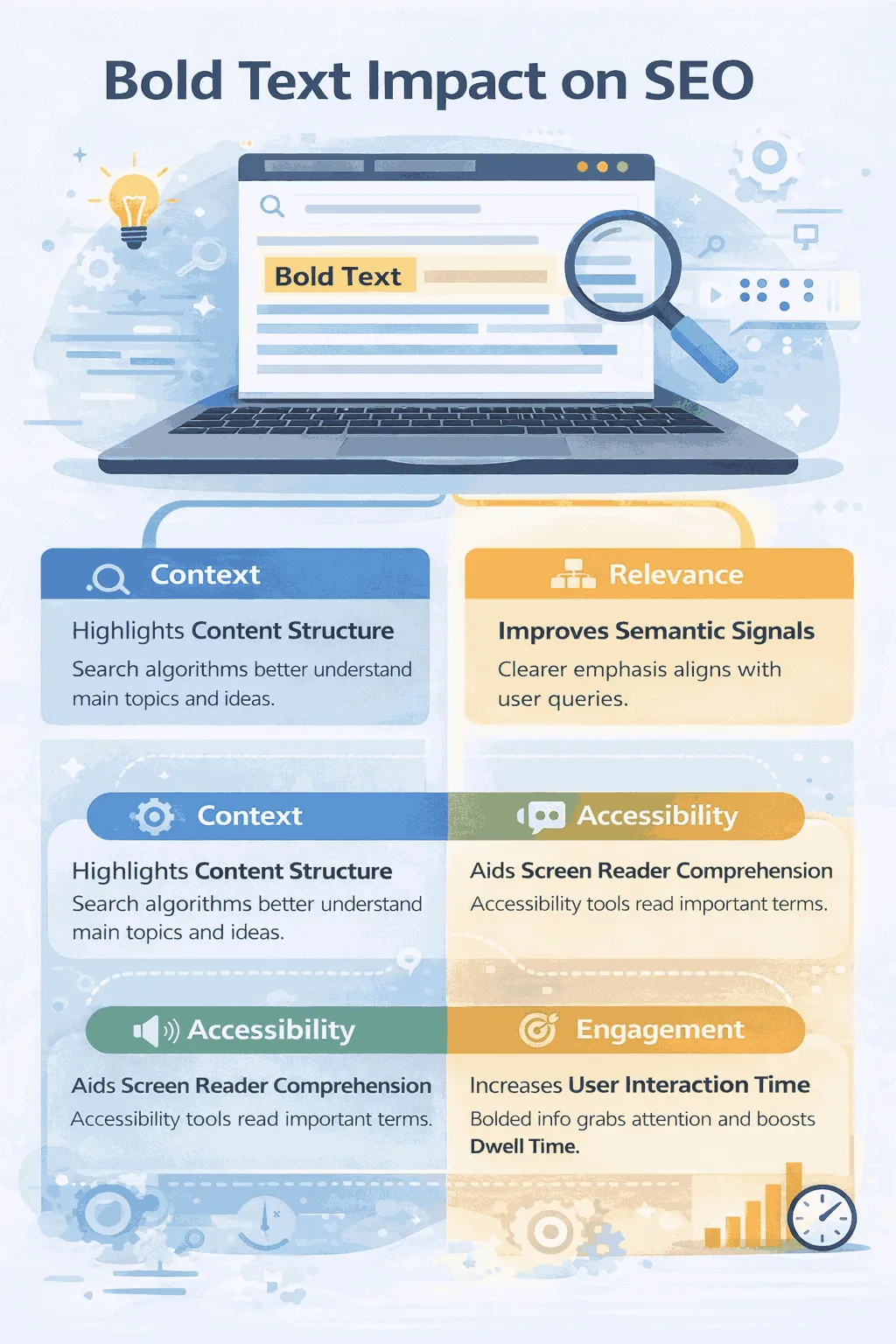
The short answer is that bold formatting does not give a direct ranking boost. Its value shows up in other areas. It helps search engines understand your main points with more clarity and makes the reading experience easier for users. These improvements strengthen the quality signals Google looks at when judging how helpful and relevant your content is.
In this blog, you’ll understand what bold text actually is, how to use it in HTML and CSS, how it affects SEO, when it makes sense to bold something, and when it starts hurting your content instead.
Let’s dive in.
What is a Bold Text

To understand how bolding affects SEO, it helps to first look at the difference between visual formatting and emphasis that carries actual meaning. In web development, both the way content appears and the meaning behind that appearance play an important role.
Visually, bold text is simply text that looks thicker or darker than the rest, added to make it stand out on the page. The real impact comes from the way this effect is created in the HTML code, because that determines how search engines and accessibility tools interpret it.
The Crucial HTML Divide
The difference between visual and meaningful bolding becomes clear when we look at the HTML tags used to create bold text. Choosing the right tag affects both SEO and accessibility.
Stylistic Bolding (<b>)

The <b> tag focuses solely on appearance. It tells the browser to make the text look bold but does not communicate any deeper meaning, urgency, or importance. It is used when something needs to stand out visually, such as names in a list or small visual distinctions that do not influence the reader’s understanding.
Semantic Bolding (<strong>)
The <strong> tag communicates meaning. It signals to the browser, and more importantly to search engines, that the content carries strong importance or seriousness. While it usually appears bold by default, the meaning behind it is what matters most.
According to the W3C Consortium, only <b> must be shown in bold, while the bold styling for <strong> is optional. Modern browsers still show it in bold, but this detail highlights that <strong> is primarily about communication and structure, not appearance.
Why Semantic Tags Matter for SEO
Choosing between <b> and <strong> influences how search engines interpret a page. Modern search algorithms use Natural Language Processing and other advanced systems to understand context within content. Since <strong> clearly conveys importance while <b> only changes style, using <strong> sends a strong structural signal to the algorithm.
Improving Contextual Relevance
Using semantic emphasis helps search engines identify which parts of the content matter most in relation to the overall topic. This makes it easier for crawlers to process, index, and categorize the page, connecting clean semantic code directly to better algorithmic understanding.
Accessibility Advantages
It also supports accessibility. Screen readers used by visually impaired individuals recognize semantic tags like <strong> and read them with emphasis, creating a more user-friendly experience.
How to Bold Text
Content can be made visually bold using HTML tags or CSS properties. However, only certain methods provide the semantic benefit that search engines value.
In HTML: The Semantic Choice
For content meant to convey importance or seriousness to both readers and search engines, the <strong> tag should be used.
HTML Example
<p>The definitive ranking factor is <strong class=”important-concept”>Dwell Time</strong>, not simple keyword count.</p>
The <b> tag should be reserved for purely visual, non-semantic situations. For instance, it can be used to differentiate a proper noun or for aesthetic styling that does not contribute to the overall content hierarchy.
In CSS: The Styling Choice
Visual boldness can also be applied using Cascading Style Sheets (CSS) through the font-weight property.
CSS Example
CSS
/* Styling a specific class */
.heavy-text {
font-weight: bold; /* Same as 700 */
}
/* Styling a numerical weight */
span {
font-weight: 700;
}
The font-weight: bold; property corresponds to the numerical value of 700, which is the standard weight for bold text.
However, relying solely on CSS, such as applying font-weight: 700; to a generic <span>, removes the semantic signal. While the text appears bold to users, the code provides no structural context for search engines, meaning any SEO benefit is indirect and based only on user experience.
The Bolding Methods: Semantic vs. Visual

This table summarizes the three common methods for creating bold text and their respective value for modern SEO:
| Method | HTML Tag / CSS Example | Semantic Meaning | Primary SEO/Algorithmic Value |
| Semantic Markup (Preferred) | <strong> | Strong Importance/Emphasis | High: Clearly signals content hierarchy to search engines |
| Presentational Markup | <b> | Attention-Grabbing/Styling | Low: Purely visual; generally ignored by search engines |
| CSS Styling | font-weight: 700; | None (Presentational Only) | Zero: Relies entirely on secondary UX benefits for SEO |
Bold Text Impact on SEO: The Confirmed Context Signal

For years, digital marketers debated whether bold text directly affects search rankings. This was clarified by Google’s Webmaster Trends Analyst, John Mueller, who confirmed that bolding important points “does help us to better understand that paragraph or that page.”
This shows that bolding acts as a contextual signal, rather than a direct ranking factor. Google’s algorithms evaluate hundreds of elements, including relevance and usability, to navigate the vast amounts of online content.
By highlighting key text, content creators make the message clearer for both readers and search engines. Bolding helps search engines categorize, index, and confirm the main topics on a page, improving overall comprehension.
Semantic Tags and Rich Snippet Generation
Using semantic emphasis correctly can also improve the likelihood of appearing in rich snippets. Google constantly works to extract precise answers for Featured Snippets, People Also Ask boxes, and Knowledge Graph entries.
When content is clearly structured and the definitive answer is highlighted with the semantic <strong> tag, Google’s extraction algorithms can easily identify that high-value text.
This doesn’t directly boost rankings, but it increases visibility, improving the chances of gaining prominent SERP features and driving higher click-through rates (CTR).
Reinforcing Expertise and Trust (E-E-A-T)
Formatting also signals the authority and trustworthiness of content, a key aspect of Google’s E-E-A-T guidelines (Experience, Expertise, Authoritativeness, and Trustworthiness).
For critical topics, such as those affecting health or finances (“Your Money or Your Life” or YMYL topics), trust is essential. Highlighting definitions, expert quotes, or statistical evidence with the <strong> tag emphasizes key content that validates quality and credibility.
This helps algorithms recognize the most important claims and supporting evidence, strengthening the page’s E-E-A-T signals.
The Evolution of the Ranking Paradox
Over the last decade, the role of bolding in SEO has changed. Older Google guidance treated <strong> and <b> equally in terms of ranking. More recent advice emphasizes bold text as a tool for understanding content rather than a ranking factor.
This shift reflects Google’s move from simple keyword-based search to sophisticated semantic search. Previously, excessive bolding was used to manipulate keyword weight, a tactic search engines now ignore.
Today, the SEO value of bolding lies in improving content context and user experience. The indirect benefits, such as improved dwell time and reduced bounce rates, have become far more influential than any direct ranking impact.
Things You Can Bold and Things You Should Avoid
Effective bolding relies on moderation and relevance. The goal is to use bold text as a spotlight to guide the reader, not a floodlight that overwhelms the page.
Strategic Bolding: What to Highlight
Bolding should be used selectively to improve the content’s scannability and structure. Key areas where bolding adds significant value include:
First-Pass Value
Highlight key phrases, important statistics, or actionable advice that allows a scanning user to quickly grasp the page’s relevance and value.
Key Definitions
Bolding the precise, core definition of the article’s subject (e.g., “Dwell time is defined as the time interval…”) helps both algorithms and users index the main concept efficiently.
Transitional Summary
Bolding the concluding phrase of a long paragraph or the summary statement before a major heading guides the reader through the content flow, making transitions smoother.
Calls to Action (CTAs)
Highlighting essential action phrases like “Sign Up Now” or “Download the Exclusive Guide” draws attention and encourages user interaction, boosting conversion rates.
Avoid Bolding: Dilution and Poor User Experience
Overuse of bold text is detrimental and dilutes the emphasis, essentially making every word equally important and rendering the formatting useless.
Avoid Excessive Use
Do not bold entire paragraphs or long sentences. This creates visual clutter and frustrates users, negating the purpose of bolding as a signal of prominence.
Avoid Redundancy
Do not bold text that is already structurally prominent, such as headings (H1, H2, H3). Headings already carry semantic and visual weight.
Avoid Over-Optimization
If too many phrases are bolded throughout an article, the signal to search engines becomes weak or confusing, reducing the content’s overall effectiveness.
Bold Keywords: A Good or Bad Practice
Bolding target keywords is a high-risk, high-reward strategy in content formatting. When done thoughtfully, it provides strong context for both users and search engines. Overused, it can trigger over-optimization flags and harm readability.
The Risk: Over-Optimization and Penalties
Excessively bolding keywords is seen as a manipulative tactic. Repeating and bolding keywords too aggressively resembles traditional keyword stuffing, which can reduce readability and potentially result in search engine penalties.
Search engines are designed to detect strategies that “obviously only serve search engines and not users.” Overuse of bold type can signal over-optimization, as pages with a high percentage of bold text appear to artificially influence rankings.
Beyond SEO, an article filled with bold keywords may seem cluttered, unprofessional, and undermine user trust.
The Reward: Strategic and Moderate Use
When applied strategically, bolding keywords delivers clear benefits. Highlighting one to three instances of the primary target keyword or essential long-tail synonyms per section, especially early in the content, provides a strong context signal to search engines.
Focus on phrases rather than isolated words. Bolding natural surrounding text keeps the emphasis meaningful and prevents keywords from appearing disconnected or spammy.
The principle of moderation ensures that bolding enhances readability and guides users, rather than stuffing keywords. Prioritizing clarity and synonyms is far more effective than maximizing keyword density.
Strategic Bolding vs. Over-Optimization Risk
The following table outlines the balance between strategic use and the risk of over-optimization:
| Bolding Practice | Impact on Readability | SEO Signal / Risk | Recommendation |
| Bolding 2-3 key concepts per section | High (Improves scannability) | Strong contextual signal, low risk | Best Practice: Use <strong> on critical takeaways |
| Bolding every instance of a keyword | Low (Cluttered / Manipulative) | High risk of over-optimization penalty | Avoid: Focus on synonyms and natural integration |
| Bolding long, complex sentences | Medium (Dilutes emphasis) | Neutral / Negative UX; signal dilution | Limit: Bolding should target concise, punchy phrases |
Bold Text Impact on Dwell Time and Reader Engagement
The most significant and safest SEO benefit of bold text comes from its indirect positive effect on user behavior metrics, particularly Dwell Time and Bounce Rate. These metrics are considered by Google as indicators of content quality.
The Scannability Imperative
Today’s users have limited attention spans, estimated at around 8 seconds. With nearly 80% of users scanning rather than reading line by line, content must be structured for easy scanning and quick comprehension.
Eye-tracking studies and heatmaps show that users rely on prominent text, headings, and the first lines of paragraphs while scanning, known as the F-pattern.
Bold text acts as a visual anchor, breaking up dense text and creating stopping points. This hierarchy reduces cognitive load, helping users quickly determine whether the content meets their needs.
The Dwell Time Enhancement Loop
Dwell time is the interval between when a user clicks a result in the SERP and when they return to the search results. It serves as a strong indicator of user satisfaction with the content.
How Bold Text Helps
Efficient use of bold text guides readers and validates content relevance quickly, keeping users engaged and increasing Dwell Time.
Longer Dwell Time signals to Google that the content is useful and answers user queries effectively, which can improve overall performance signals, crawl priority, and ranking potential.
Avoiding Bounce Rate Issues
If text is hard to read or poorly structured, users leave quickly, raising the bounce rate. Strategic bolding reduces this risk by improving scannability and immediate content comprehension.
Competitive Advantage in Engagement
In highly competitive search results where all websites meet technical SEO standards, user engagement becomes a deciding factor.
Pages with content that is easier to scan and immediately valuable, supported by strategic bolding, tend to achieve better engagement metrics, encouraging Google to rank them higher.
Bold Text vs. Italics vs. Underline: SEO Impact Compared
When applying text formatting, it is important to maintain a hierarchy of semantic importance. Misusing formatting can confuse readers and dilute emphasis.
Bold (<strong>)
Bold represents the highest level of semantic emphasis outside of heading tags. It should be reserved for critical concepts, key definitions, and phrases that define the page’s main subject.
Italics (<em> and <i>)
Italics provide milder, secondary emphasis. The <em> tag conveys semantic stress, often used to distinguish dialogue or subtle changes in meaning. The <i> tag is mainly stylistic, applied to foreign words, technical terms, or titles of works. While italics improve readability, they carry significantly less contextual weight than bold text.
The Underline Warning (<u>)
The underline tag should be avoided for general emphasis. On the web, underlining is universally recognized as indicating a hyperlink. Using it on non-linked text can frustrate users, cause mis-clicks, and degrade UX. Although <u> exists in HTML5, its use for styling is poor practice and may cause page validation issues.
Conclusion
Bold text is a strategic necessity, not a ranking loophole. Its value lies in how search engines index content and, more importantly, how users consume it. Using the semantic <strong> tag sparingly to highlight key concepts, definitions, and action points sends strong contextual signals to Google while improving scan ability.
This leads to longer Dwell Times and lower Bounce Rates, indirect but crucial quality signals for ranking. The best approach is always to optimize boldness for the human reader first; the algorithmic benefits will naturally follow.