
Have you noticed how affiliate marketing has quietly turned into a major revenue engine?
By 2026, the global affiliate marketing industry is valued between $17 billion and $20 billion, and the momentum shows no signs of slowing. With rapid adoption of digital tools and continued growth in e-commerce, the market is expected to reach nearly $28 billion by 2027, expanding at an annual rate of 14.3%.
What was once treated as a side monetization channel has now become a core performance-based acquisition model, with more than 80% of brands running structured affiliate programs.
For SEO professionals, this shift raises the bar. Success now depends on stronger brand authority, deeper trust signals, and content built around real user value, especially as search engines lean further into AI-led discovery and stricter quality evaluation.
How Affiliate Marketing Fits Into the SEO Ecosystem

Affiliate marketing works on a simple idea. Publishers earn commissions by promoting a merchant’s products or services through tracked links. When SEO enters the picture, this model becomes far more powerful. Organic search acts as the main entry point for qualified traffic, bringing users who already have intent.
Unlike paid ads that disappear once spending stops, affiliate SEO creates lasting assets. Well-optimized content can continue driving traffic, clicks, and revenue months or even years after publication. That long-term value is why affiliate marketing has become a serious growth channel for brands and publishers alike.
The Core Players Behind Every Affiliate Sale
At its foundation, affiliate marketing operates through a three-party system.
- The merchant or advertiser owns the product, manages inventory, and fulfills orders.
- The affiliate or publisher creates content that educates, compares, or recommends products.
- The consumer searches, evaluates options, and makes the final decision.
This structure limits risk for merchants because payment is tied to outcomes such as sales, leads, or installs. There is no spend on impressions or empty clicks. For affiliates, the focus stays on content quality and relevance rather than ad budgets.
Types of Affiliate Relationships That Matter for SEO
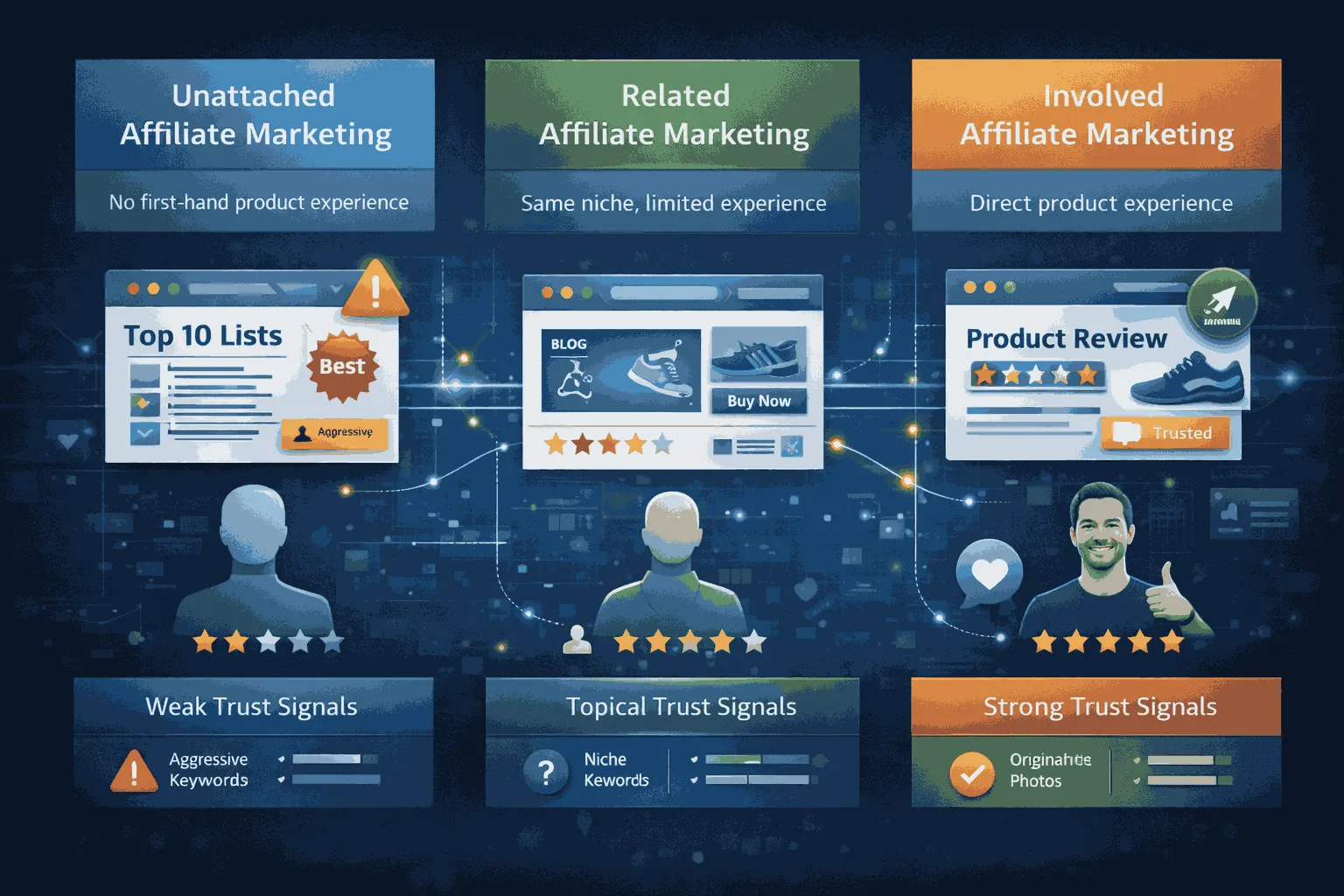
Search performance today depends heavily on how closely an affiliate is connected to the product they promote. These relationships typically fall into three categories.
Unattached Affiliate Marketing
This low-commitment model involves no personal experience with the product. Affiliates often rely on large “best of” lists and aggressive keyword targeting. While easy to scale, this approach struggles as search engines give more weight to real experience and credibility.
Related Affiliate Marketing
Here, affiliates promote products within their niche, even if they have not personally tested every item. A fitness blogger recommending running shoes is a common example. This model benefits from topical relevance, though it may still lack the depth that stronger rankings demand.
Involved Affiliate Marketing
This is the strongest model for affiliate SEO. The affiliate has direct experience with the product and supports claims with original images, testing insights, and honest pros and cons. This approach builds trust and aligns closely with Google’s E-E-A-T expectations around experience and authority.
Global and Regional Market Dynamics
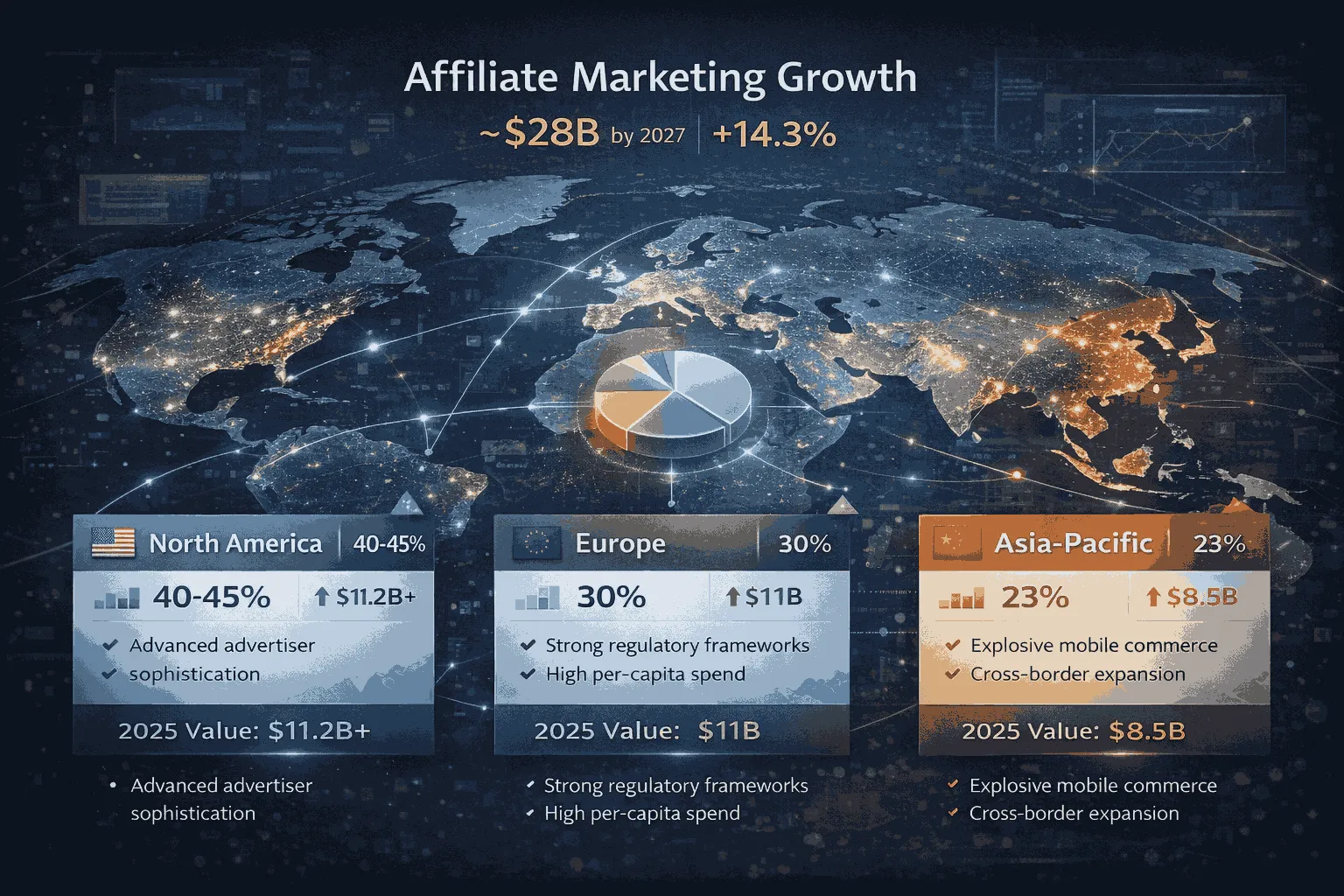
North America continues to lead the affiliate marketing space, generating more than 40 percent of global revenue. The United States remains the largest single market, supported by advanced e-commerce infrastructure and advertiser maturity.
At the same time, the Asia-Pacific region is growing at the fastest pace. Mobile commerce adoption now exceeds 80 percent in major economies such as China and India, creating strong momentum for affiliate-driven sales.
| Region | Market Share | Key Growth Drivers | 2025 Value (Est.) |
| North America | 40-45% | Advanced advertiser sophistication; mature e-commerce. | $11.2B+ |
| Europe | 30% | Strong regulatory frameworks; high per-capita spend. | $11B |
| Asia-Pacific | 23% | Explosive mobile commerce; cross-border expansion. | $8.5B |
| Other Regions | 7% | Emerging digital transformation in LATAM and Africa. | $2.6B |
What This Means for SEO-Focused Affiliates
While the US remains the most lucrative market, growth opportunities are no longer limited to one region. Cross-border transactions now account for roughly a quarter of affiliate sales. Affiliates who invest in international SEO, localized content, and global intent mapping are positioned to gain a real edge as competition increases.
The Technical Backbone of SEO-Driven Affiliate Programs
Behind every affiliate link sits a highly technical system built to track behavior, assign credit, and reward publishers accurately. For SEO-focused affiliates, understanding how this infrastructure works is essential. It helps you choose programs that treat attribution fairly and support sustainable growth over time.
How Affiliates Get Paid
Affiliate programs use different payout structures based on how customers typically buy and how long decisions take.
- Pay Per Sale (PPS)
Affiliates earn a percentage of each completed purchase. Retail programs often offer 3 to 10 percent, while SaaS, finance, and high-ticket offers can range from 20 to 70 percent.
- Cost Per Action (CPA)
Payment is tied to a specific action, such as a free trial signup, account creation, or app install. No purchase is required.
- Pay Per Lead (PPL)
Common in B2B and finance niches, this model rewards affiliates for collecting qualified contact details like form submissions or consultation requests.
- Recurring Commissions
A single referral can generate monthly payouts for as long as the customer stays subscribed. This model is especially attractive for subscription-based software and services.
- Hybrid Structures
These combine an upfront payout for a lead with a percentage of the eventual sale. Affiliates benefit from faster returns while still earning long-term value.
Tracking Systems in a Privacy-First Environment
Affiliate tracking has shifted toward solutions that respect user privacy while maintaining accuracy.
- First-Party Cookies
Stored on the merchant’s domain, these cookies are less likely to be blocked by browsers and are treated as part of essential site functionality.
- Server-to-Server Tracking
Instead of relying on the user’s browser, data is sent directly between servers. This method improves reliability and performs well even when ad blockers are present.
- Fingerprint Monitoring
This approach creates a digital identifier based on device traits. It works as a backup when cookies fail, though it requires careful compliance handling.
Understanding Attribution Windows
The attribution window, often called cookie duration, defines how long an affiliate remains eligible for commission after a user clicks their link.
| Cookie Duration | Category | Typical Use Cases | What It Means for Affiliates |
| 24–48 hours | Short | Impulse buys, marketplaces | Requires volume and fast intent |
| 30 days | Standard | Fashion and general e-commerce | Common retail benchmark |
| 90 days | Extended | Travel and luxury purchases | Supports longer decision cycles |
| 180+ days | Long-term | B2B software and finance | Strong for research-heavy buyers |
Another important factor is cookie hierarchy. When multiple affiliates touch the same user, persistent cookies usually override session-based ones, which can directly affect who earns the commission.
Attribution Models That Shape Payouts
Attribution rules determine how credit is assigned when several touchpoints exist.
- Last Click
The final affiliate interaction receives full credit. This favors coupon and deal-focused sites. - First Click
The affiliate who introduced the user to the brand earns the commission. This benefits awareness-driven SEO content. - Linear Attribution
Every interaction shares the commission equally. - Time Decay
More recent touchpoints receive a higher percentage of the credit. - Position-Based (U-Shaped)
The first and last interactions receive the largest share, with the remaining credit split across middle touches. - Data-Driven Attribution
Machine learning evaluates the actual impact of each interaction. This model offers the most precision but requires advanced tracking and data volume.
For SEO affiliates, these technical details are not background noise. They directly influence revenue, content strategy, and which programs are worth long-term investment. Understanding the system helps you play it smarter.
Affiliate Links and Search Engine Behavior
The technical treatment of affiliate links by search engines is a pivotal factor in domain authority maintenance. Google and other major engines utilize link attributes to differentiate between editorial recommendations and compensated placements.
Qualifying Outbound Links: The Hint-Based System
Since 2020, Google has treated all link attributes, sponsored, ugc, and nofollow, as “hints” rather than strict directives. This means that while search engines may choose not to pass PageRank through these links, they can still crawl them to understand the contextual relationship between pages.
- rel=”sponsored”: This is the mandatory attribute for links involving financial compensation. Google strongly prefers this tag for affiliate links as it provides the most precise data for its spam detection algorithms.
- rel=”nofollow”: This attribute is used when a publisher wants to link to a site but does not want to imply an endorsement. While still acceptable for affiliate links, “sponsored” is the modern best practice.
- rel=”ugc”: Specifically for content generated by users, such as blog comments or forum posts. If a user posts an affiliate link in a comment section, it should ideally be marked as rel=”ugc sponsored”.
Link Schemes and Algorithmic Penalties
Search engines are continuously monitoring for “link schemes,” which are overt attempts to manipulate rankings through unnatural linking patterns. This includes excessive reciprocal link exchanges with other affiliates or purchasing backlinks that pass PageRank.
A critical takeaway is that affiliate links do not directly benefit a page’s SEO because they do not transfer link equity. Conversely, they do not hurt SEO if they are properly declared and contextualized. The “unnatural outbound links penalty” only occurs when a pattern of links is found to be either irrelevant or part of a deceptive strategy.
Do Affiliate Links Help or Hurt SEO? A Practical Breakdown
The relationship between affiliate monetization and organic performance is complex. While affiliate links themselves are neutral, the content strategies often used to promote them can significantly impact a site’s standing in the search results.
How Affiliate Links Can Hurt SEO
Affiliate links become problematic when they are used in a way that degrades the user experience or attempts to mislead search algorithms.
- Thin Content and Doorway Pages: Pages that lack original value and exist only to funnel users to an affiliate offer are frequently demoted.
- Cloaking and Sneaky Redirects: Deceptive practices where users see one landing page and search engines see another are among the fastest ways to receive a manual penalty or site-wide deindexing.
- Ad-Link Bloat: A high density of links relative to useful text signals a “spammy” environment, often resulting in lower engagement metrics which indirectly suppress rankings.
- Lack of Transparency: Failing to disclose affiliate relationships not only violates FTC guidelines but also erodes the “Trustworthiness” signal in E-E-A-T assessments.
How Affiliate Programs Can Indirectly Help SEO
While the links do not pass authority, a well-run affiliate strategy can support a site’s overall growth and visibility.
- Diversification of Content: Affiliate programs encourage the creation of detailed comparisons, reviews, and how-to guides, formats that naturally attract long-tail search traffic.
- Brand Awareness and Mentions: Frequent mentions of a brand across a network of trusted affiliates can act as a significant signal to LLMs and AI search assistants, building “AI authority”.
- Referral Traffic and User Engagement: High-quality traffic directed to a site can lead to secondary benefits, such as social shares and natural editorial backlinks from other websites that discover the content.
Best SEO Practices For Affiliate Websites
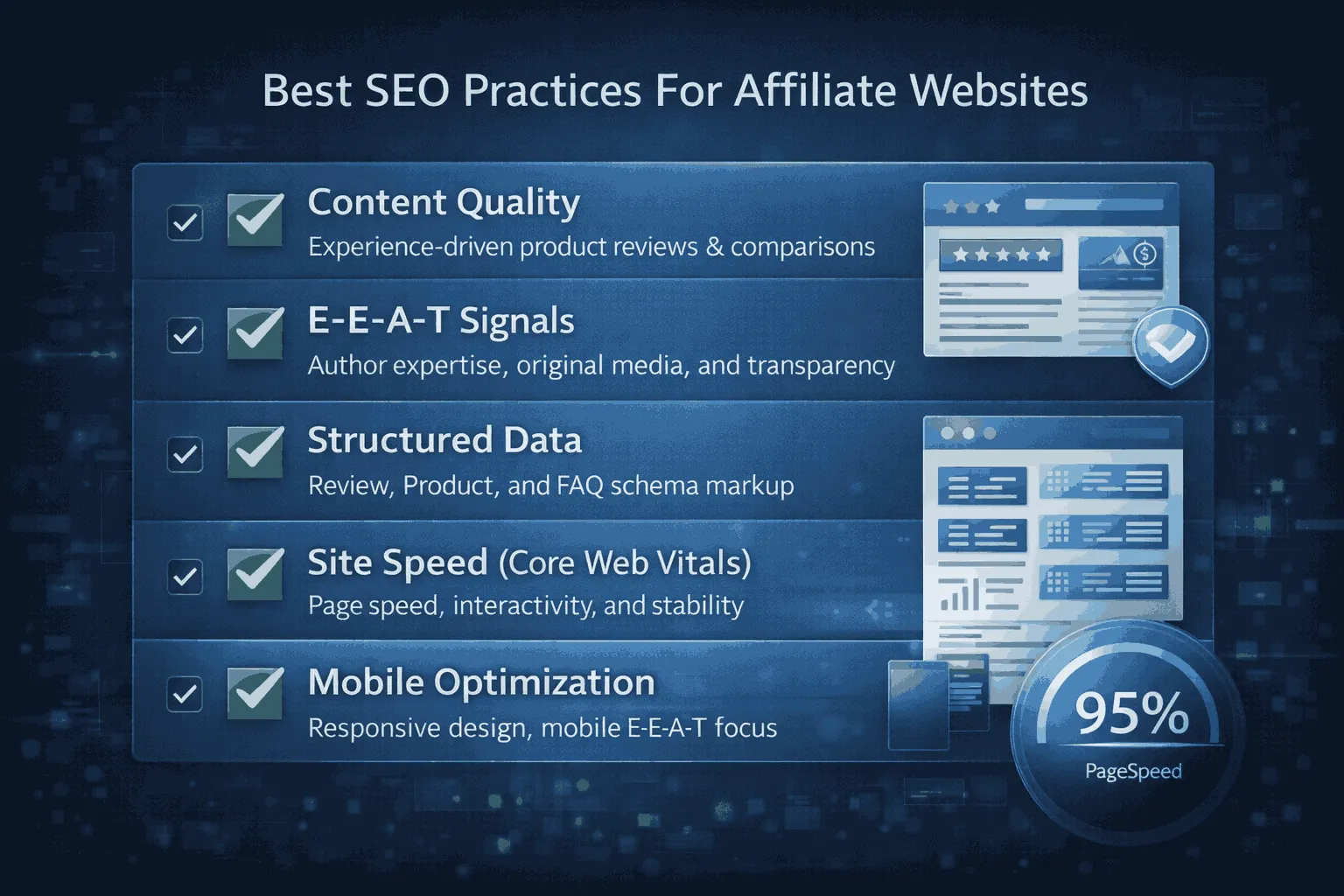
Successful affiliate SEO is no longer about matching keywords; it is about building a trusted brand that search engines view as a definitive resource.
Implementing Advanced E-E-A-T Strategies
Google’s human quality raters and its automated systems now place a massive premium on “Experience”.
- Proof of Experience: For a product review, include original photos, videos, and specific testing results (e.g., “the battery lasted 8 hours and 12 minutes in our heavy-usage test”).
- Credentialed Authorship: Every piece of content should have a clear byline from a named author with verifiable expertise. Author hubs and bio pages that link to professional credentials and historical work are essential.
- Objective Analysis: Use a judge-like approach to reviews. Discuss pros, cons, and alternatives honestly. Side-by-side comparison tables are highly effective for demonstrating impartiality.
- Transparency Signals: Maintain a comprehensive “About Us” page, consistent contact information, and up-to-date privacy and disclosure policies.
Strategic Keyword and Entity Optimization
The 2026 search landscape has shifted from keyword-centric to topic-centric and entity-based strategies.
- Commercial Intent Prioritization: Focus on “commercial investigation” modifiers like “best,” “review,” “vs,” and “alternative”.
- Topical Authority and Clustering: Build ecosystems of interconnected content. For instance, a central pillar page on “Link Building” should link to sub-guides on “Digital PR,” “Broken Link Building,” and “Guest Posting”.
- Entity Clarity: Use structured data (Schema.org) to help Large Language Models understand the relationships between the entities on your site, your authors, the products you review, and the companies that make them.
Technical Excellence and User Experience
Technical performance is a non-negotiable ranking factor, especially as mobile commerce continues to dominate.
- Core Web Vitals Optimization: Focus on LCP (load speed), FID (interactivity), and CLS (visual stability). Slow sites significantly increase bounce rates and kill conversions.
- Mobile-First Responsive Design: Since over 60% of traffic originates on mobile, layouts must be thumb-friendly and easily scannable on small screens.
- Structured Data for Rich Results: Implementing Review, Product, and FAQ schema improves the likelihood of appearing in rich snippets and AI Overviews.
Common Affiliate SEO Mistakes That Kill Rankings
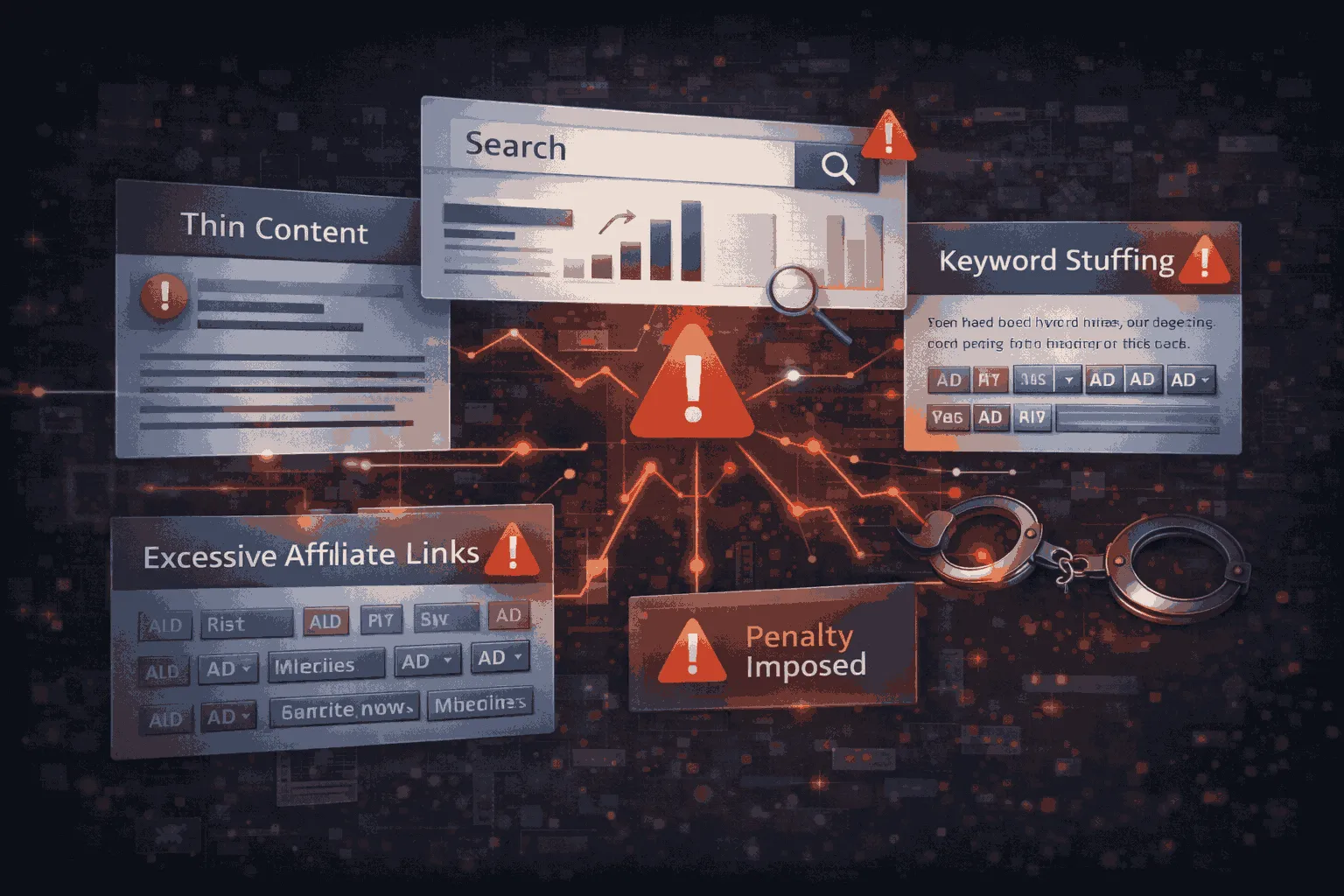
Even experienced publishers often fall into traps that trigger algorithmic demotions or manual penalties. Identifying these errors is the first step toward building a resilient site.
Content and Optimization Blunders
- Keyword Stuffing: Repeating target phrases unnaturally ruins readability and triggers modern NLP-based spam filters.
- Ad-Link and Interstitial Overload: Disruption of the reading experience through excessive links, pop-ups, or “ad-above-the-fold” layouts is a major negative signal.
- Fake Freshness: Updating only the timestamp of an old article without making meaningful improvements to the data or insights is seen as a deceptive practice.
- Repetitive or AI-Spun Content: Google is aggressively demoting pages that summarize existing information without adding a unique angle or proprietary research.
Technical and Architectural Errors
- Internal Link Neglect: Poor site hierarchy prevents the efficient distribution of “link juice” and makes it harder for bots to understand which pages are the most important.
- Redirect Chains and Loops: Complex redirect patterns waste crawl budget and frustrate users, often leading to deindexing of key commercial pages.
- Broken Multimedia: Missing images, broken videos, and faulty alt-text signals a lack of editorial oversight.
The March 2024 Core Update and its Impact on Affiliate Websites
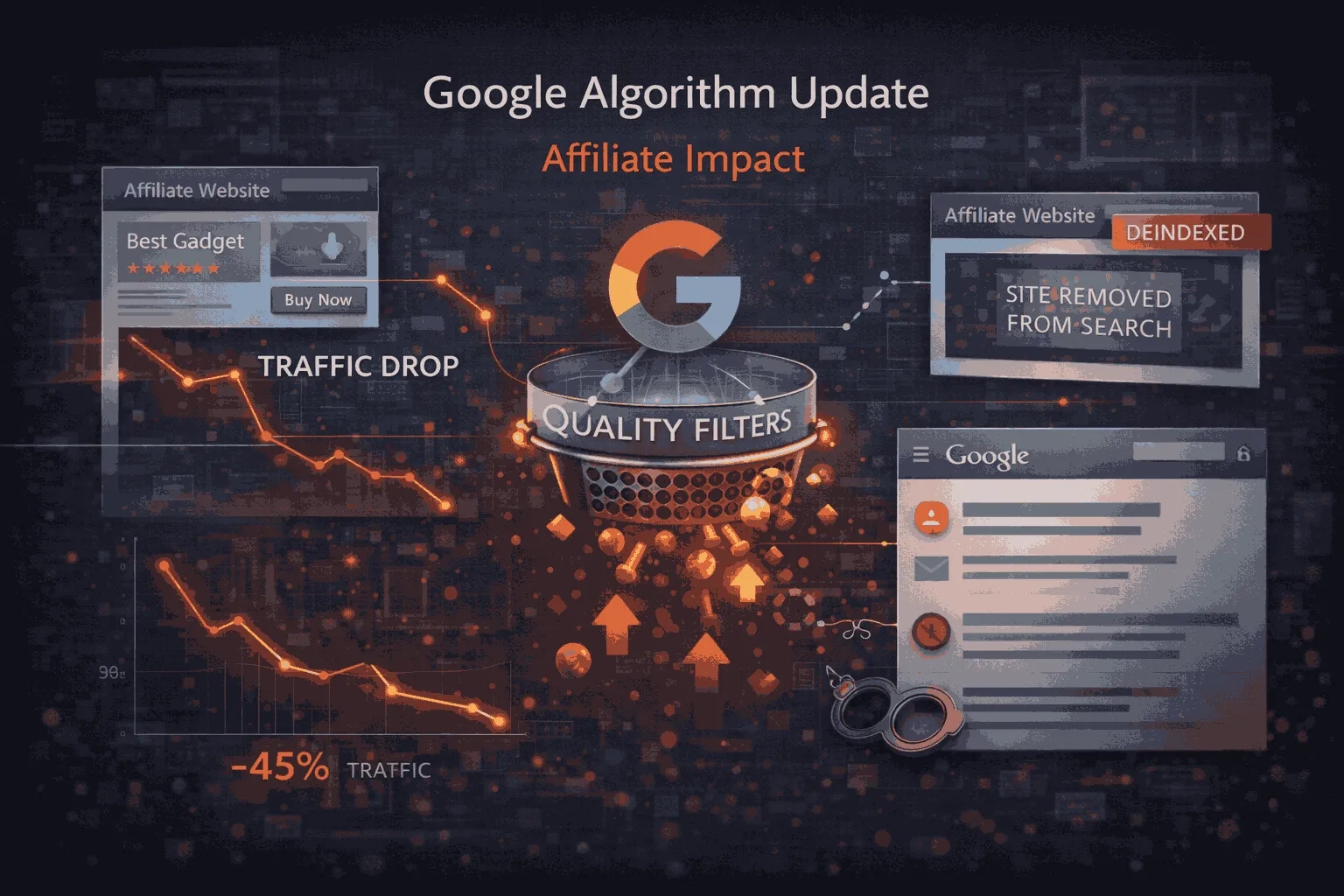
The March 2024 Core Update represented a historic shift in search quality standards, integrating the “Helpful Content System” directly into Google’s core ranking algorithm. The update’s stated goal was to reduce unoriginal, search-engine-first content by 40%, a target it eventually surpassed by reaching a 45% reduction.
The Targeted Abuse Patterns
Google introduced three major spam policies that had an immediate and severe impact on the affiliate landscape :
- Scaled Content Abuse: This policy targeted the mass production of unoriginal pages, whether by automation (AI), human efforts, or a combination, intended primarily to manipulate search rankings.
- Site Reputation Abuse (Parasite SEO): This crackdown targeted third-party content (like high-intent coupon or product review pages) hosted on authoritative news or educational domains without host involvement. Major publishers like Forbes and the New York Times saw significant traffic drops in their affiliate-driven sections due to this policy.
- Expired Domain Abuse: This targeted the common practice of buying “aged” domains with high past authority and filling them with irrelevant, low-quality affiliate content to game the system.
Lessons From Deindexing and Volatility
Ian Nuttall’s 2024 study reported that of nearly 50,000 sites monitored, roughly 1.7% were completely removed from the Google index following the update. The study found a 100% correlation between mass-deindexed sites and those relying heavily on AI-generated posts with little human oversight.
Recovery for these sites is not a matter of “waiting out” the update. It requires a fundamental pivot toward “people-first” strategies.
- Content Pruning: Removing thin, unhelpful, or redundant pages is essential to improve the sitewide quality signal.
- Situational Writing: Successful sites have moved away from “sterile” content toward writing that accounts for the user’s specific context and needs.
- Traffic Diversification: The update served as a brutal reminder that relying 100% on Google is a high-risk strategy. Sites that have survived and thrived in 2026 are those that have built independent communities on social media, email, and podcasts.
Modern Search Horizon: AI overviews and Multichannel Discovery
The monopoly of the traditional “blue link” search result has ended. Discovery in 2026 is an omni-touchpoint experience involving conversational AI, video-first platforms, and social search.
Evolving From Ranking to Retrieval
In the era of AI Overviews (formerly SGE), the goal of SEO has evolved from “ranking #1” to “being cited”. AI systems synthesize information from multiple trusted sources, giving the greatest weight to brands with consistent, positive mentions across the web. To win in AI Overviews, affiliate content must be:
- Authoritative and Citable: Linking to official documents, studies, and data sources increases the likelihood of being referenced by AI agents.
- Optimized for Zero-Click Search: High-quality, informational content that answers the user’s question directly inside the search result page builds brand recall, even if the user does not click through to the site.
- Opinionated and Specific: AI is excellent at summarizing facts but struggles with context, timing, and genuine advice. Decision-support sites that explain why and for whom a product makes sense are the new “trust layer” of the internet.
Profitable Affiliate Niches
The profit potential of affiliate niches are closely tied to product consideration cycles and commission structures.
| Profit Rank | Niche | Avg. Monthly Income (Est.) | Key Characteristics |
| 1 | Education & eLearning | $15,551 | High demand for remote skills; high commissions. |
| 2 | Travel & Leisure | $13,847 | High per-conversion payouts; visual-heavy. |
| 3 | Beauty & Skincare | $12,500 | Driven by social proof and influencer trends. |
| 4 | Finance & FinTech | $9,296 | Regulated (YMYL); requires deep E-E-A-T. |
| 5 | AI Software (SaaS) | $7,418 | Recurring revenue; high-growth sub-niches. |
| 6 | Health & Wellness | $7,194 | $6.3 trillion global market; massive variety. |
Conclusion
The evolution of affiliate marketing has rendered shortcut-based SEO strategies obsolete. The search environment now rewards publishers who commit to being genuine authorities in their niche, prioritizing first-hand experience, transparent relationships, and technical excellence. While algorithm updates like the March 2024 Core Update have introduced significant volatility, they have also cleared the path for high-quality creators to dominate search rankings without competing against mass-produced spam.
To build a sustainable affiliate business, publishers must view Google not as their sole source of traffic, but as one part of a broader discovery engine. By building multichannel authority across AI assistants, social platforms, and owned email communities, affiliates can achieve the resilience needed to thrive in any algorithmic climate.
The future of the industry belongs to those who provide the highest value to the end user, transforming from mere link distributors into indispensable guides in the digital economy.