
For multinational companies looking to penetrate or expand within the People’s Republic of China must optimize for Baidu as it is not just an optional marketing tactic, it is one of the most crucial requirements for online visibility.
Baidu leads the search engine market in China with over 63.2% market share. This prominence makes Baidu a dominant gateway to China’s vast digital economy. With its unique infrastructure, strict regulations and distinct user behavior, Baidu differs from search engines like Google. Therefore, the SEO strategies that work globally usually don’t work for Baidu. It is important to fully adapt to Baidu’s algorithms, local ranking signals, and regulatory framework if one wants to be visible on the search engine.
One of the most critical challenges is to overcome technical and compliance barriers for example site speed and stability are directly related to securing an Internet Content Provider or ICP license and meeting censorship requirements. In other words, effective Baidu SEO starts with infrastructure and compliance, not content.
What is Baidu SEO Optimization?
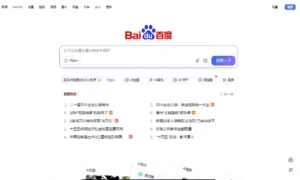
Baidu SEO is the process of optimizing a website to maximize its visibility in Baidu’s Search Engine Results Pages or SEFPs. To get the best results, it is necessary to align with its unique algorithms, content standards, and the country’s regulatory framework. In contrast to global SEO practices, Baidu SEO is focused exclusively on the Chinese audience.
Therefore, deep localization is necessary for Baidu optimization. Any content intended to be published on Baidu must be written in Simplified Chinese, the official script of Mainland China. It should reflect fluency, cultural nuance, and idiomatic expressions. Moreover, machine translation is not enough as Baidu can detect non-native phrasing that leads to poor visibility.
Truly localized content helps reduce bounce rates and boost engagement. Baidu considers both of these factors as ranking signals.
Cultural and Infrastructural Alignment
Writing generic content is not sufficient for Baidu SEO. It should reflect cultural adaptation and infrastructure planning.
In contrast to Google that applies global standards such as E-E-A-T or Experience, Expertise, Authoritativeness, Trustworthiness, Baidu’s criteria revolve around state regulation and the Great Firewall.
Ranking higher here requires local relevance, cultural fluency, and technical stability within China’s closed internet ecosystem. Therefore, server location, translation quality, and the link building source must be carefully selected. Both the factors carry regulatory and cultural weight.
All of these choices directly impact whether Baidu and the Chinese users will perceive a website as trustworthy and credible.
User Behavior and Technical Preferences
Another important factor includes mobile optimization of a website. Baidu’s audience is mostly mobile first. Therefore, it is necessary to optimize a website for mobile devices to become digitally more visible. It means, titles, meta descriptions and layouts must be tailored for smaller screens.
In addition to that, Baidu’s SERPs prefer rich media. It means high quality images and videos usually stand out text-heavy content. However, brands with visual assets need to optimize for Baidu images to capture organic traffic.
Understanding the Baidu Algorithm Landscape
Apparently, Baidu’s search system looks similar to that of Google. But it works differently because of China’s market and internet rules. It uses the latest AI models like ERNIE which understand Chinese language better than Google’s BERT.
However, Baidu still depends on literal signals such as exact keyword placement. For example, ranking chances can improve if one puts the target keyword at the start of a title tag. It shows that success depends on both well-written natural content and strong on-page SEO structure.
The Importance of Traditional SEO Signals
In contrast to Google, Baidu still relies on traditional SEO elements. Meta tags are of great importance, and even the meta keywords tags continue to remain a ranking factor. Experts recommend 5 to 8 relevant keywords to be placed in the tag. These help Baidu’s crawler read and rank pages easily while also ensuring compliance with local rules.
To perform well, websites need to balance traditional keyword-based optimization with modern, AI-driven content quality.
Key Algorithm Updates and User Experience
In recent years, Baidu has introduced updates to improve user experience and penalize manipulation tactics. These demonstrate its dedication towards promoting high quality content.
- Breeze & Thunder (2017–2021): Baidu penalized low quality content, slow loading websites, and the ones using black-hat SEO. These updates stress on the technical integrity and smooth website performance to secure higher rankings.
- Hurricane (2017–2019): This update targeted duplicate or scraped content, emphasizing original content.
In short, Baidu rewards unique, engaging content and fast, stable websites. Good user experience and technical strength are now the minimum requirements to rank well.
Ways to Do SEO for Baidu: On-Page and Technical Strategies
The following strategies can help build visibility by combining localization, traditional optimization, and multimedia enhancement.
A. Content Localization and Quality
Baidu SEO is based on high quality, native Chinese content. Its algorithms are able to detect poor translations.
Therefore, native copywriters are necessary for cultural fluency, subject matter experts to ensure accuracy and local SEO experts for target keyword optimization.
Unlike Google, Baidu prefers literal keyword usage instead of semantic context. It rewards early placement of target terms in titles, exact matches in H1 tags, and keyword density between 2-4 % in body text.
Moreover, the content should be original and fresh. Regular updates especially in native formats like Baijiahao articles receive higher visibility.
B. On-Page Technical Optimization (Traditional Ruleset)
Baidu values SEO tactics that global marketers consider legacy, especially in site architecture and internal linking. It means a clear structure is important.
The homepage should link to main category pages and subpages should connect back to the homepage. All anchor texts should be keyword rich, and breadcrumbs should establish hierarchy.
Baidu’s off-page link evaluation is less advanced than Google’s. Therefore, precise internal linking and regular audits play an important role in boosting site visibility.
Meta Tag Specifications
Meta elements also play a vital role with character limits to suit mobile users.
| Meta Element | Recommended Baidu Length | Key Optimization Rule |
| Meta Title | <60 characters (≈27 Chinese characters) | Place keyword at the beginning |
| Meta Description | <155 characters (≈60 Chinese characters on mobile) | Must be unique, supplement title, avoid stuffing |
| Meta Keywords | 5–8 keywords | Still an active ranking factor |
Each description should represent the actual content and be short enough for better mobile display.
Technical Code Structure
Websites looking to rank on Baidu must prioritize static HTML. Baidu still relies on static HTML and struggles with websites that use JavaScript or dynamic content. Developers should ensure important content and links are not embedded within javascript or flash elements.
C. Multimedia Optimization
Baidu’s SERPs value images and videos. Multimedia is a powerful traffic driver in the Chinese search engine. Baidu Images is one of the few properties that sends direct organic traffic to third party sites. The high quality visuals should be optimized with descriptive Chinese filenames, captions and alt tags to enjoy the maximum benefits.
What Makes Baidu SEO Different from Google SEO
Though Baidu and Google serve as dominant search engines, their SEO strategies differ in many fundamental ways. These differences are driven less by technology alone and more by China’s regulatory environment, Baidu’s closed ecosystem, and its technical priorities.
Regulatory and Ecosystem Divergence
It is important to understand that compliance and ecosystem strategy can not be separated from SEO. Unlike Google which works in an open environment, Baidu is more of a state-regulated and self-promoting ecosystem.
Censorship and Compliance
Baidu works under strict PRC censorship laws that constantly monitors content for compliance. In case of any violation, one must face penalties or even site blocking. Companies usually hire Chinese legal experts to review content and perform regular compliance audits.
SERP Bias and Ecosystem Favoritism
Badu’s search results have strong inclination towards its own platforms, for example Baidu’s Baijiahao, Baidu Baike, and Baidu Zhidao even if the third party content is more relevant. This means marketers must treat Baidu’s ecosystem itself as part of their SEO strategy. By publishing on Baijiahao businesses can quickly secure Page 1 visibility and build trust while the main site gains long-term authority.
Comparative Ranking Signals
The table below compares how Baidu’s approach is different from Google’s. These differences will help understand why strategies that work globally usually fail in China.
| Ranking Factor | Baidu’s Emphasis | Google’s Emphasis |
| Language | Mandatory Simplified Chinese, native fluency | Supports 150+ languages with advanced NLP |
| Meta Tags | Heavy reliance (title keywords, meta keywords still count) | Minimal impact; used mainly for CTR |
| Technical Stack | Prefers static HTML; weak with JavaScript | Fully capable with JavaScript and dynamic content |
| Local Presence | Prioritizes local content, Mandarin, ICP hosting | Local SEO matters, but global accessibility is key |
| Link Authority | Geo-biased; favors .cn domains and official Chinese sources | Rewards diverse, high-quality global links with E-E-A-T |
| Social Signals | Weibo and WeChat directly influence rankings | Indirect or minimal role |
Baidu’s dependence on local authority, meta tags, and social signals make it different from Google’s E-E-A-T driven approach. This means brands looking to rank in China’s search engine must work around compliance, localization, and ecosystem integration instead of applying global techniques.
Hosting in China Helps with Baidu Rankings
When it comes to ranking on Baidu, hosting selection is far more than just a technical choice. It directly impacts the rankings. In contrast to Google where server location does not play a major role, Baidu links performance, accessibility, and compliance closely to visibility.
The Infrastructure Mandate and Site Speed
How long does a site take to load? It is one of the core ranking factors. A quick loading site is most likely to rank on Baidu. However, the Great Firewall makes it hard for foreign websites to rank. It filters and slows down international traffic.
Pages that are hosted outside of China usually suffer from latency, instability and blocked dependencies such as Google Fonts. Baidu interprets that as poor user experience. Baidu prefers to rank fast, stable sites hosted in Mainland China.
The formula to rank on China’s search engine is clear:
Local Hosting → Better Speed → Stronger User Experience → Higher Rankings.
The ICP License: Compliance as a Technical Lever
Websites need to obtain Internet Content Provider License to host in Mainland China. Local telecoms can legally block unlicensed sites. Though it is not necessary for indexing, the license comes with several benefits.
- Local Hosting: Allows use of Mainland serves for minimum latency
- Signal Trust: license is more like a compliance badge that boost credibility
- Advanced Verification: It is necessary for Baidu’s Trust badges and SERP rankings
However, it is not simple for foreign companies to acquire ICP. Businesses that are registered in China or joint ventures with limited foreign ownership usually qualify. Moreover, the process is entirely in Chinese which requires local expertise and a domestic contact person to simplify things.
Strategic Alternatives to Mainland Hosting
Businesses can adopt certain strategies when it is not possible to fully comply with ICP. These techniques will help reduce latency while staying out of China.
- Near-Shore Hosting: Getting hosting from proximal countries like Hong Kong, South Korea or Singapore can also help as they have different legal frameworks.
- China RIM CDNs: Content Delivery Networks with edge servers near China e.g., Hong Kong, South Korea can accelerate static content delivery without needing an ICP license. Though it’s not as effective as Mainland hosting. However, they improve performance for market entry.
Baidu Indexing Differs from Google’s
It is comparatively harder and slower to index on Baidu than Google. It needs active management and manual oversight to ensure timely visibility.
Crawl and Indexing Dynamics
Baidu usually takes up to a week to index a new content in comparison with Google that quickly indexes a new content.
Webmasters need to carefully manage crawl budgets, prefer key pages, and use Baidu’s Webmaster Tools for manual URL submissions and sitemap updates.
Baidu supports directives like canonical, nofollow, noarchive, and robots.txt. But it does not support hreflang that makes multilingual SEO less effective. Instead, Simplified Chinese is the dominant requirement for content consistency.
Link Building for Baidu: What Works and What Doesn’t
Link building is one of the most important parts of Baidu SEO. However, its evaluation of links is quite localized and biased towards Chinese sources.
Geographic Bias and Authority Sources
Baidu gives value to backlinks from Mainland Chinese Websites especially official and authoritative domains including government portals and major news outlets. Alongside this, Chinese-language websites from nearby countries like Singapore, Hong Kong are also considered valuable. Moreover, they are usually easier to secure for international businesses.
Utilizing the Baidu Ecosystem
Though it is not easy to acquire high quality Mainland links, it is better to focus on Baidu’s own ecosystem. Here are the benefits of some common platforms
- Baijiahao offers quick visibility
- Baidu Zhidao and Zhihu enable contextual link placement through Q&A participation
- Baidu Baike helps improve topical authority through interlinking.
Baidu in return prefers these internal links on the basis of self-preference that boost external site rankings.
Modern Tactics and Penalization Risks
Modern effective marketing techniques like content marketing, guest posting and the skyscraper techniques also work for Baidu. All of these techniques emphasize quality and relevance.
On the other hand, manipulative tactics like PBNs, spammy forum links and aggressive self-created backlink are risky to use for Baidu. Baidue penalizes such websites and it is hard to recover from Baidu’s penalties. Authoritative link building is the only strategy that goes a long way.
Baidu Tools for SEO (Use Baidu Analytics for SEO Insights
Using Baidu’s own tools is necessary to be successful with its SEO. These tools provide direct technical information and localized user insights which are usually not available on global platforms.
A. Baidu Webmaster Tools or Ziyuan
Ziyuan works as Baidu’s equivalent of Google Search Console. It is the central hub specifically for technical SEO management. It allows manual URL and sitemap submissions to speed up Baidu’s slower indexing.
Ziyuan monitors crawl errors, and helps webmasters adjust crawl frequency. It tracks backlinks and broken links. It also identifies security issues while helping manage migrations or downtime without penalty.
In short, Ziyuan is essential for keeping a site healthy, crawlable, and compliant within Baidu’s ecosystem.
B. Baidu Tongji or Baidu Analytics
Baidu Tongji provides analytics specifically for the Chinese market. In comparison with global tools, it delivers fast, unsampled data with deeper demographic insights. In fact, it covers user age, location, occupation, device type, and interests.
Because of its local accessibility, reports are stable and available within hours. Tongji also integrates PPC campaign data directly. It provides businesses a unified view of both paid and organic performance.
All of these features make it a powerful market research tool for targeting Chinese audiences effectively.
Conclusion
Ranking on Baidu requires more than traditional SEO, it demands compliance with Chinese regulations. Alongside this, a reliable infrastructure and culturally relevant content are vital.
Baidu rewards operational discipline and strict adaptation to local regulations. Businesses looking to win in this closed ecosystem must acquire an ICP license and host within from Mainland China. It will ensure speed, stability and trust. Success also depends on balancing SEO practices with high quality, native Chinese content that aligns with Baidu’s AI-driven models.
Since Baidu prefers its own platforms, publishing on Baijiahao, Baike, and other ecosystem properties is also important for visibility. It also helps build long-term authority for the main domain.
Companies that invest in native expertise, maintain trust through quality backlinks and fast site performance, and avoid black-hat tactics are best positioned for sustainable success.
By aligning compliance, ecosystem integration, and continuous refinement, brands can establish a strong and competitive presence on Baidu.