
Did you know that nearly one-third of internet users discover new brands through search engines? Even as algorithms grow more complex, blogging remains a top-performing channel for B2B brands, often beating paid social campaigns.
Blog commenting has evolved too, it’s no longer just a link-building tactic. Today, it helps engage readers, add context to content, and build meaningful connections. Modern SEO values authority, social proof, and real human interaction over sheer volume.
In this blog, we will learn how blog comments influence SEO, the best practices for leaving effective comments, how to find high-value blogs for engagement, and how to avoid common mistakes that can harm your site’s authority.
The Basics of Blog Commenting: More Than Just Feedback

Blog commenting is the act of leaving insights, questions, or feedback on digital articles and blog posts. At its core, it creates a direct connection between readers, content creators, and other audience members. Platforms like WordPress, which powers over 43% of the web, have made this interaction standard. In fact, users on WordPress.com alone post more than 77 million comments every month.
What Makes a Blog Comment
A typical blog comment includes the commenter’s name, email (often linked to services like Gravatar), a website URL, and the message itself. While the message adds value through ideas or discussion, the URL was historically the main focus for SEO, used to build backlinks. Today, search engines are better at distinguishing editorial links from user-generated content. This has shifted the role of comments from direct SEO benefits to driving authority signals and referral traffic.
Why Comments Matter Now
Blog posts have grown longer and more resource-rich, with the average length hitting around 1,400 words, a 77% increase over the past decade. As content becomes more authoritative, the comments section becomes a space for peer review, expert clarification, and even long-tail keyword growth. This not only keeps the page engaging for readers but also signals freshness to search engines.
How Blog Comments Influence SEO

Blog comments no longer impact SEO through links alone. Their value comes from a mix of user engagement, semantic relevance, and the signals search engines pick up from user-generated content.
Understanding Link Attributes
Since 2019, Google treats link attributes like rel=”nofollow” as hints rather than strict rules. The rel=”ugc” attribute, specifically for user-generated content, helps search engines differentiate between editorial content and comments.
Using these attributes correctly can enhance your site’s authority and improve entity mapping, even if direct PageRank isn’t passed.
| Link Attribute | Purpose | SEO Signal |
| rel=”dofollow” | Standard editorial endorsement | Passes PageRank and ranking equity |
| rel=”nofollow” | Blocks endorsement of untrusted sites | Serves as a “hint” for discovery and entity recognition |
| rel=”ugc” | Marks user-generated content | Signals non-editorial content and helps filter spam |
| rel=”sponsored” | For paid or affiliate links | Protects from penalties related to undisclosed paid links |
Beyond links, the context of comments matters. Using related terms or synonyms, also called Latent Semantic Indexing (LSI) keywords, helps search engines better understand the topic. For example, a post on “SEO strategies” could gain value from comments discussing “backlink audits” or “keyword research,” naturally expanding keyword coverage.
Engagement and User Experience Signals
Modern search algorithms, like Google’s RankBrain, prioritize User Experience Optimization (UXO). Comments that spark interaction increase dwell time, showing search engines that users find the content valuable.
High engagement can lead to indirect SEO benefits:
- Lower Bounce Rates: Interactive comment sections keep visitors on the page longer.
- More Social Shares: Posts that invite discussion can boost shares by 23%.
- Frequent Indexing: Active comment sections signal freshness, encouraging search engines to crawl pages more often.
Finding High-Value Blogs for Effective Engagement

Not all blog commenting delivers equal value. To get the most SEO and networking benefit, focus on niche-specific, high-authority blogs instead of mass outreach. This approach involves three key strategies: using curated lists, leveraging search operators, and analyzing competitors.
1. Using Online Lists and Databases
A great starting point is finding blogs that actively welcome engagement. Plugins like CommentLuv let commenters share links to their latest posts, offering mutual visibility. Databases of “instant approval” or high Domain Authority (DA) blogs provide ready-made opportunities for meaningful interactions.
| Website Category | Top Platforms (DA 80+) | Engagement Type |
| General & Business | Entrepreneur.com, HBR.org, HubSpot.com | Professional/Expert |
| Marketing & SEO | NeilPatel.com, Moz.com, SearchEngineLand.com | Technical/Strategic |
| Tech & Software | Zoho.com, TechCrunch.com, G2.com | Feature-Based/Reviews |
| Education (.edu) | Harvard.edu, Stanford.edu, Yale.edu | Academic/Authoritative |
For the best results, target CommentLuv-enabled blogs in your niche, ensuring referral traffic is relevant and engaged.
2. Mastering Google Search Operators
Google search operators help uncover niche blogs with active comment sections. By using specific commands, you can filter results and find the most promising opportunities.
| Operator Query | Purpose |
| [keyword] “leave a comment” | Finds blogs inviting comments in your niche |
| [keyword] “post a comment” | Targets standard comment box pages |
| [keyword] “notify me of follow-up comments” | Finds blogs with engagement plugins |
| site:.edu [keyword] “add comment” | Access high-authority educational blogs |
| intitle:roundup [keyword] | Discover link roundups to suggest your content |
| “this blog uses premium CommentLuv” | Targets blogs offering backlinks to your latest post |
Combine these with site: or inurl: searches for precise sub-niche results, for example: inurl:blog “SEO tips” “leave a reply”.
3. Competitor Research: Mapping the Engagement Landscape
Analyzing competitors’ commenting habits can reveal high-value opportunities:
- Backlink Profile Auditing: Tools like Ahrefs, SEMrush, or Moz can show where competitors leave comments. Focus on high DA/DR blogs to gain strong SEO signals.
- Monitoring Private Communities: Competitors often engage in Slack channels, Facebook Groups, or Discord communities. Observing these spaces highlights audience pain points you can address in your own comments.
- Top-Performing Post Analysis: Use BuzzSumo to find competitor posts with the most comments. Study the conversation style, questions, case studies, or rebuttals, to craft contributions that add unique value.
By combining curated lists, search operator strategies, and competitor insights, you can target blogs where your comments make a real impact, both for SEO and community building.
Why Most Blog Commenting Efforts Fail
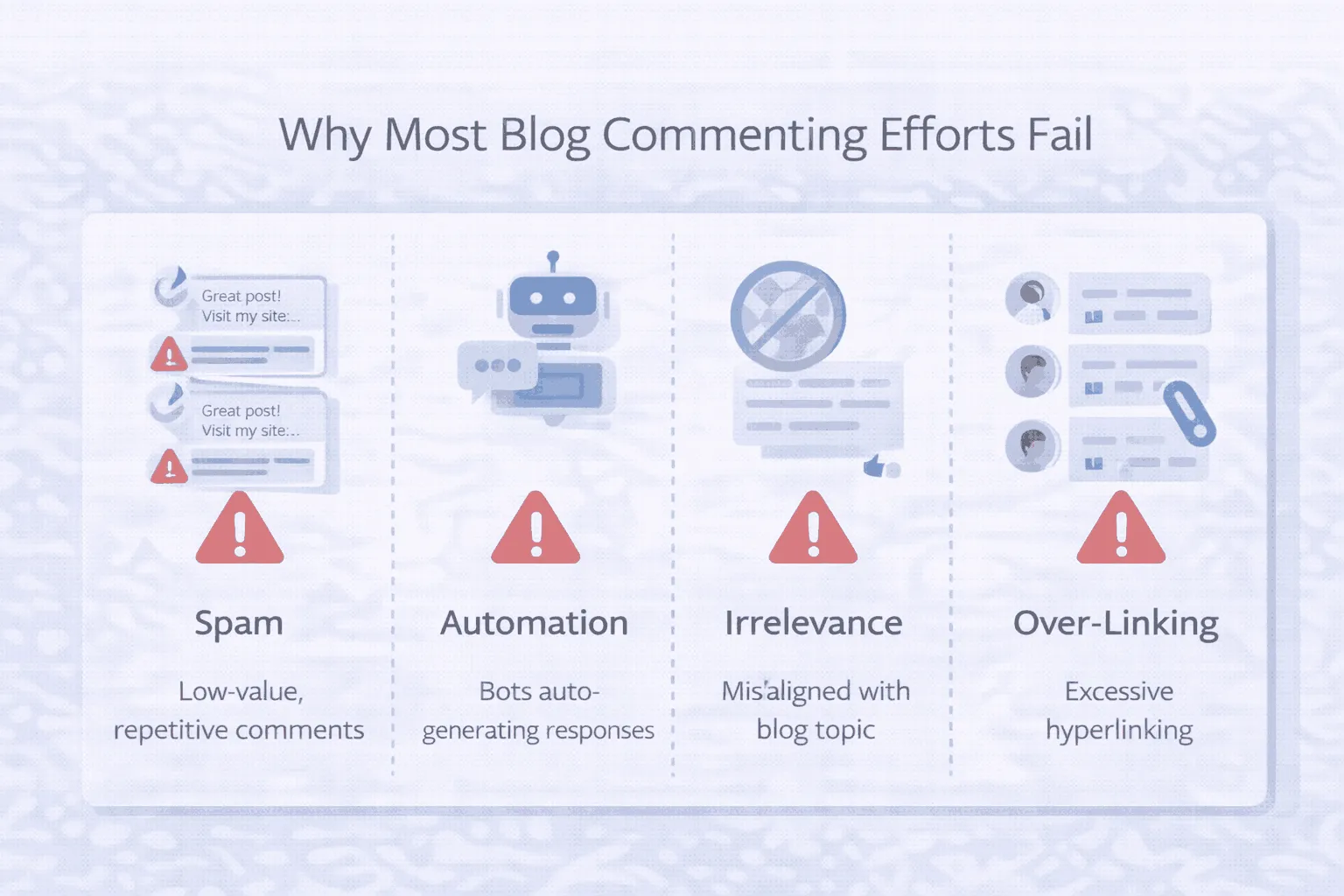
Blog commenting has real benefits, but many attempts fail or even backfire. The main reason is a misunderstanding of how modern search engines detect spam and low-value content.
Google’s SpamBrain: The AI Spam Watchdog
SpamBrain is Google’s AI system that flags disruptive or manipulative commenting practices. Using machine learning, it compares your activity against known spam patterns. High volumes of irrelevant or automated comments can lead to serious penalties, including de-indexing or loss of link value.
| Spam Characteristic | Potential Consequence |
| Automation | Flagged as non-human behavior |
| Irrelevance | Misaligned topics signal low-quality content |
| Over-Linking | Excessive links trigger manual review |
| Generic Comments | Phrases like “Great post” get filtered by tools like Akismet or Jetpack |
The End of “Link Stuffing”
Previously, marketers used mass commenting campaigns to build backlinks. Today, this approach is not only ineffective but risky. Modern moderation tools and search filters ensure that only genuine, thoughtful comments survive.
Leaving comments on untrusted or spammy sites can also hurt your own site’s reputation. Search engines consider the quality of the sites you interact with, so frequent association with low-quality pages can limit your ranking potential.
Blog Commenting in Modern SEO
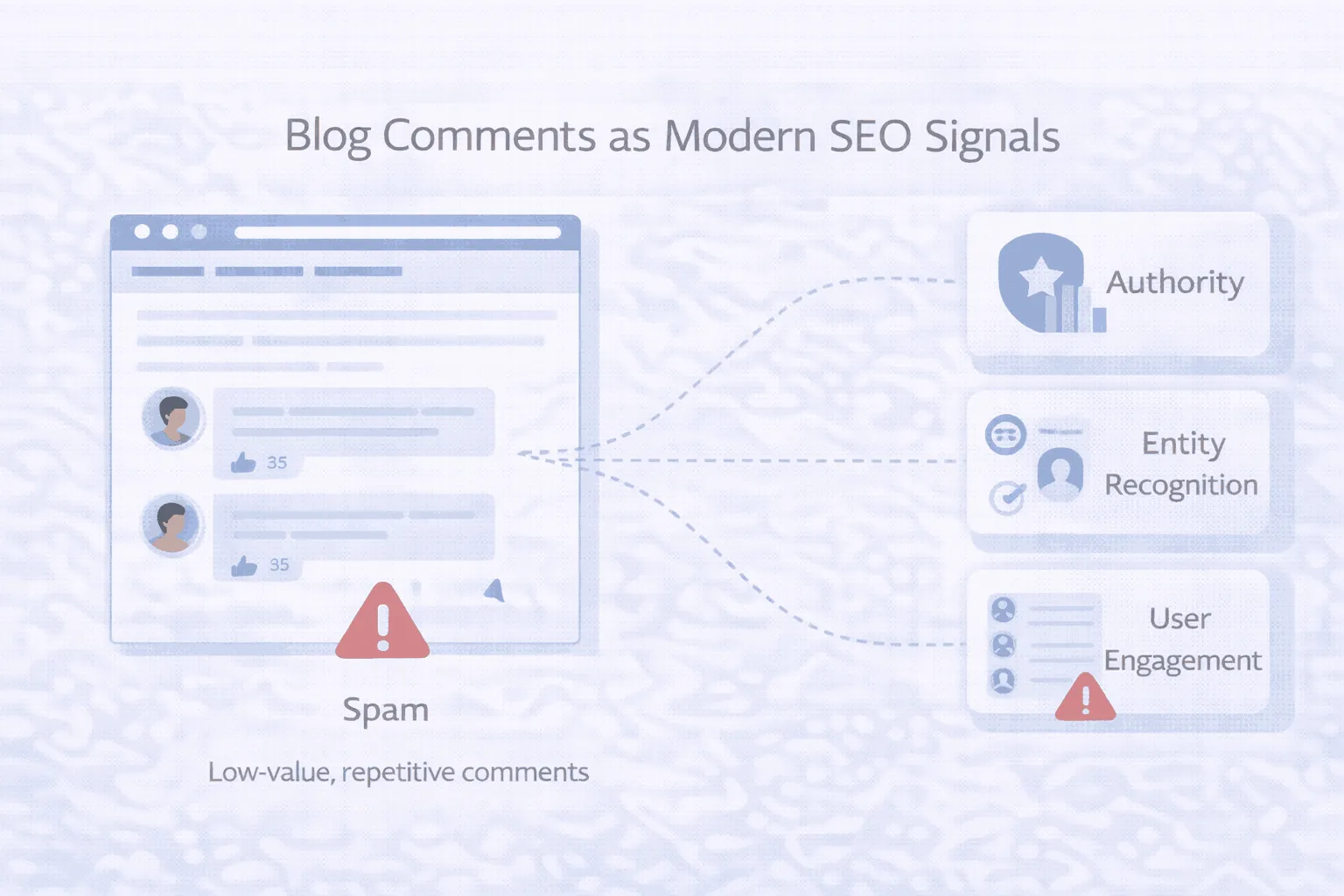
The SEO landscape is evolving beyond traditional keywords. Today, search engines focus on entities, topical depth, and AI-powered analysis rather than just link counts.
Entity Recognition and Citation Value
AI-driven search engines assess the sentiment and context of brand mentions. A well-thought-out comment on a high-authority blog can carry as much weight as a backlink. These unlinked mentions help build an authority footprint, signaling expertise.
Third-party citations often matter more than self-published content. For example, if an expert references your site in a comment, AI models are more likely to include your brand in summarized answers. This shifts the value of nofollow links and mentions from “wasted SEO” to essential components of a brand’s identity.
Leveraging People Also Ask (PAA)
The People Also Ask box is a prime opportunity to attract top-of-funnel traffic. By answering common questions in 40–50 word comments on high-ranking blogs, search engines may feature your response directly in PAA snippets.
| PAA Signal | Commenting Strategy |
| Relevance | Answer questions closely related to the post topic |
| Clarity | Keep answers simple and concise (35–50 words) |
| Formatting | Use bullet points or step-by-step lists |
| Intent | Focus on “How,” “Why,” and “Can you” queries |
Human-Centered Content Wins
With AI-generated content everywhere, human insights stand out. Blog comments allow you to show Experience and Expertise through personal anecdotes or real-world examples. Sharing how a strategy worked for you adds authenticity, boosting trust and credibility in the eyes of algorithms.
Building Connections Through Blog Commenting
Blog commenting is a powerful tool for networking and influencer engagement. Today, building a consistent creator presence matters more than chasing one-off backlinks.
Focus on Authenticity, Not Size
Micro-influencers with engaged audiences often outperform larger creators. Commenting thoughtfully on their posts increases the chance of a reply and provides social signals that can lead to deeper collaborations.
Best Practices for Influencer Engagement:
- Be Specific: Highlight a particular insight from their post that resonated with you.
- Use a Gravatar: A real profile picture builds familiarity and trust.
- Stay Consistent: Regular, thoughtful participation makes you a recognized voice in their community.
- Offer Solutions: Answer questions in the comments to position yourself as an expert and a helpful contributor.
Step-by-Step Guide to Commenting the Right Way
For beginners, the following framework ensures that every comment you leave provides value and adheres to SEO best practices.
Phase 1: Pre-Comment Research
- Verify the Site: Check Domain Authority (DA) and Spam Score using tools like MozBar or SEOQuake. Aim for DA >30 and spam score <10%.
- Read the Full Post: Avoid commenting based only on headlines, skimmed comments are easy to spot.
- Identify Your Hook: Find a point in the article to expand on or question.
Phase 2: Crafting the Comment
- Structure: Start with a greeting using the author’s name, add your hook and insight, and end with a question to encourage discussion.
- Length: Keep it 4–6 lines, enough to show effort but still scannable.
- Avoid Self-Promotion: Only include links if necessary to answer a question, and use the “Website” field rather than the comment body.
Phase 3: Post-Comment Action
- Monitor Replies: Engage with authors and other readers to build community signals.
- Track Your Links: Maintain a spreadsheet of commented sites, including dates and DA, to monitor which platforms drive referral traffic.
Conclusion
Blog commenting isn’t dead, it has evolved. Today, it bridges technical SEO with qualitative authority signals. While rel=”ugc” links provide foundational SEO hints, the real power lies in enriching content with related keywords, boosting engagement metrics like dwell time, and building citation signals that AI-powered search engines recognize.
A strategic approach to commenting means focusing on human-centered participation. By using search operators and competitor research to find high-authority niches, and consistently offering genuine, expert insights, you’re not just optimizing for algorithms, you’re building a trusted brand. Authority now belongs to those who are active, engaged, and indispensable to their community.