
Did you know that nearly half of all global website traffic comes from organic search? Even as AI tools and zero-click results change how people find information online, blogging remains a powerful way to build authority and capture users’ intent.
Studies show that websites with active blogs create 434% more indexed pages than those without, giving search engines more content to crawl and rank.
This blog explores how blog posts impact SEO and offers practical strategies to help you create content that performs.
Understanding the Technical Role of Blog Posts in SEO
A blog post is more than just written content. Technically, it is an HTML page built to be discovered, evaluated, and ranked by search engines. Understanding how a blog interacts with platforms like Google, which controls over 90% of global search traffic, is key to unlocking its SEO value. The process relies on three main stages: crawling, indexing, and ranking.
How Crawling Works
Crawling is the first step, where search engine bots, sometimes called spiders, scan the web to find new or updated content. Google uses around 15 types of crawlers, with the main “Googlebot” responsible for reading everything on a page, including HTML, JavaScript, and CSS.
New blog posts are discovered in two ways:
- Following links from existing pages
- Using XML sitemaps submitted to search engines
For large websites, the “crawl budget” is important. This is the number of pages a search engine can crawl on a site within a set time. Active blogs are crawled more often, which helps new content appear in search results quickly.
Indexing: Storing and Evaluating Content
After crawling, a page moves to indexing. This is when search engines analyze the content, check its quality, and store it in their database. They look at elements such as the title, canonical URLs, images, and overall usability to determine relevance.
| Technical Element | Purpose | Importance |
| Title Tags | Defines main topic | Key for categorization |
| Canonical Tags | Indicates preferred page version | Prevents duplicate content issues |
| Image Alt Text | Describes visual content | Supports accessibility and Image Search |
| Schema Markup | Provides structured data | Boosts visibility in rich results and AI summaries |
Pages that meet quality standards, accurate, detailed, and helpful, are indexed and become eligible to rank. Thin content or pages with technical issues may be excluded entirely.
Ranking and Matching User Intent
Ranking is the final stage, where search engines select the most relevant content from their index to answer user queries. Ranking now happens in milliseconds and is influenced by factors like location, device, and authority of the content.
Search engines focus heavily on user intent. Around 70% of searches are informational, meaning people are looking for answers, guidance, or insights. Blog posts that provide thorough, useful content are far more effective at satisfying these queries than static product or service pages.
How Blogging Boosts SEO Performance
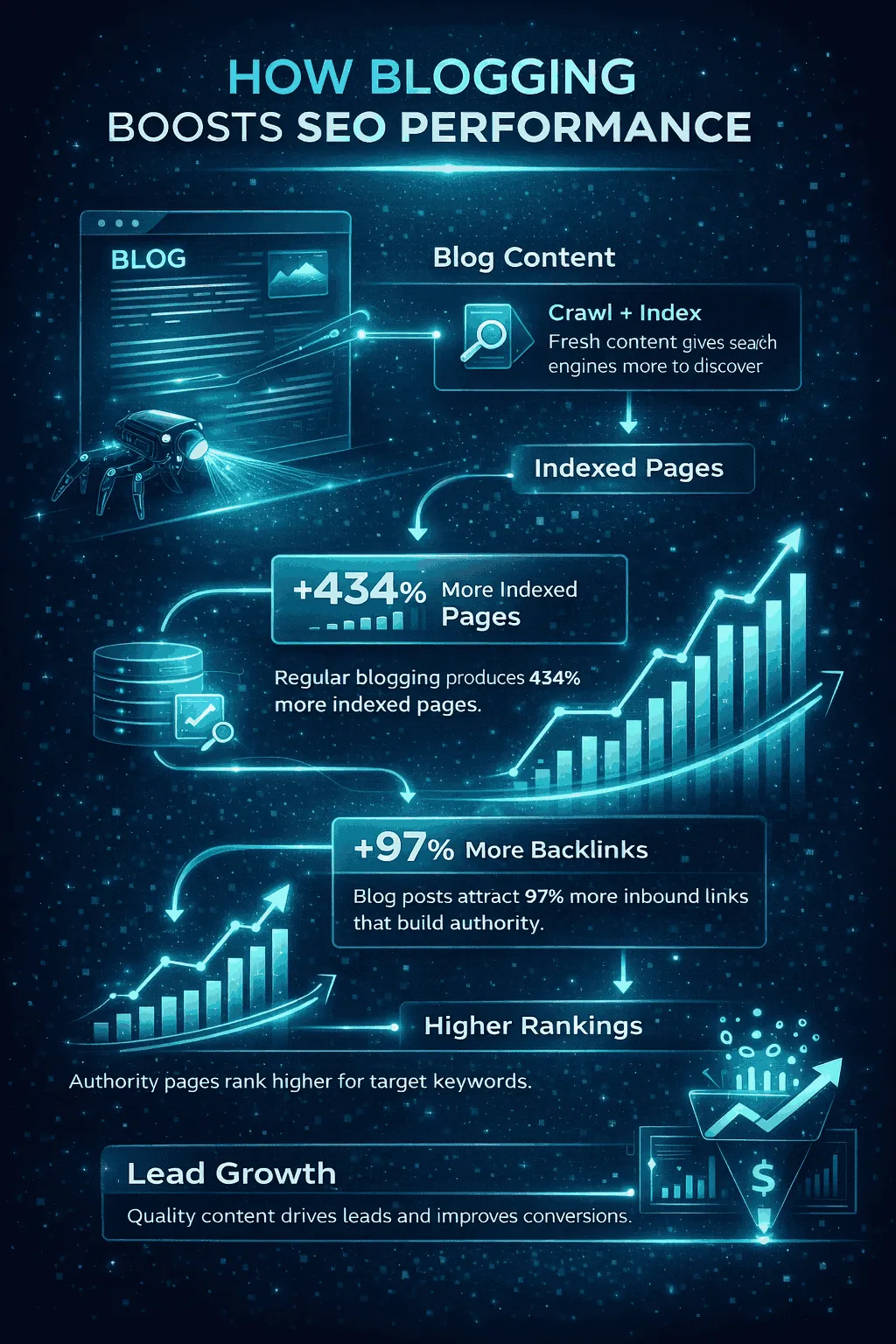
Blogging does more than fill a website with content. It directly impacts the metrics search engines use to measure a site’s credibility, authority, and usefulness, making it a critical tool for SEO growth.
Building Domain Authority and Trust
Regular, high-quality blog posts help a website earn trust with both users and search engines. They encourage longer visits, social sharing, and repeat traffic, all signals that content is valuable. Over time, a consistent publishing schedule establishes topical authority, showing search engines that the site is an expert in a specific niche through interconnected, in-depth articles.
Driving Leads and Improving Conversion
Blogging also plays a direct role in business growth. Companies that blog regularly are 13 times more likely to see a positive ROI than those that don’t. In B2B markets, 71% of buyers use blog content to research vendors and solutions before making decisions.
| Metric | Bloggers | Non-Bloggers |
| Monthly Leads | 67% increase | Baseline |
| Lead Growth Rate | 126% higher | Baseline |
| Lead Close Rate | 14.6% (SEO leads) | 1.7% (Outbound leads) |
| Email Traffic | 2x increase | Baseline |
These numbers show that blogging not only attracts traffic but also nurtures potential customers toward conversion.
Backlinks and Citations
Backlinks remain one of the strongest SEO ranking factors. On average, the top Google result has 3.8 times more backlinks than results ranked 2–10. Blog posts naturally attract links by offering research, infographics, or detailed guides that others want to reference. Sites with active blogs get 97% more inbound links, creating a cycle of growing authority and improving rankings across the entire domain.
Choosing the Right Blog Post Formats
Today, the structure and strategy of a blog post matter more than sheer quantity. Certain formats perform better for authority building, traffic, and ranking for competitive keywords.
The Topic Cluster and Pillar Page Strategy
A proven approach is the hub-and-spoke model. A central pillar page covers a broad topic in depth, such as “The Complete Guide to Solar Energy.” Supporting spoke posts dive into related subtopics like “How solar panels work in winter” or “Solar battery storage costs.”
Linking these spokes back to the pillar creates a network of content that signals expertise to search engines. This method supports E-E-A-T (Experience, Expertise, Authoritativeness, and Trustworthiness), helping the site rank higher and gain credibility.
Informational vs. Commercial Blog Types
Blog content should match the user’s stage in the buying journey. While product pages target immediate purchases, blogs are effective for information gathering and research.
- How-To Guides: Help users solve problems and often appear in Featured Snippets or People Also Ask boxes.
- Comparison Posts: Articles like “Product A vs. Product B” attract users deciding between options and have high conversion potential.
- Original Research: Publishing unique data or survey results builds backlinks naturally and positions the brand as an authority over time.
Practical Tips for Writing SEO-Friendly Blog Content
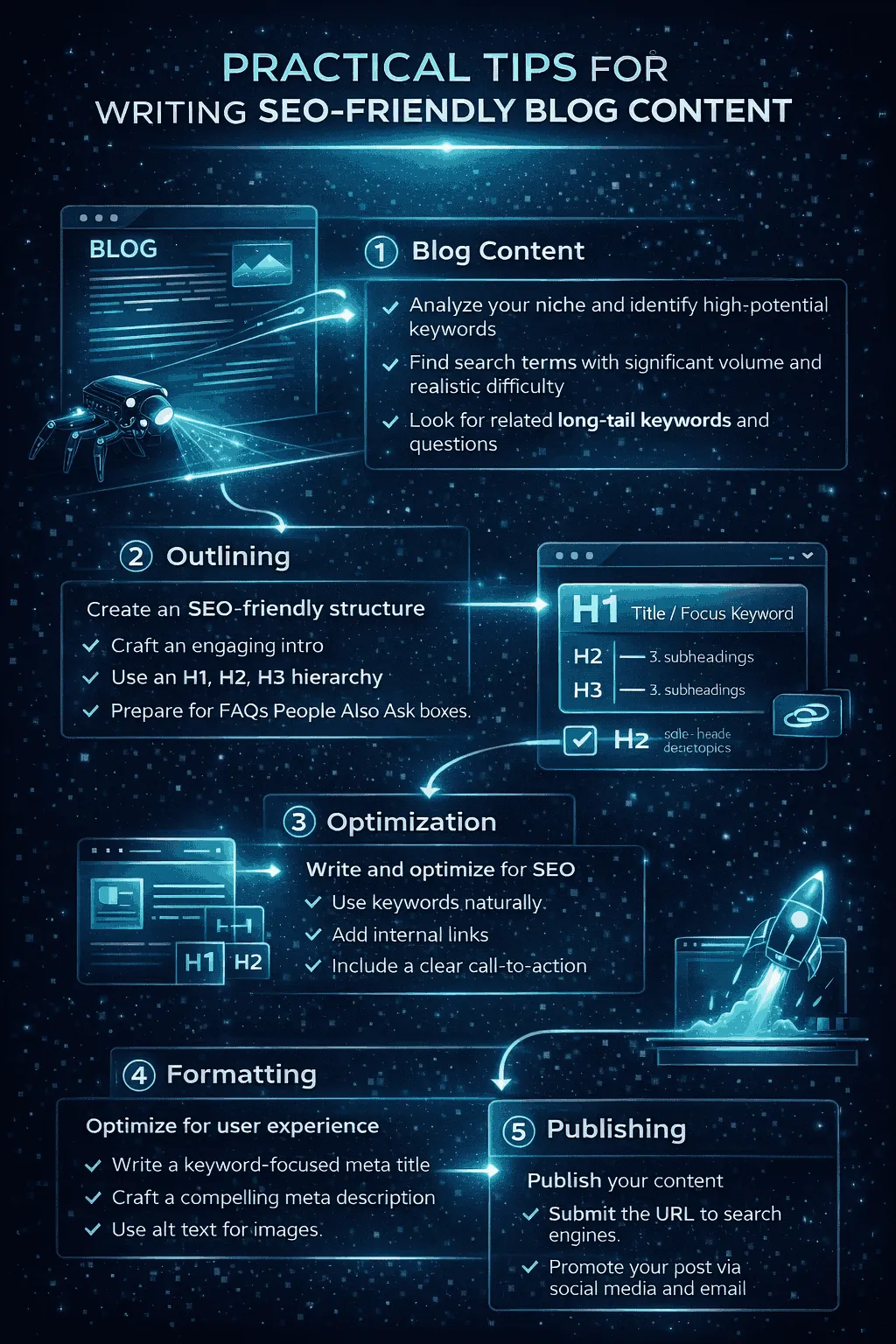
Creating SEO-optimized blogs involves more than just keywords. Content must be easy for both humans and AI search tools to understand, a practice called Generative Engine Optimization (GEO).
Smart Keyword and Prompt Research
Keyword research is still the foundation of SEO, but it now includes conversational prompts for AI. Use tools like Semrush Keyword Magic Tool to find:
- Primary Keywords: High-volume terms with manageable competition.
- Fan-Out Queries: Related questions users might ask AI.
- Long-Tail Keywords: Phrases longer than three words that address specific needs and attract high-quality traffic.
Crafting Effective Titles and Meta Descriptions
- Title Tags: Aim for 6–13 words. Adding a colon or hyphen can boost click-through rates by 9%.
- Meta Descriptions: Think of these as ad copy. Include the primary keyword and a clear call-to-action to encourage clicks, which indirectly improves rankings.
Formatting for Readability and AI
Most readers skim content before diving in. To make posts scannable:
- Header Hierarchy: Use H1 for the title, H2 for main sections, and H3 for sub-points. This structure helps both readers and AI.
- Bullet Points and Lists: Break data and steps into lists so AI tools like Google’s SGE can easily extract key information.
- Short Paragraphs: Keep each paragraph focused on a single idea to improve readability and engagement.
This approach ensures your blog content is easy to navigate, AI-friendly, and more likely to rank and convert.
Determining the Best Blog Post Length for SEO
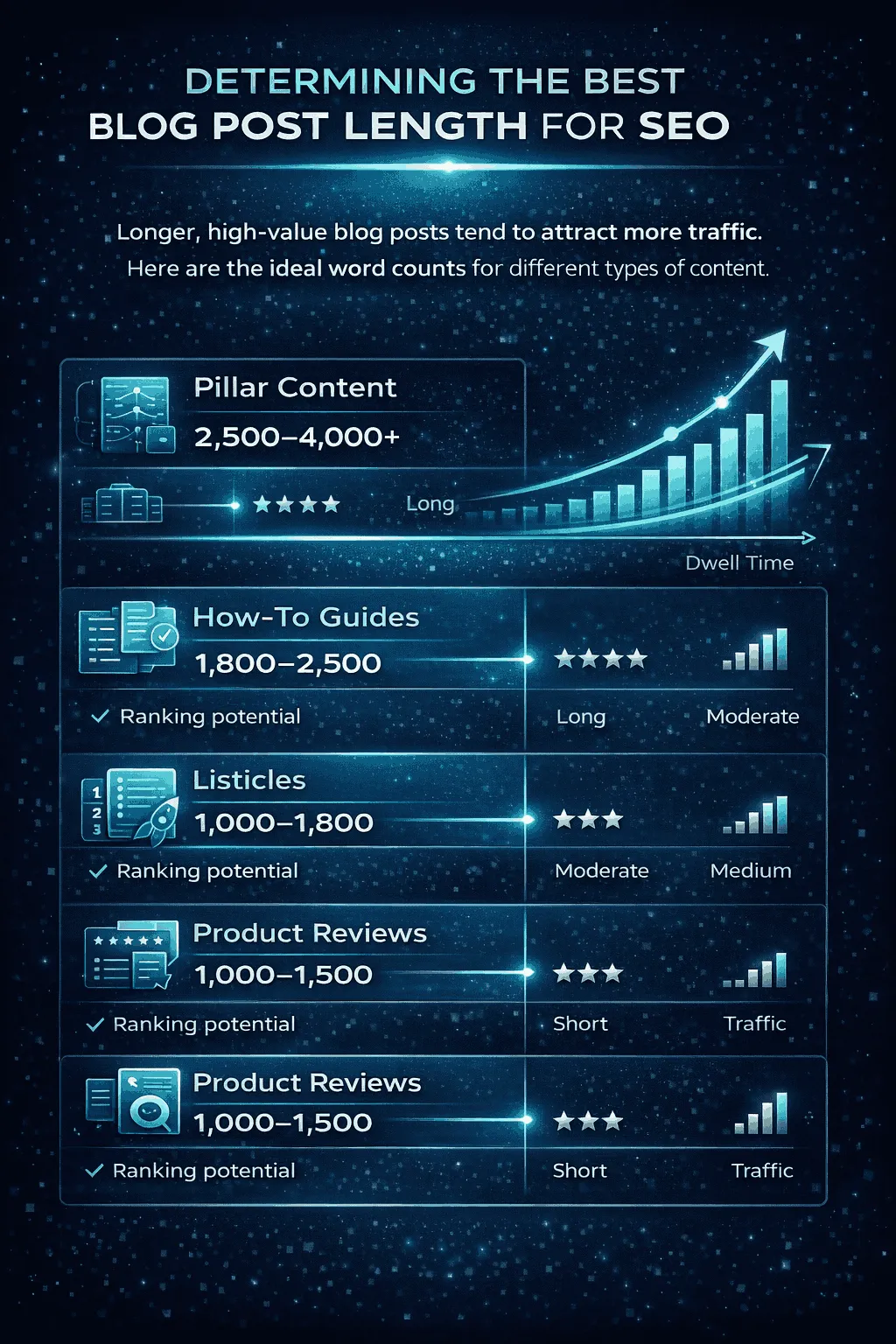
While quality always matters more than length, data from 2026 shows that detailed, comprehensive posts often perform better in competitive search results.
Recommended Length by Blog Type
The ideal word count depends on the goal and topic complexity. Search engines favor content that covers a subject thoroughly.
| Blog Type | Recommended Length | Why It Works |
| Pillar Content | 2,500–4,000+ | Serves as a central hub covering a broad topic. |
| How-To Tutorials | 1,800–2,500 | Provides detailed step-by-step guidance. |
| Listicles | 1,000–1,800 | Easy to skim while still offering depth. |
| Product Reviews | 1,000–1,500 | Offers enough detail to build trust and aid decision-making. |
| News/Company Updates | 300–700 | Focuses on timely relevance rather than authority. |
Dwell Time and Engagement
Longer, well-written posts tend to keep readers on the page longer, which signals quality to search engines. However, length without value can increase bounce rates and harm rankings.
Publishing Schedule: Frequency and Consistency
Regular posting is key to building organic growth. Frequent, consistent blogs give more chances to rank for high-value keywords and attract traffic.
| Frequency | Outcome |
| 4+ posts per week | 3.5x more traffic than posting once a week. |
| 2–4 posts per month | Common among 48% of marketers. |
| Daily posts | 57% of daily bloggers report better results. |
| Irregular | Often leads to plateaued or declining traffic. |
The Compounding Growth Effect
SEO results build over time. Early signals, like impressions, appear within the first 3 months. Noticeable traffic growth and ranking improvements usually occur between months 4–6. The most significant gains, compounding growth, happen around months 7–12. Businesses that post rarely risk losing ground to competitors with fresher, more authoritative content.
This shows that combining optimal post length with frequent, consistent publishing is the best approach for long-term SEO success.
Common Blogging Mistakes to Avoid
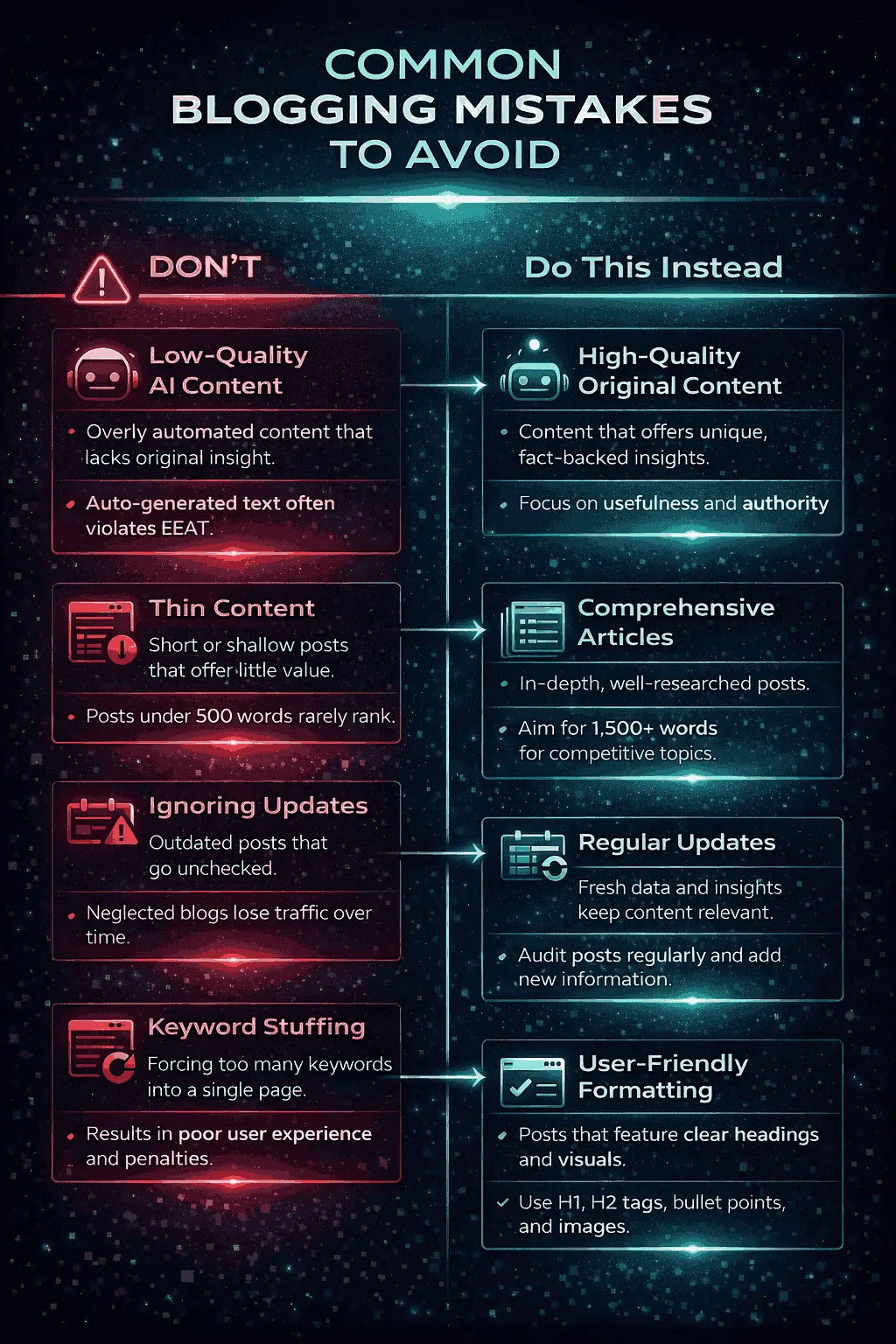
Even experienced bloggers can fall into traps that hurt SEO. Search engines, nowadays, are stricter about quality and relevance, so avoiding these mistakes is crucial.
Over-Reliance on Low-Quality AI Content
AI can be a powerful assistant, but using it to generate entire posts without human input often backfires. Google prioritizes content that provides unique insights, data, or experience. AI works best for outlining, keyword research, and grammar checks, while the core ideas should come from a human writer.
Neglecting Updates and Content Maintenance
Many bloggers ignore older posts, 62% fail to update content regularly. Keeping posts current with new stats, keywords, and insights can boost traffic by up to 70%. Updating old posts often provides better ROI than writing new ones.
Ignoring User Intent
Writing for search engines instead of readers is a common pitfall. If a “how-to” post is actually a thin sales pitch, users will leave quickly. High bounce rates signal poor quality, lowering rankings over time.
Choosing the Right Content Format: Blogs vs. Infographics
Text is essential for SEO, but visuals like infographics add value, especially for complex information. Combining both formats often works best.
| Attribute | Blog Posts | Infographics |
| SEO Depth | High; targets many keywords | Moderate; relies on alt text and surrounding text |
| Link Building | High for original guides | Very high; widely shared and embedded |
| Shareability | High on educational platforms | Extremely high on social media and Pinterest |
| Production Time | ~4 hours | Requires professional design; more time-intensive |
Infographics act as link magnets, often attracting 178% more backlinks than posts without visuals. They also remain relevant for years.
Using AI Tools Effectively
AI is essential for scaling content, but it must enhance human creativity rather than replace it.
Popular AI Tools
- Surfer SEO – Checks word count, keywords, and semantic relevance.
- Jasper – Generates content while maintaining brand voice.
- ChatGPT (Plus) – Helps with research, content gaps, and structured data.
- Clearscope – Ensures content covers all subtopics for authority.
AI-Assisted Blogging Workflow
- Keyword Selection – Find primary and secondary keywords with AI tools.
- Outlining – Use AI to create a clear structure with H1, H2, and H3 headings.
- Drafting – Generate a first draft using AI tools while keeping tone and audience in mind.
- Optimization – Use tools like Clearscope for semantic depth and topic coverage.
- Human Review – Edit the draft to add unique insights, verify facts, and ensure it sounds natural.
This approach allows bloggers to produce high-quality, SEO-friendly content quickly while maintaining originality and authority.
Final Thoughts
SEO blogging is now more about authority than publishing volume. Posting often is no longer enough. Each blog must be useful, accurate, and trustworthy. A strong post needs to serve three audiences at the same time: human readers who want clear answers, search engines that evaluate authority, and AI systems that pull reliable facts.
Content should be treated as a living asset, with regular updates that add fresh data, examples, and insights. Topic clusters and pillar pages have become a standard way to show depth and expertise in a niche. Visual content and AI tools help scale content creation, but the core ideas and insights should remain human-led.
In the end, blogs that offer real information gain through original data, unique perspectives, and complete answers are the ones that perform best as search technology continues to change.