What if your brand’s visibility depended less on who links to you and more on who talks about you?
Online search has moved beyond counting backlinks and now pays closer attention to brand mentions as signals of credibility. More than 70% of consumers place greater trust in brand mentions than in traditional ads, and search engines reflect this behavior by treating unlinked mentions as implied links.
As Google and AI platforms like ChatGPT rely more on entity understanding instead of simple keyword matching, the context and sentiment around these mentions strongly influence E-E-A-T. This shift shapes organic visibility, performance in generative search, and how a brand is perceived online.
How Brand Mentions Work in Modern SEO
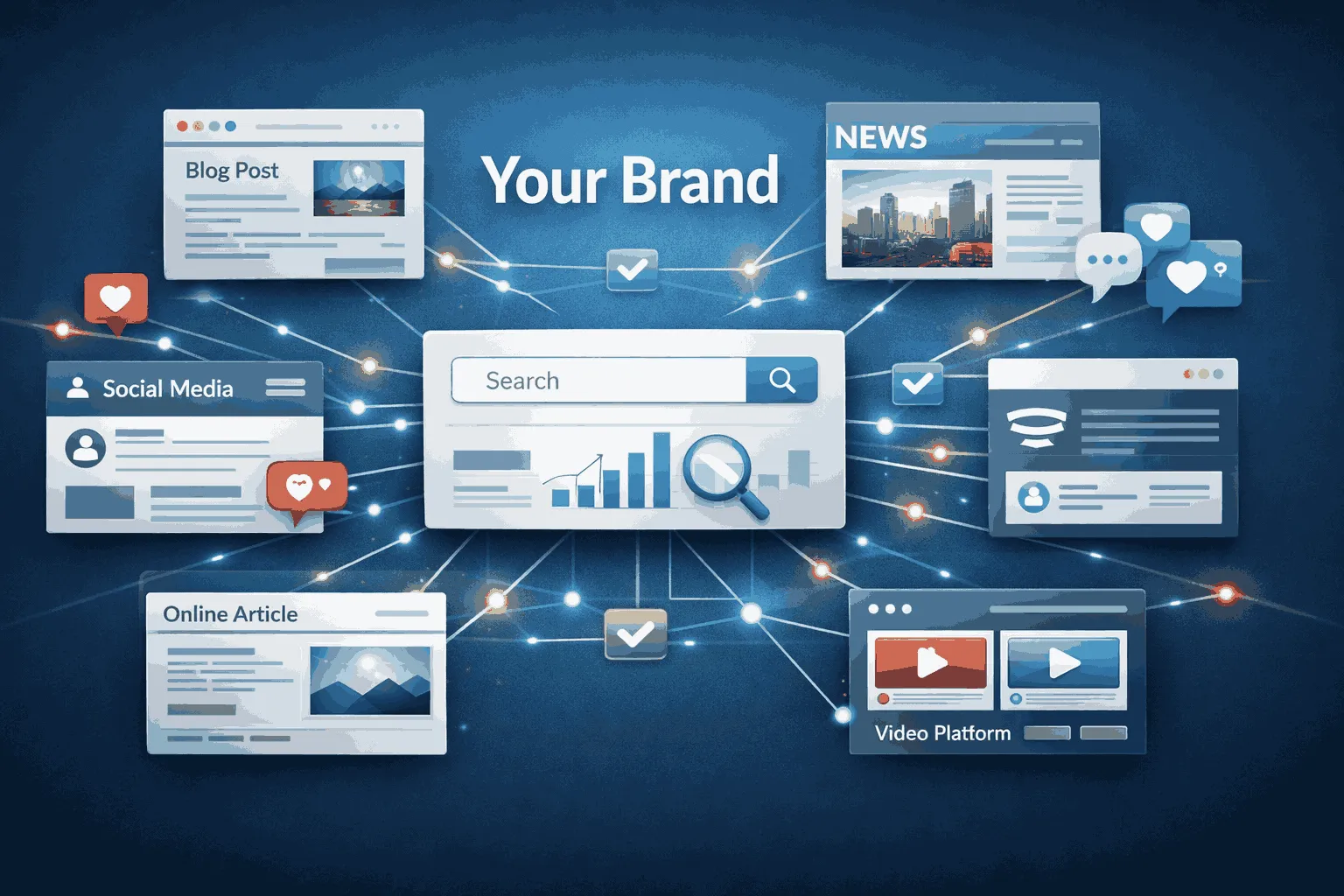
A brand mention is any public online reference to your company, products, or services, with or without a clickable link. These mentions signal that your brand exists, stays active, and takes part in online discussions. Search engines now treat them as meaningful data points that help shape your brand’s entity profile rather than simple text references.
Brand Mentions as Entity Signals
Modern search systems use brand mentions to understand your business as an entity. How often your brand is mentioned, where it appears, and the context around it all influence how search engines assess relevance and trust. This directly affects your visibility across search and AI-driven platforms.
Types of Brand Mentions Explained
Brand mentions can be grouped based on how clearly your brand is referenced and how search engines interpret those references.
| Mention Type | Category | Implementation | SEO Significance |
| Direct Mention | Explicit | Specific brand or product name | High: clear entity signal |
| Indirect Mention | Implicit | Slogan, nickname, description | Moderate: depends on language interpretation |
| Linked Mention | Technical | Hyperlink to your website | Direct: passes link equity |
| Unlinked Mention | Qualitative | Plain-text reference | Indirect: implied trust signal |
| Implied Mention | Contextual | Features or traits | Entity association |
Why These Differences Matter
Each type of mention helps search engines connect your brand to specific topics. When your brand appears repeatedly alongside subjects like cybersecurity or organic skincare, that connection grows stronger inside the Knowledge Graph. This allows search systems to favor brands that show consistent authority across platforms instead of relying only on traditional link building.
How Brand Mentions Directly Affect Your Search Rankings
Many people still believe that only links affect SEO. That idea no longer fits how search works today. Google’s own patents show that unlinked brand mentions are treated as implied links. In simple terms, when your brand is mentioned in plain text, search systems can read it as a vote of confidence, similar to a backlink.
When an authoritative source like a news site or an industry publication mentions your brand, it acts as a public endorsement. Even without a clickable link, Google reads this as a signal of relevance and credibility. This plays a strong role in shaping your E-E-A-T profile, especially because Google looks closely at what independent sources say about you.
How Google Processes These Signals
Search engines collect brand mentions into what can be described as a reputation file. When your brand is consistently mentioned in a positive way across news sites, blogs, forums, and reviews, your trust score increases. While these mentions do not pass link equity in the traditional sense, they still help push authority toward your website.
In competitive markets, this wider visibility can help you rank above competitors who may have similar backlink profiles but fewer brand mentions across the web.
The Indirect Impact and User Behavior Effect
Brand mentions also support your SEO through indirect paths tied to real user behavior.
Branded Searches and Visibility
When people see your brand mentioned in articles, podcasts, or social posts, many search for your brand name directly. This growth in branded searches tells Google that users actively seek you out, which signals authority and relevance.
Click Behavior and Trust
Familiarity plays a big role in search results. When users recognize your brand, they are more likely to click your listing. A stronger click-through rate sends positive engagement signals that support higher rankings.
Indirect Benefits of Brand Mentions
| Indirect Benefit | Mechanism | SEO Outcome |
| Branded Search Growth | Users search for your brand name | Signals authority to Google |
| CTR Improvement | Familiarity increases clicks | Stronger organic positions |
| Social Proof | Mentions build trust | Better engagement and conversions |
| Referral Traffic | Users visit through mentions | Improved user signals |
| Knowledge Panel Growth | Frequent mentions support rich results | More SERP visibility |
Long-Term Visibility Effects
Each brand mention introduces you to new audiences who may not find you through standard keyword searches. These touchpoints increase recall during buying decisions and often lead to natural backlinks over time. Writers and creators who discover your brand through mentions may later reference you with links in their own content.
Over time, this cycle strengthens your authority, visibility, and search performance without relying solely on traditional link building.
Brand Mentions in the Age of Generative AI
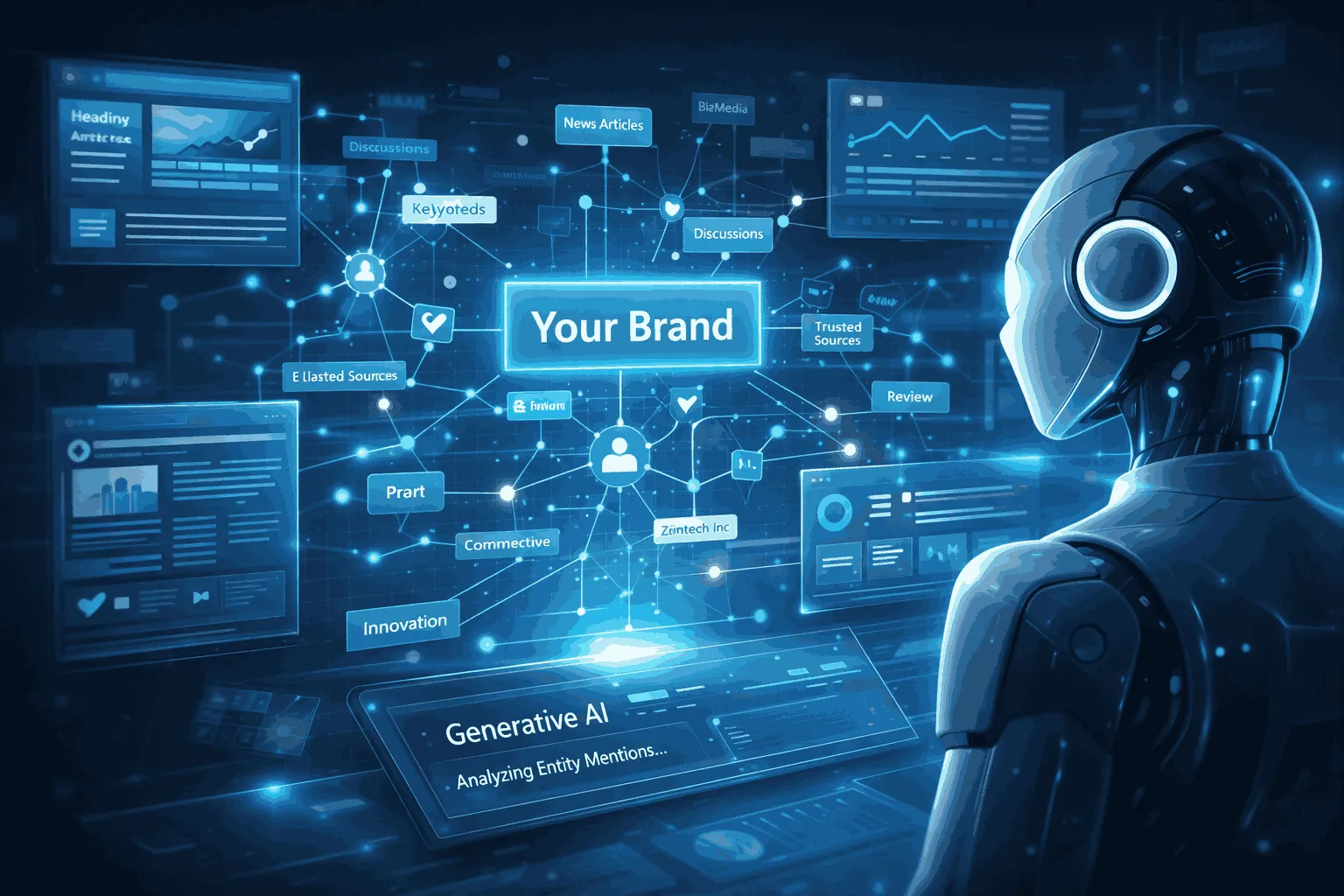
With the rise of generative search, brand mentions have moved from a supporting role to a core requirement. Large language models like ChatGPT, Gemini, and Claude learn from massive amounts of public content, including articles, discussions, and news coverage. In this setup, your brand is not viewed as a website. It is understood as an entity shaped by how and where it is mentioned.
AI models look at language patterns, context, and frequency to decide whether your brand is credible enough to reference. The more consistent and relevant these mentions are, the easier it is for AI systems to recognize and trust your brand.
Why Mentions Matter More Than Links in AI Search
Studies on Google’s AI Overviews show a strong link between brand mentions and AI visibility. Research from Ahrefs found that web mentions are the strongest factor behind whether a brand appears in AI-generated answers.
| Feature | Correlation with AI Overview Visibility |
| Brand Web Mentions | 0.664 |
| Branded Search Volume | 0.237 |
| Traditional Backlinks | 0.218 |
This data shows that brand mentions carry significantly more weight than backlinks in generative search results. AI systems tend to reference brands that appear often across trusted third-party sources rather than those relying mainly on links.
How AI Chooses Which Brands to Cite
When AI generates summaries or answers, it depends on co-occurrence. This means it looks at how often your brand appears alongside specific topics, industries, or competitors. If your brand shows up regularly in the right context, AI is more likely to treat you as a trusted source.
To show up in AI summaries, you need a consistent and topic-focused presence across the web. These mentions help AI build its internal knowledge graph and recommend your brand without needing a direct link to your site.
Measuring Your Brand’s Visibility in AI Search
As search moves from simple blue links to conversational AI answers, tracking your brand requires more than regular keyword tools. Modern Generative Engine Optimization (GEO) platforms can measure how AI perceives your brand, including sentiment in AI responses and share of voice across multiple LLMs.
Enterprise and Mid-Market GEO Solutions
| Tool Name | Market Focus | Key Features |
| Profound | Enterprise | Tracks 10+ engines; SOC 2 compliance; ChatGPT Shopping monitoring |
| Ahrefs Brand Radar | Strategic | 360° brand health view; monitors entity positioning and sentiment |
| Peec AI | Mid-Market | Geographic/language targeting; BI integration via Looker Studio |
| ZipTie | Optimization | Focuses on AI Overviews; includes content optimization module |
| Otterly.AI | Startups | Quick deployment; tracks link citations and AI Readiness scores |
| Scrunch AI | Safety | Brand safety and compliance across persona-based GEO |
These tools help you see where your brand appears in AI-generated content and how it is being portrayed. For example, Peec AI can show whether your brand is being recommended for features like “best price” or if competitors dominate certain regions. This insight helps you act quickly to address misinformation or competitive gaps.
Monitoring Your Brand’s Presence in LLMs
Visibility today goes beyond ranking positions. It involves understanding the data and sources that AI models trust. Tools like AIclicks.io identify which third-party sites AI models rely on most. By securing mentions on these trusted sources, you can strengthen your brand’s “semantic neighborhood” and ensure AI systems recognize your authority in your industry.
Keeping track of AI visibility not only supports your SEO strategy but also positions your brand as a trusted, recognized entity in the evolving digital landscape.
Linked vs. Unlinked Mentions: What You Need to Know
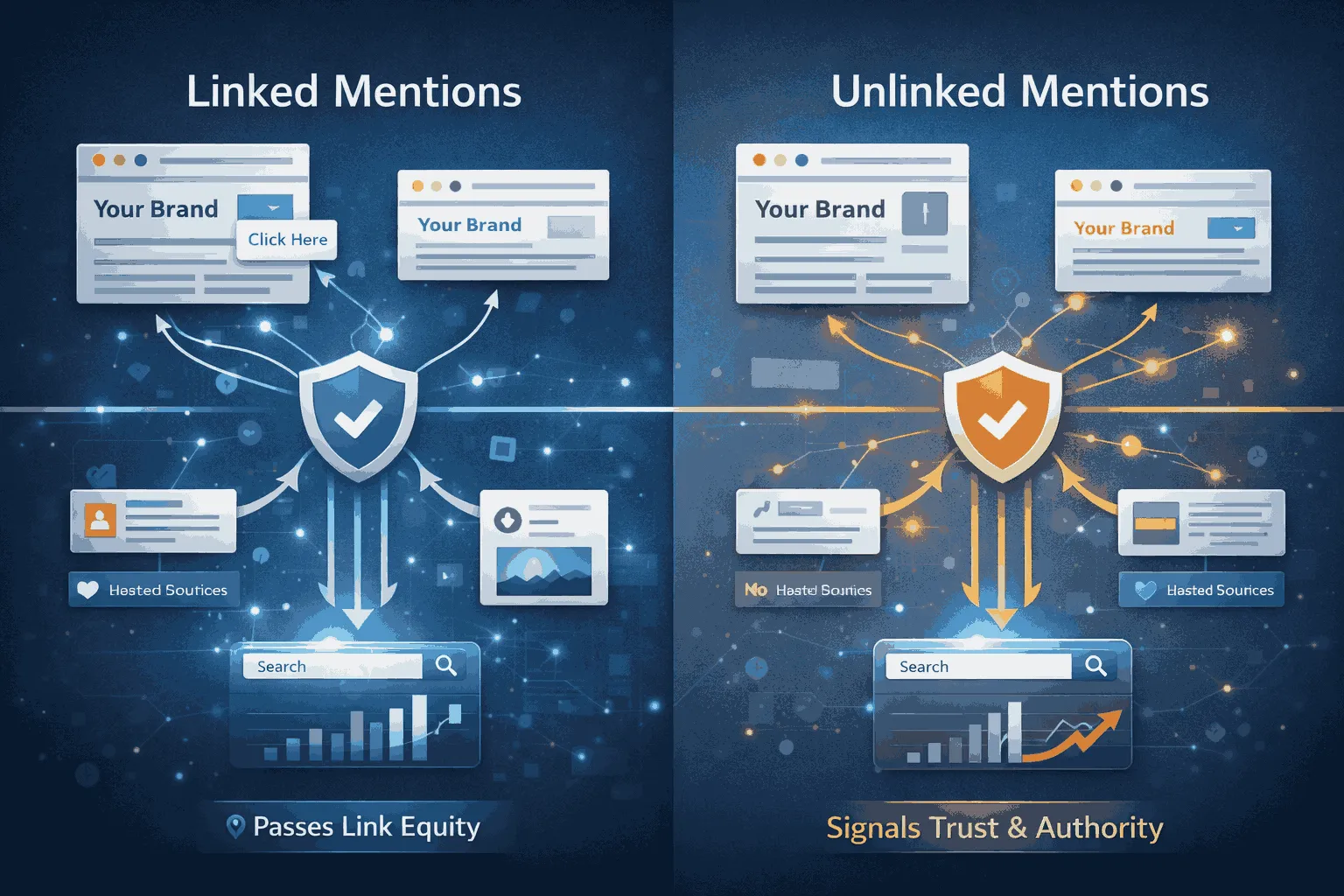
Linked and unlinked mentions aren’t competitors, they complement each other in a strong SEO strategy. Linked mentions, or traditional backlinks, pass authority and help search engines discover and index your pages. They give users a direct path to your site and remain a key ranking factor.
Unlinked mentions, on the other hand, signal trust and reputation. They don’t pass link equity in the traditional sense but help search engines and AI systems recognize your brand as a credible entity. For LLMs, the context and clarity of a mention often matter more than a link, as AI interprets linguistic patterns to determine authority.
Linked vs. Unlinked at a Glance
| Feature | Linked Mentions (Backlinks) | Unlinked Mentions |
| Technical Role | Authority transfer (PageRank) | Reputation signal (entity salience) |
| User Value | Direct navigation to your site | Awareness and recall |
| Measurement | Domain rating / authority scores | Share of voice / sentiment analysis |
| Risk Profile | Can be penalized if spammy | Low risk; mostly organic signals |
| GEO Value | Supporting validation | Primary input for AI summaries |
Why You Need Both
Using both types of mentions creates a complete trust signal. A brand with lots of backlinks but no unlinked mentions may appear artificially promoted. Conversely, a brand with a healthy mix of backlinks and unlinked mentions signals genuine popularity and authority to both search engines and AI systems.
How Brand Mentions Boost Your Local SEO
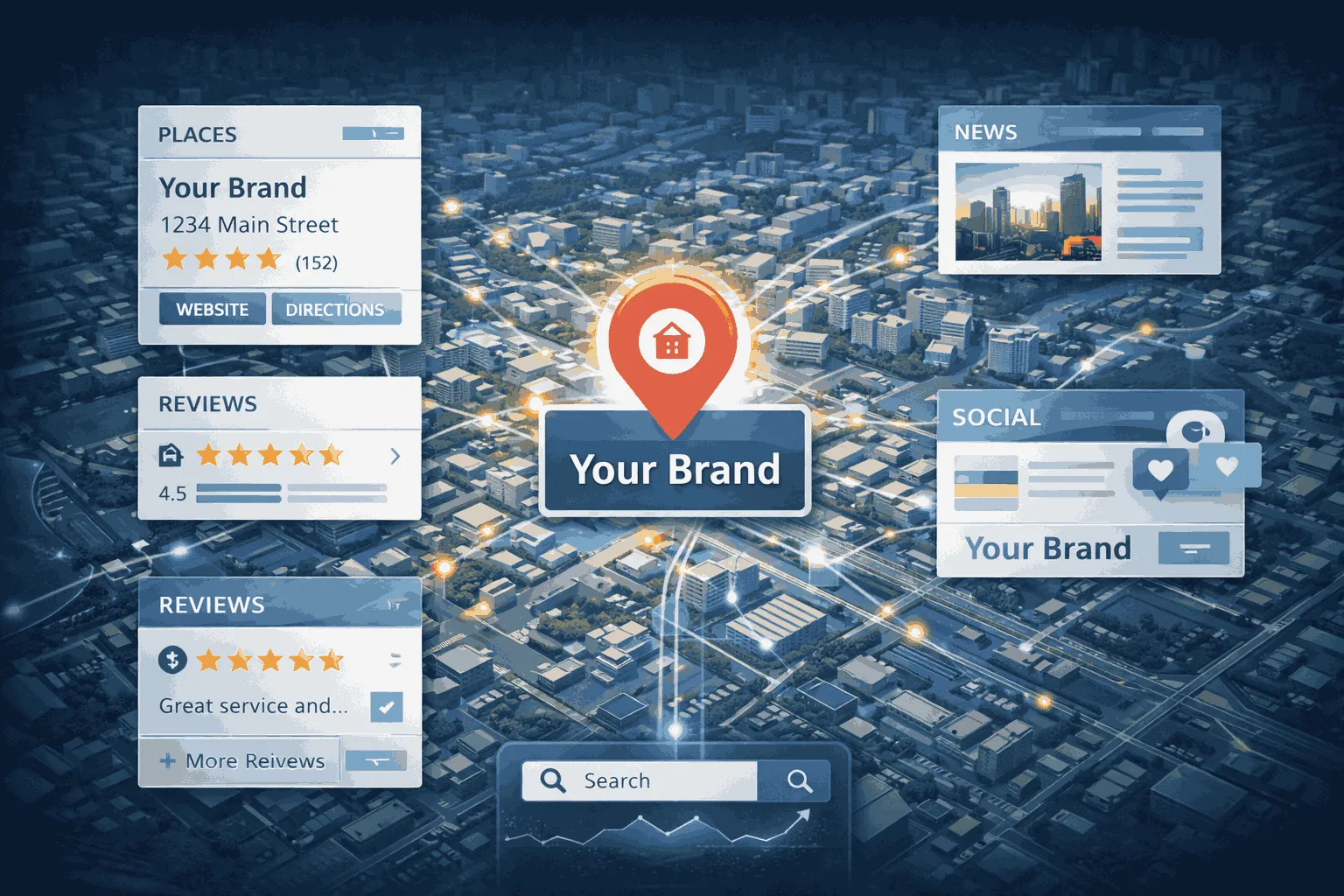
If you’re targeting local customers, brand mentions, also called unstructured citations, play a key role in Google’s Local Pack rankings. Google evaluates local businesses based on Relevance, Distance, and Prominence. While distance and category relevance are mostly fixed, prominence depends heavily on how often your business is mentioned online.
Prominence reflects how well-known and trusted your business is in the community. Mentions in social media, news articles, local blogs, event listings, and reviews signal to Google that your business is active and respected. The more frequently your brand appears across these channels, the higher your chances of ranking in the Map Pack.
Keep Your NAP Consistent
To maximize the impact of local mentions, your Name, Address, and Phone number (NAP) must be consistent across all references. Even unlinked mentions are most effective when they match the formatting of your Google Business Profile.
Local SEO Impact of Brand Mentions
| Local Ranking Factor | Influence | Role of Mentions |
| Google Business Profile | 32% | Completeness & posting updates |
| Reviews | 20% | Customer-generated brand mentions |
| On-Page Signals | 15% | Local keywords & case studies |
| Link/Citation Signals | 15% | NAP consistency & prominence |
| Behavioral Signals | 9% | Clicks & direction requests |
The Power of Reviews
Reviews are a special type of brand mention. They provide user-generated content that signals relevance to Google while building consumer trust. Listings with a 4.5+ star rating and at least 50 reviews are 57% more likely to appear at the top of local search results.
For local businesses, maintaining a strong presence through mentions, reviews, and NAP consistency is critical to standing out in the Map Pack and attracting nearby customers.
The Risks of Negative Brand Mentions
While positive mentions boost authority, negative references can harm both your SEO and digital reputation. Search engines and AI models use Natural Language Processing to detect sentiment, so complaints about product flaws, high fees, or poor service can be recognized and factored into rankings.
Sudden spikes in negative mentions, like viral social media complaints or critical threads, can signal a drop in trustworthiness. Even if indirect, this can lower engagement and clicks, prompting Google to rank your brand lower in search results.
Negative Impact in AI Search
Generative AI also responds to sentiment in training data. Negative references can lead chatbots to steer potential customers away. For example, a car rental brand faced issues when AI models associated it with hidden fees and limited availability. If negative sentiment outweighs positive mentions, it can undermine your entire SEO strategy, as AI begins to treat your brand as less trustworthy.
Consequences of Negative Mentions
| Impact Category | Effect | SEO/Business Consequence |
| Reputation | Lower consumer confidence | Fewer conversions and sales |
| Authority | Reduced E-E-A-T score | Potential ranking drops |
| AI Visibility | Exclusion from AI summaries | Loss of zero-click traffic |
| Engagement | Lower SERP click-through rate | Algorithmic suppression |
Managing the Risk
To protect your brand, monitor mentions constantly and respond quickly. Reputation management includes generating positive content to outweigh negative listings and addressing customer complaints before they escalate. Proactive engagement ensures your brand maintains trust, authority, and visibility across both search engines and AI platforms.
Ethical Strategies for Earning High-Value Brand Mentions
Building mentions ethically strengthens your brand’s reputation and authority while supporting long-term SEO growth.
Treat Mentions as Digital PR, Not Just Links
Acquiring brand mentions is about building your reputation, not just collecting links. The goal is to earn mentions in the right context, on authoritative sites, where they genuinely add value.
Create Assets People Want to Mention
The most effective way to gain mentions is by offering resources that others naturally want to reference:
- Original Research & Proprietary Data: Share new insights or industry trends that journalists and bloggers cite.
- Expert Commentary & Thought Leadership: Offer unique perspectives or quotes on trending topics to position your brand as an authority.
- Interactive Tools & Guides: Develop practical resources that solve user problems, which are often included in roundups or “best of” lists.
Link Reclamation and Community Engagement
You can also convert existing unlinked mentions into backlinks through polite outreach, improving the reader’s experience. Engaging in guest posts, collaborative content, or influencer partnerships creates recurring organic mentions over time.
Think Long-Term
Mention acquisition is a marathon, not a sprint. One mention rarely makes a big difference. Consistently earning them over 12–18 months can reshape how AI models and search engines perceive your brand.
Brand Mentions vs. Navigational Backlinks
Understanding the difference helps you build a modern SEO strategy.
| Aspect | Brand Mentions | Backlinks (Navigational) |
| Primary Platform | AI answer engines, social media, forums | Traditional search engines (Google) |
| Main Benefit | Recognized, credible entity | Passes link equity & improves rankings |
| Measurement | Sentiment, share of voice | Referral traffic, Domain Authority (DA/DR) |
| Strategy Focus | Top-of-funnel / brand awareness | Bottom-of-funnel / performance |
| Risk Level | Minimal (qualitative) | Higher if link building is aggressive |
Brand mentions build long-term awareness and credibility in AI-driven and human search environments, while backlinks deliver direct, measurable SEO impact. Together, they create a balanced strategy that strengthens both authority and visibility.
Conclusion
Brand mentions bridge traditional PR and modern SEO. As search engines and AI shift from focusing on keywords to understanding entities, the way your brand appears across the web is just as important as backlinks. Mentions act as off-page SEO signals, showing authority and trustworthiness that both AI and search algorithms rely on.
To stay ahead, focus on building consistent brand visibility. Create valuable content, manage sentiment carefully, and track how your brand appears across traditional and AI-driven search platforms.
Over time, this approach forms a strong “SEO moat,” protecting your rankings and establishing your brand as a recognized authority in the evolving world of search and conversational AI.