
For years, digital marketing has been shaped by the belief that using a keyword more often leads to better search rankings. This idea, known as the keyword quantity myth, assumes that repetition signals authority to search engines. While this approach worked in the early days of SEO, it no longer applies.
Search engines have changed how they read and rank content. They no longer scan pages for repeated phrases alone. Instead, they focus on meaning, context, and user intent. With machine learning and natural language processing in place, search engines now understand what a page is actually about rather than how many times a keyword appears.
This outdated belief still creates confusion for business owners and marketers. It often results in keyword stuffing, where terms are forced into content, headings, and metadata, hurting clarity and user experience. Modern SEO focuses less on keyword counts and more on content quality, relevance, and trust.
In this blog, we will break down how semantic search works, why topic-based content matters, and how aligning with search intent plays a bigger role than keyword volume in SEO results.
How Search Engines Learned to Understand Meaning
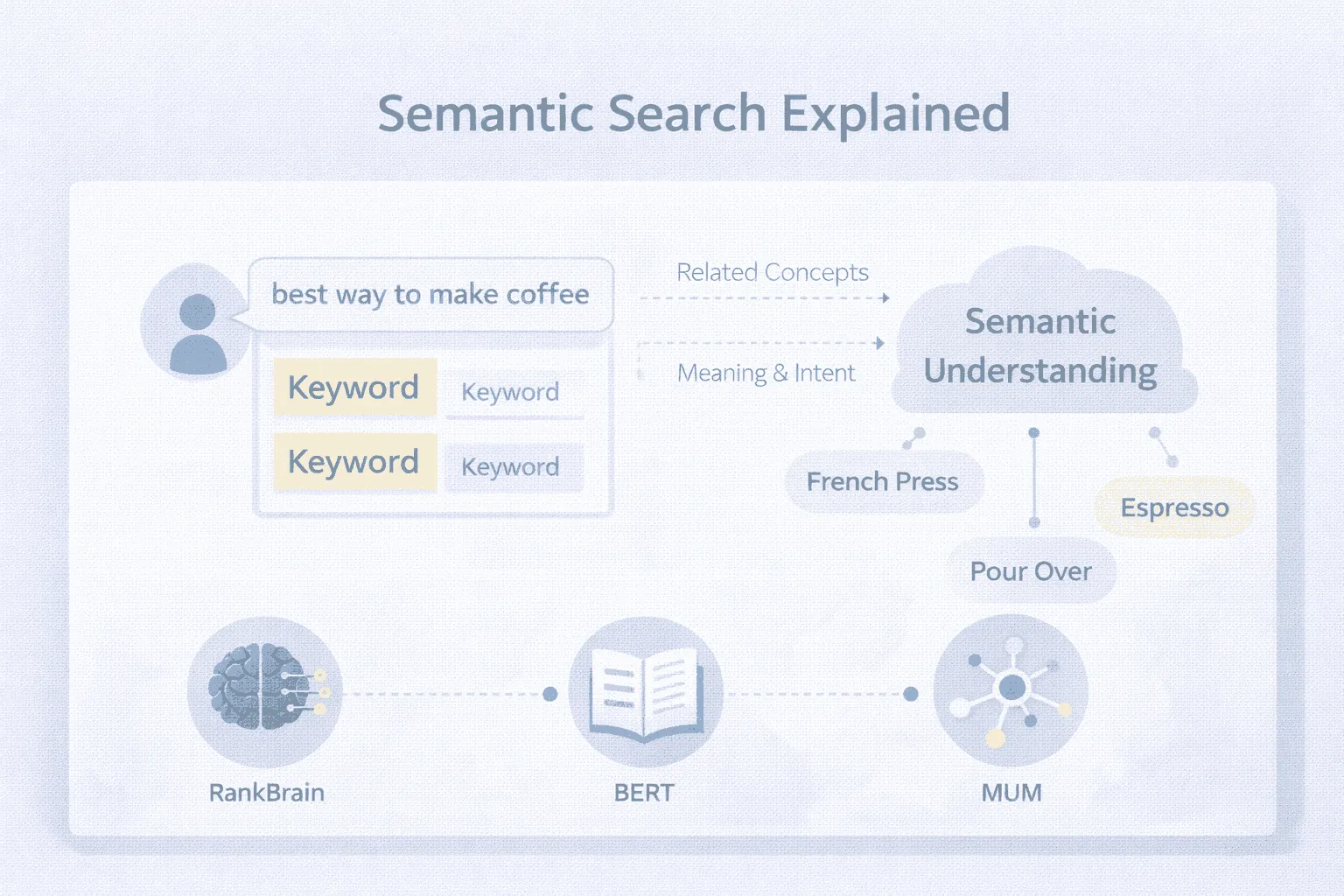
SEO has shifted from simple word matching to understanding meaning and intent. In the early days of the internet, search engines like AltaVista and early Google relied heavily on keyword repetition to judge relevance. The more a phrase appeared on a page, the higher it could rank, even if the content offered little real value.
This approach shaped early SEO strategies and led to heavy keyword repetition and link building, often without regard for content quality.
| Era | How Search Engines Worked | Common SEO Approach | Result |
| 1998 to 2010 | Keyword matching and PageRank | Keyword density and link volume | Keyword stuffing and spam |
| 2011 to 2014 | Quality filters and link checks | Better content and natural links | Penalties for low quality pages |
| 2015 to 2021 | Machine learning and semantic models | Topic authority and intent focus | Better understanding of context |
| 2022 to present | AI and entity based systems | E E A T and helpful content | Focus on expertise and user value |
The turning point came in 2011 with the Panda update, which targeted thin and over optimized content. Soon after, the Hummingbird update changed how Google handled queries by focusing on the relationship between words instead of treating them separately.
Machine learning pushed this shift even further. RankBrain, launched in 2015, helped Google understand unfamiliar queries by linking them to related concepts. In 2019, BERT improved Google’s ability to understand natural language, including how word order and small connectors affect meaning. More recently, MUM expanded this capability by analyzing text, images, videos, and multiple languages at once.
Together, these changes reduced the value of exact keyword repetition and placed greater weight on topical depth, context, and relevance. Search engines now reward content that explains a topic clearly rather than content that repeats the same phrase many times.
Types of Keywords Used in Modern Content
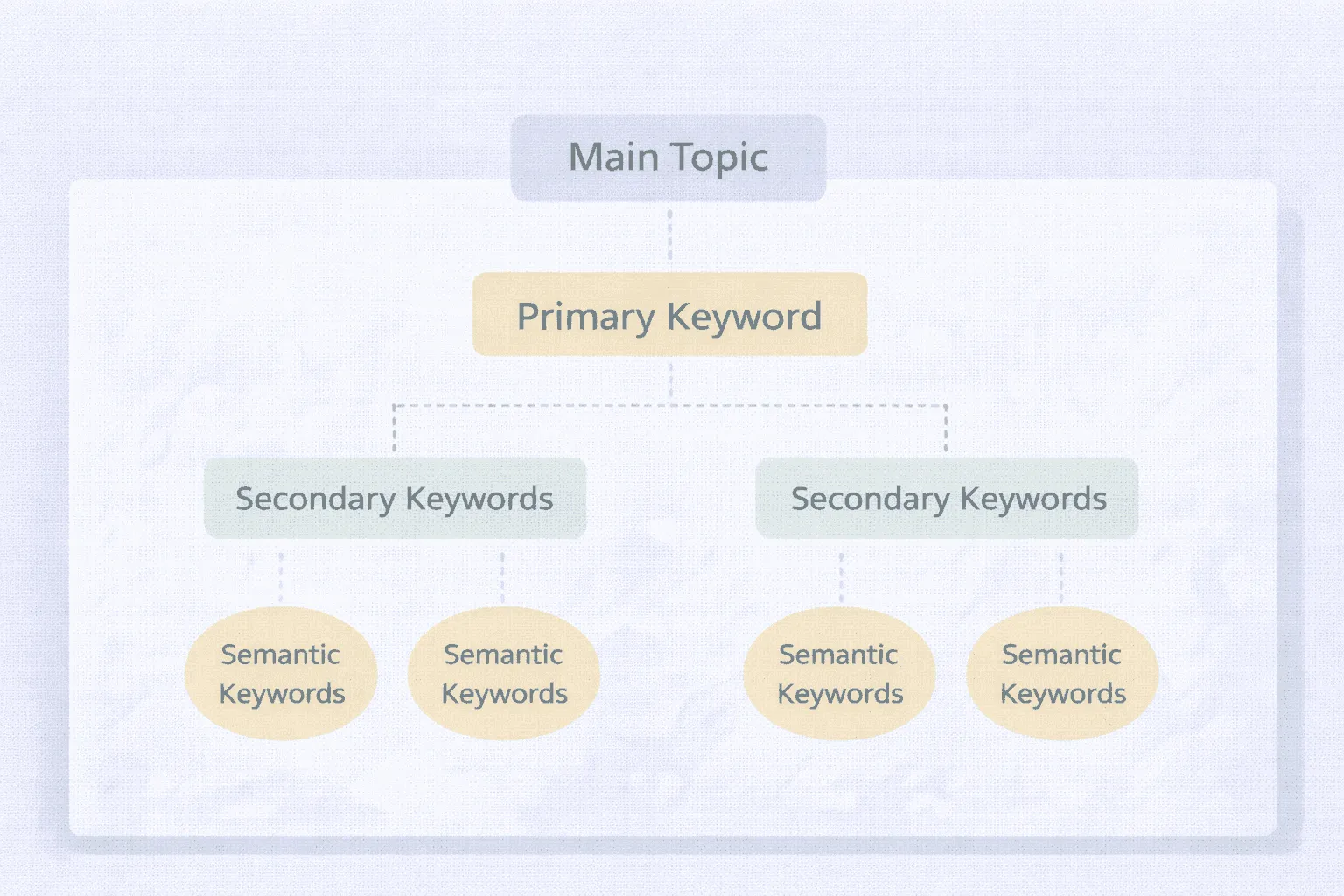
To understand why “more keywords” is a vague goal, it helps to clarify what “more” actually means in modern SEO. Today, keyword use follows a structured approach. Instead of focusing on a single phrase, content is built around a group of related terms that support one main topic.
Primary and Secondary Keywords
The primary keyword is the main topic of the page. It should closely match the main search query the content is meant to answer. Secondary keywords support that main term by adding context and detail.
For example, if the primary keyword is “weight loss tips,” secondary keywords may include phrases like healthy eating habits, metabolism, cardio exercises, and caloric deficit. These help explain the topic more clearly without shifting focus.
Semantic Keywords and Related Terms
The term “LSI keywords” is commonly used in SEO, but Google has stated that it does not rely on a specific LSI system. That said, semantic relevance still matters. These are words and phrases that naturally appear when a topic is explained properly.
For instance, an article about credit cards would naturally include terms like interest rate, annual fee, credit score, and rewards program. These are not substitutes for the main keyword, but they help define the topic and improve clarity for both users and search engines.
Keyword Variations and Long-Tail Queries
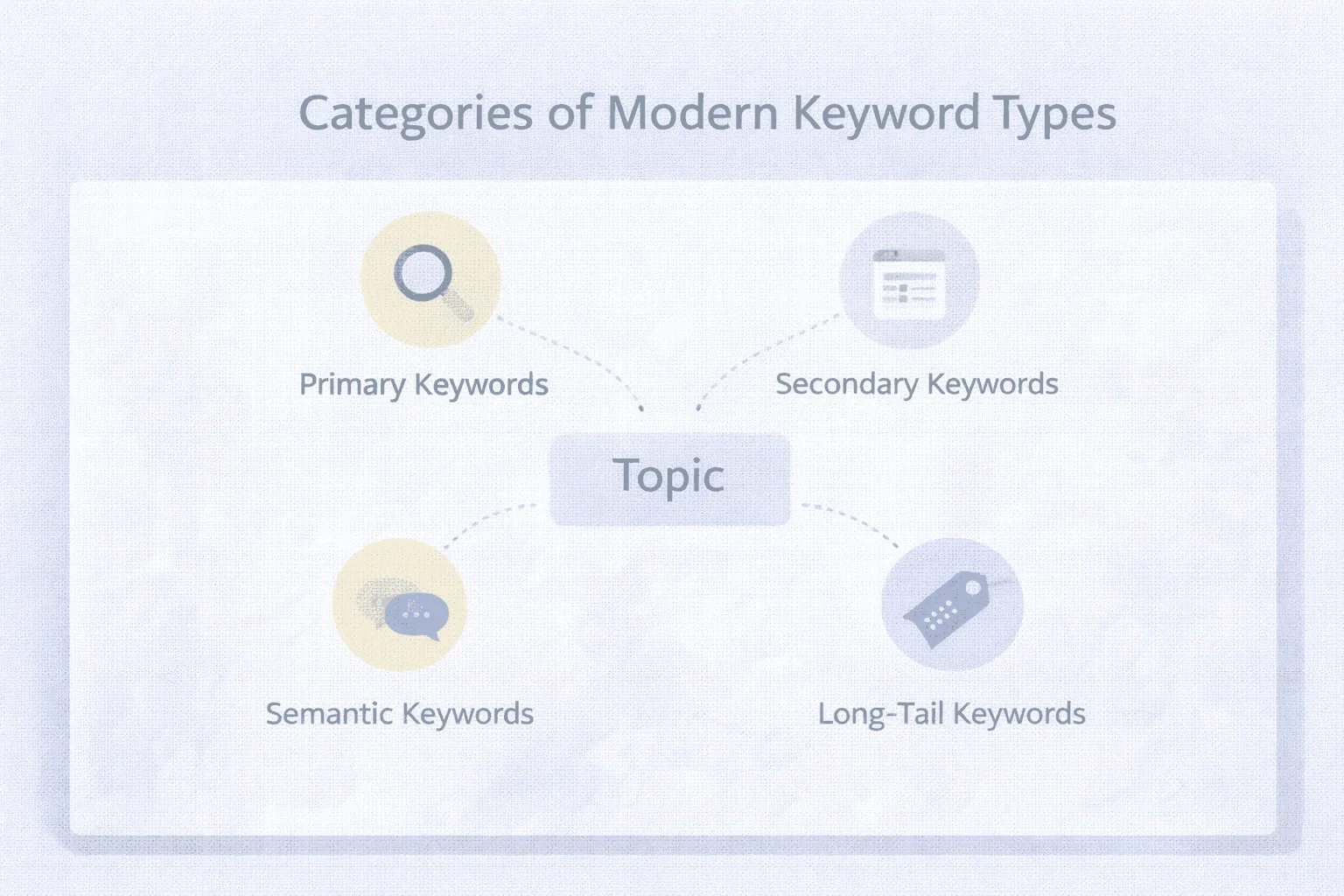
Keyword variations include plurals, different tenses, and close synonyms. They keep the content natural and prevent repetitive phrasing. Long-tail keywords are longer, more specific queries. While they attract less traffic, they often convert better because the search intent is clearer.
Studies show that long-tail searches make up a large share of overall search traffic. This highlights the value of targeting specific user needs instead of focusing only on high-volume terms.
| Keyword Type | What It Means | How It Is Used |
| Primary | Main topic of the page | Title, H1, meta elements |
| Secondary | Supporting subtopics | H2s, H3s, body content |
| Semantic | Contextual related terms | Natural use throughout content |
| Long-tail | Specific multi-word queries | FAQs and targeted sections |
How Search Engines Understand Context and Meaning
Search engines no longer rely on matching exact phrases. They now use natural language processing to understand context. This allows algorithms to identify entities such as people, places, concepts, and things, and then analyze how those entities relate to each other within a sentence.
Semantic Search and User Meaning
Semantic search helps search engines understand what a user actually wants, not just the words they type. For example, when someone searches for “best way to make coffee,” Google understands the intent behind the query. It knows the user is likely looking for brewing methods such as French press, pour over, or espresso, even if those terms are not mentioned.
In the same way, a page that naturally includes words like beans, grinder, water temperature, and filter can be accurately understood as content about coffee brewing. There is no need to repeat the main keyword over and over for the topic to be clear.
How Entity Recognition Works
Entities form the foundation of Google’s Knowledge Graph. An entity is a clearly defined concept that can be connected to other related concepts. For instance, SEO is an entity that links to ideas such as backlinks, content quality, and technical audits.
When a page covers several related entities in a meaningful way, it signals depth and completeness. This semantic depth helps search engines view the content as a strong resource. It carries far more weight than repeating a single keyword multiple times.
Using Multiple Keywords the Smart Way
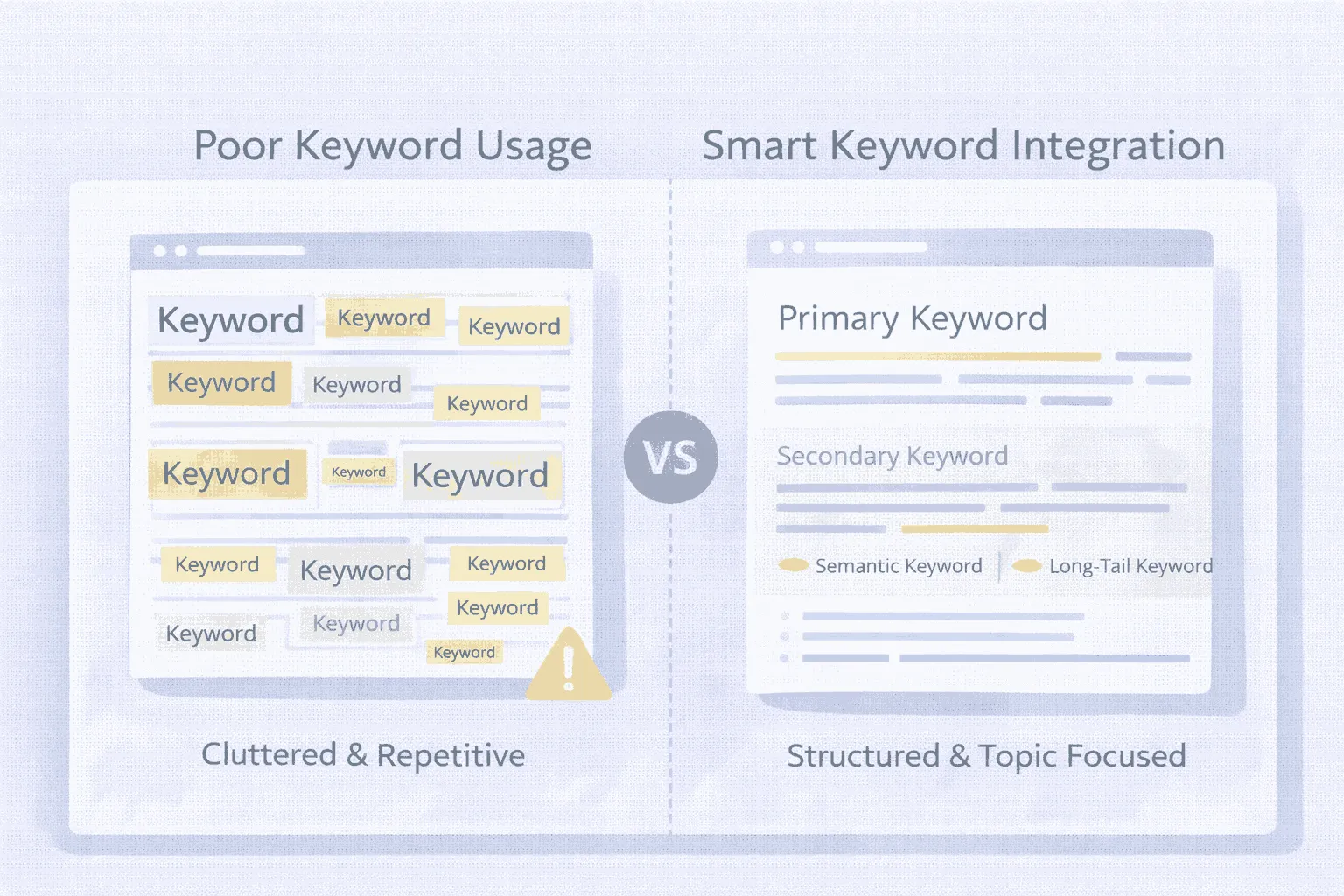
Using too many keywords in the wrong way can hurt SEO. Using multiple keywords correctly can strengthen it. The difference comes down to purpose. Extra keywords work when they help cover a topic more fully and meet different levels of user intent.
Long Form Content and Topical Coverage
Longer content often performs better in search results, but length alone is not the reason. What matters is depth. Longer articles allow space to naturally include secondary and semantic keywords that explain a topic in detail.
High-ranking content in 2025 focuses on information value. Pages perform well when they offer clearer explanations, practical insights, or details that competing content does not cover. This depth signals relevance and usefulness to search engines.
The Topic Cluster Approach
The topic cluster model shifts SEO away from optimizing single pages for individual keywords. Instead, it organizes content around a central topic.
A pillar page covers a broad subject at a high level. Cluster pages support it by covering specific subtopics in detail.
Example structure
- Pillar page: A complete guide to digital marketing
- Cluster page: How to conduct a content audit
- Cluster page: Email automation workflows
- Cluster page: Segmenting customer lists for higher engagement
This structure allows many related keywords and entities to appear naturally across the site. It helps search engines understand that the website has strong knowledge across the entire topic.
Case Study: Dick’s Sporting Goods Pro Tips Hub
Dick’s Sporting Goods noticed that their audience searched for how-to content alongside product-related queries. In response, they built a Pro Tips Hub filled with instructional content for every sport they support.
By creating hundreds of related cluster pages, they built strong topical authority. This led to higher organic traffic and improved rankings for competitive keywords, as search engines recognized the depth and usefulness of the content.
When Focusing on Keyword Count Backfires
When SEO strategies focus on hitting a specific keyword number instead of helping the reader, performance usually drops. Search engines and users can both sense when content is written for algorithms rather than people.
Keyword Stuffing and Ranking Issues
Keyword stuffing happens when a term is repeated so often that the content feels unnatural. Modern algorithms are very good at spotting this behavior. When readers land on a page that feels forced or awkward, they leave quickly.
High bounce rates and short time spent on a page signal to Google that the content is not useful. Over time, this leads to ranking drops because the page fails to meet user expectations.
Keyword Cannibalization and Weakened Authority
Keyword cannibalization occurs when multiple pages on the same website target the same keyword and intent. This creates confusion for search engines because they cannot decide which page deserves to rank.
Instead of one strong page performing well, authority gets split across several similar pages. The result is unstable rankings or poor visibility for all of them.
| Issue | What Causes It | SEO Impact |
| Keyword stuffing | Forcing keywords for density | Ranking loss and poor engagement |
| Cannibalization | Multiple pages for one intent | Weakened authority and unstable rankings |
| Intent mismatch | Ignoring search results | Low engagement and zero conversions |
| Thin content | Pages created only for keywords | Low quality signals and removal from index |
How Over Optimization Hurts User Trust
Content written mainly for search engines often fails to connect with real readers. When users look for help and find repetitive, keyword-heavy messaging, trust drops quickly.
This leads to higher bounce rates and fewer conversions. Search engines track these engagement signals closely, including whether users return to search results after clicking a page.
One Page, One Intent
Strong SEO focuses on search intent rather than keyword volume. Search intent explains why someone searches for a term in the first place.
Types of Search Intent
| Intent Type | User Goal | Content Format |
| Informational | Learn or get answers | Guides, tutorials |
| Navigational | Visit a specific site | Brand or login pages |
| Commercial | Compare options | Reviews and comparisons |
| Transactional | Make a purchase | Product and checkout pages |
Search results change based on intent. A query like “how to boil an egg” shows guides and videos. A query like “buy running shoes” shows product pages and ads.
Why Intent Mismatch Hurts Rankings
Intent mismatch happens when a page targets a keyword but delivers the wrong type of content. For example, a user searching for a how-to guide who lands on a sales page will leave almost immediately.
Even if the keyword appears many times, the page will struggle to rank. Search engines favor pages that match the expected format and solve the user’s problem clearly.
How to Place Keywords Without Hurting Readability
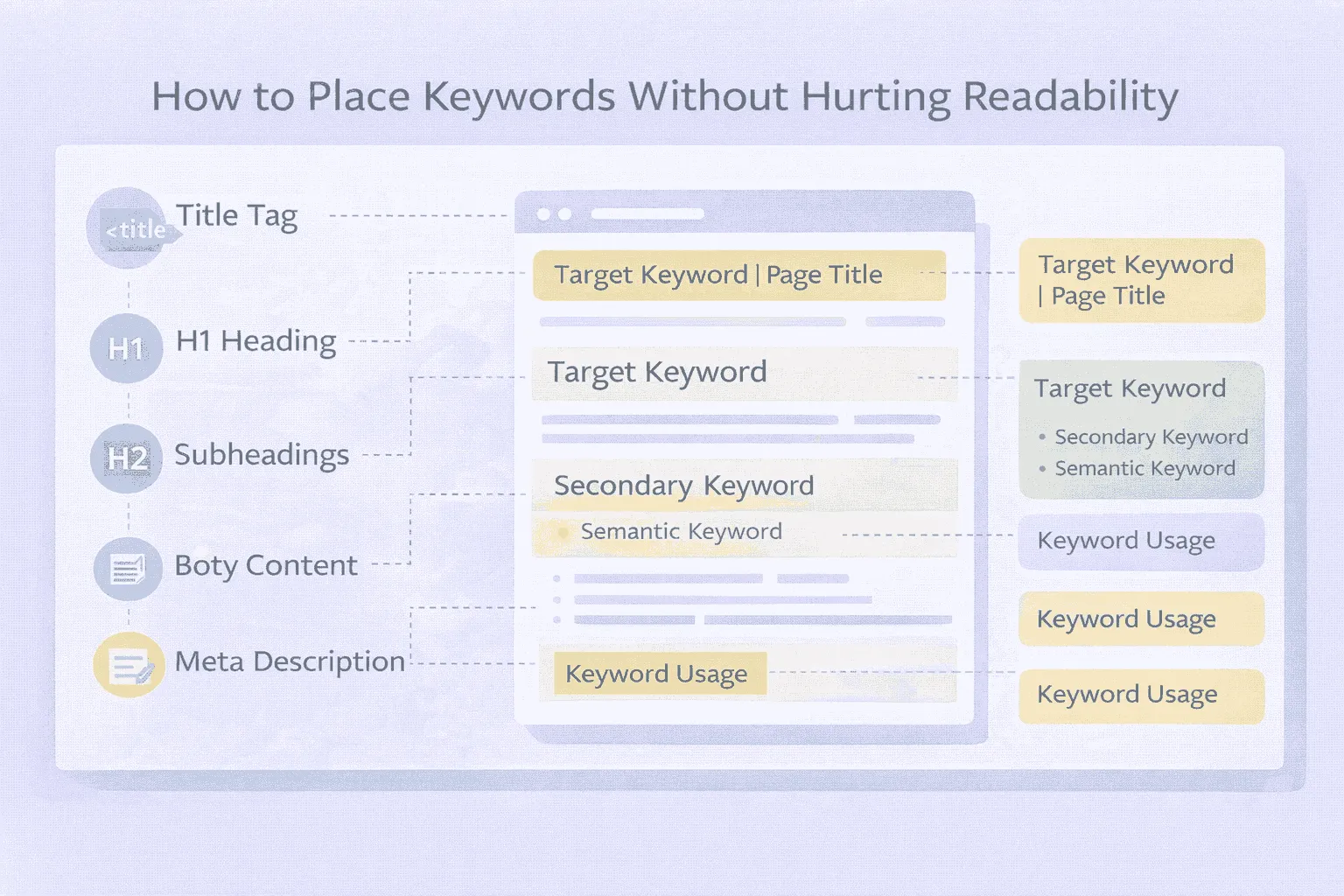
Effective keyword placement helps search engines understand your page while keeping the content smooth for readers. The goal is relevance without disrupting flow.
On Page Elements That Carry the Most Weight
Title tag
The title tag is the strongest on page signal. Place the primary keyword near the start. Keep it between 50 and 60 characters so it displays properly in search results.
H1 heading
Each page should have one H1 that acts as the main title. It should clearly reflect the topic and include the primary keyword.
Subheadings (H2 and H3)
Subheadings help structure content and guide readers. This is where secondary keywords and long tail phrases can fit naturally without forcing repetition.
Opening paragraph
Include the primary keyword within the first 100 words to establish the topic early.
Meta description
Meta descriptions do not affect rankings directly, but they influence clicks. A clear description between 150 and 160 characters that includes the primary keyword can improve click through rate.
Image alt text
Alt text helps search engines understand images and improves accessibility. Use keywords only when they describe the image accurately.
Keyword Density: How Much Is Enough
There is no ideal keyword density. A common guideline is 1 to 2 percent for the primary keyword so it stays visible without sounding forced.
Recent studies show that pages ranking in the top results today use far fewer exact match keywords than older pages. This reflects how search engines now value meaning and topic coverage over repetition.
Keywords vs Topics vs Intent
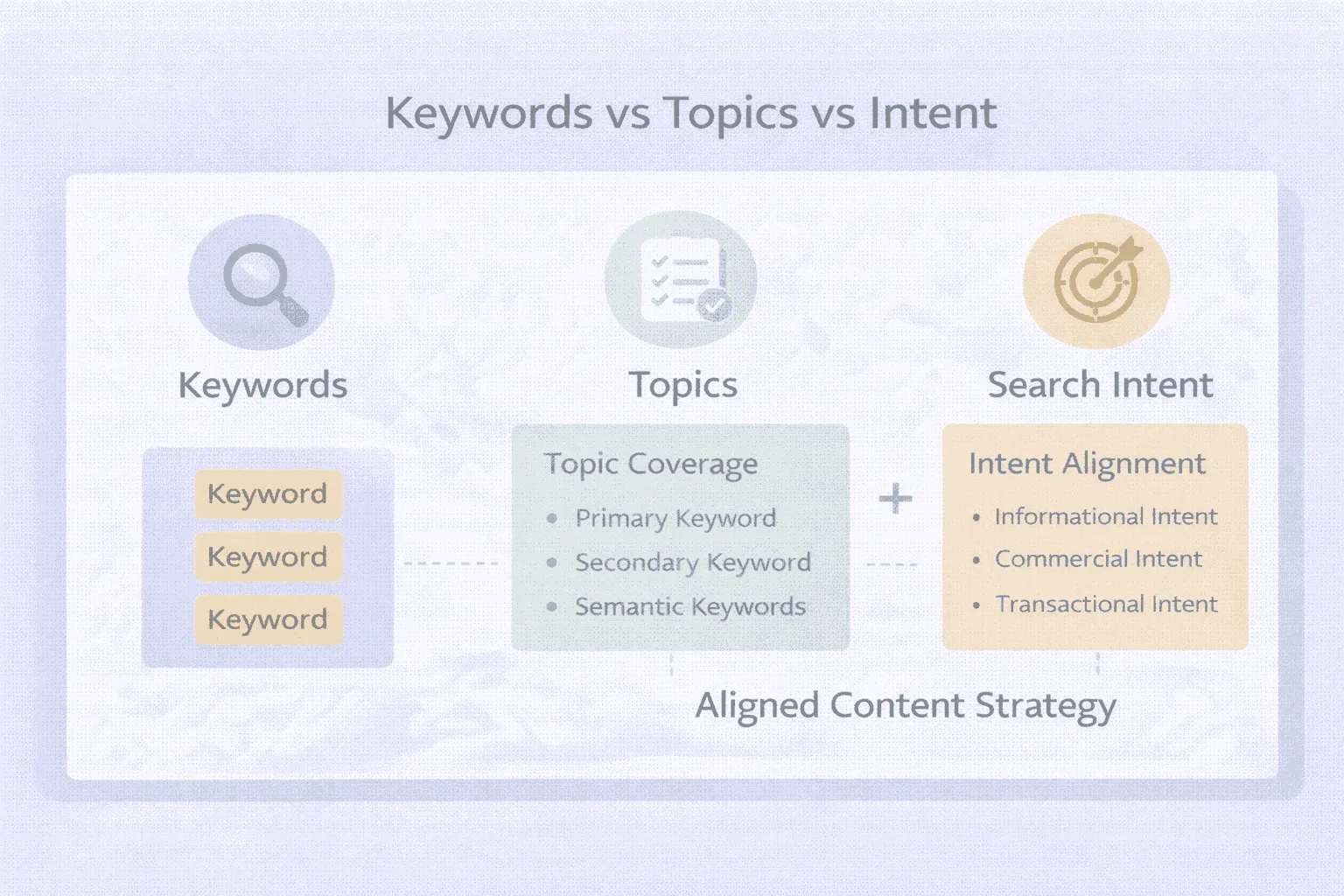
Modern SEO places far more weight on topical authority and intent alignment than on keyword count.
The Topic Based Approach
A topic based approach focuses on covering a subject thoroughly. This naturally brings in related terms and allows a single page to rank for many long tail queries.
When a page explains a topic in depth, it can rank for hundreds or even thousands of related searches without forcing keywords into the text.
Why Intent Matters More
When two pages compete for the same query, the page that better matches user intent usually wins. Search engines aim to satisfy users, not count keyword usage.
Pages with stronger engagement signals, such as longer time on page and higher click through rates, send a clear signal that the content is useful. This matters far more than repeating a keyword.
How to Find and Fix Common Keyword Issues
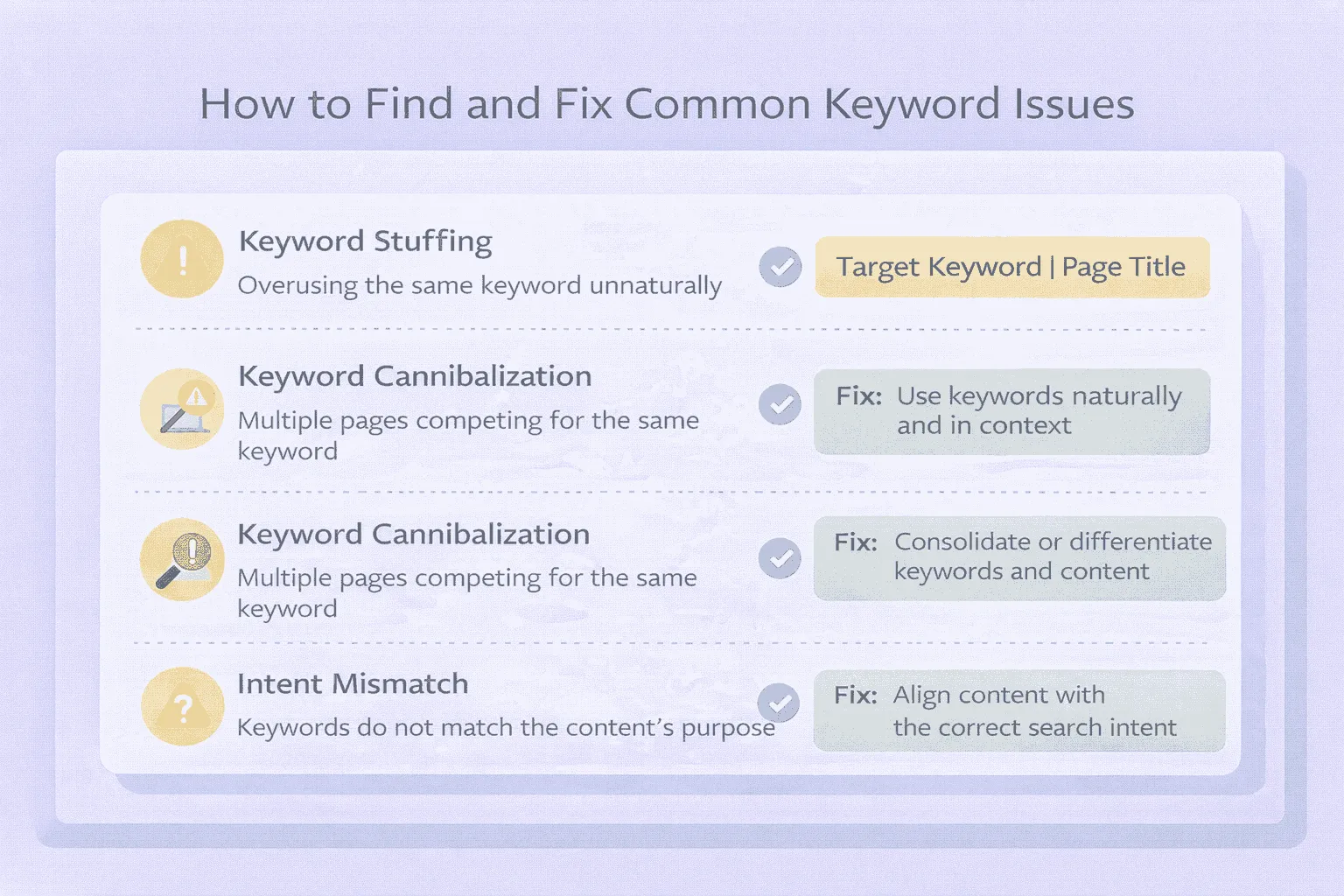
Regular checks help keep your SEO foundation strong.
Finding Keyword Cannibalization
Keyword cannibalization happens when multiple pages rank for the same query and serve the same intent. You can spot this in Google Search Console by filtering a query in the Performance report and reviewing which pages get impressions.
If several pages target the same intent, merging them or redirecting weaker pages helps concentrate authority.
Checking for Keyword Stuffing
A content audit should flag repeated phrases and awkward sentence structures. If the same keyword appears in every heading or nearly every sentence, it is likely overused.
SEO writing tools can help identify density issues that may look spammy to search engines.
Fixing Intent Mismatch
Before publishing content, review the search results for your target keyword. If the top results are videos or guides and your page is a sales pitch, the intent does not match.
Aligning content type with what users expect is critical for ranking and engagement.
The Future of Keywords in AI Driven Search
Keywords still matter, but their role is changing as AI becomes a bigger part of search results. Features like AI Overviews and generative search systems now focus more on understanding topics than matching phrases.
AI Overviews and Topic Understanding
Search engines now use AI to generate direct answers on the results page, especially for complex questions. These systems pull information from sources that show strong topic knowledge and clear structure.
For example, an AI overview for “how to choose a retirement account” is more likely to reference content that clearly explains 401(k)s, IRAs, tax rules, and contribution limits in context. Pages that show this level of understanding are far more useful than pages that repeat a keyword without depth.
Why Information Value Matters More
SEO success going forward depends on information value. Search engines want content that adds something new, whether that is original insight, deeper explanation, or real expertise.
Repeating the same points found on other ranking pages while targeting the same keywords is no longer enough. Systems are built to reward content that brings clarity, originality, and trust rather than recycled phrasing.
Conclusion
Keywords remain important, but their value lies in how naturally they support high-quality content rather than in sheer repetition. Modern SEO prioritizes relevance, context, and user intent, rewarding pages that fully address a topic and satisfy the reader’s needs.
A smart strategy focuses on a primary keyword supported by related terms, semantic phrases, and long-tail variations, placed thoughtfully in titles, headers, and meta elements. Aligning content with search intent and organizing it into topic clusters helps establish authority and allows a page to rank for many related queries.
Ultimately, writing for humans first, providing clarity, usefulness, and expertise, creates engagement signals that search engines favor. Keyword success today comes from relevance and integration, not quantity.