
Did you know that Joomla powers over 9% of all business websites, even though its overall market share is just 1.8%? This shows that professionals and developers trust it for serious, results-driven projects. Joomla is more than just a content management system it’s a platform built with advanced SEO capabilities at its core, giving you full control over metadata, URL structures, and performance metrics.
In this guide, you will learn why Joomla is an excellent choice for your website, how it supports high search rankings, and how to leverage its built-in features for maximum visibility without depending heavily on third-party plugins.
Why Joomla Is an SEO Friendly Platform for Your Website
Joomla is a powerful platform designed to help your website perform well in search engines. Its built-in SEO tools make it easy for you to manage SEF URLs, metadata, and caching, giving your site a competitive edge. If your website handles complex content, multiple languages, or high traffic, Joomla’s solid structure and modern codebase give you a reliable foundation for long-term growth and better search visibility.
Joomla SEO Performance Overview
Here’s a quick look at how Joomla stacks up across key SEO and technical metrics:
| Metric | Analysis |
| SEO Rating | High (Native features outperform many competitors) |
| Key Strength | Hierarchical structure and built-in multilingual support |
| Technical Base | PHP 8.1+, MVC architecture, clean database tables |
| Speed / Core Web Vitals | Native WebP/AVIF support, Gzip compression, and three-layer caching |
| Primary Audience | Businesses, developers, and content-heavy websites |

What Joomla Is and How It Works for Your Website
Joomla is a versatile, open-source content management system that sits between simple blogging tools and complex enterprise platforms. It started as a fork of Mambo and has grown into a system known for its stability, flexibility, and SEO-friendly structure. At the heart of Joomla is its Model-View-Controller (MVC) architecture. This design separates your website’s data (Model), display (View), and logic (Controller), allowing you to change how content looks through “template overrides” without touching Joomla’s core code.
The Three Layers of Joomla
- Core Software: Manages users, organizes content, and handles basic SEO settings.
- Database: Usually MySQL or PostgreSQL, where each content type has its own table to speed up queries.
- Extensions Layer: Adds extra functionality through Components, Modules, and Plugins.
How Joomla Organizes Content for SEO
One of Joomla’s strongest features is its hierarchical content structure. You can create unlimited nested categories, making your site easy to navigate for both users and bots. Joomla also includes a robust Access Control List (ACL), allowing content writers to manage articles and metadata without accessing sensitive technical settings, ensuring SEO consistency.
Is Joomla Good for SEO? A Practical Overview
Joomla is widely recognized as a strong platform for SEO, offering built-in tools and flexibility that often outperform standard website builders. While platforms like WordPress are praised for simplicity, Joomla gives you deeper control over technical and on-page SEO, allowing your website to meet modern search engine requirements without relying on extra plugins.
How Joomla Supports Modern SEO Standards
Joomla’s design aligns with today’s ranking factors, including Core Web Vitals and E-E-A-T. Its latest versions require PHP 8.1+, ensuring fast server-side performance. Native support for advanced image formats like WebP and AVIF, combined with multi-layer caching, helps your pages load quickly, a critical factor for SEO.
Built In SEO Features You Can Use Immediately
One of Joomla’s biggest advantages is its comprehensive set of SEO tools built into the platform. From the Global Configuration menu, you can manage how search engines interact with every page of your site without needing to touch any code.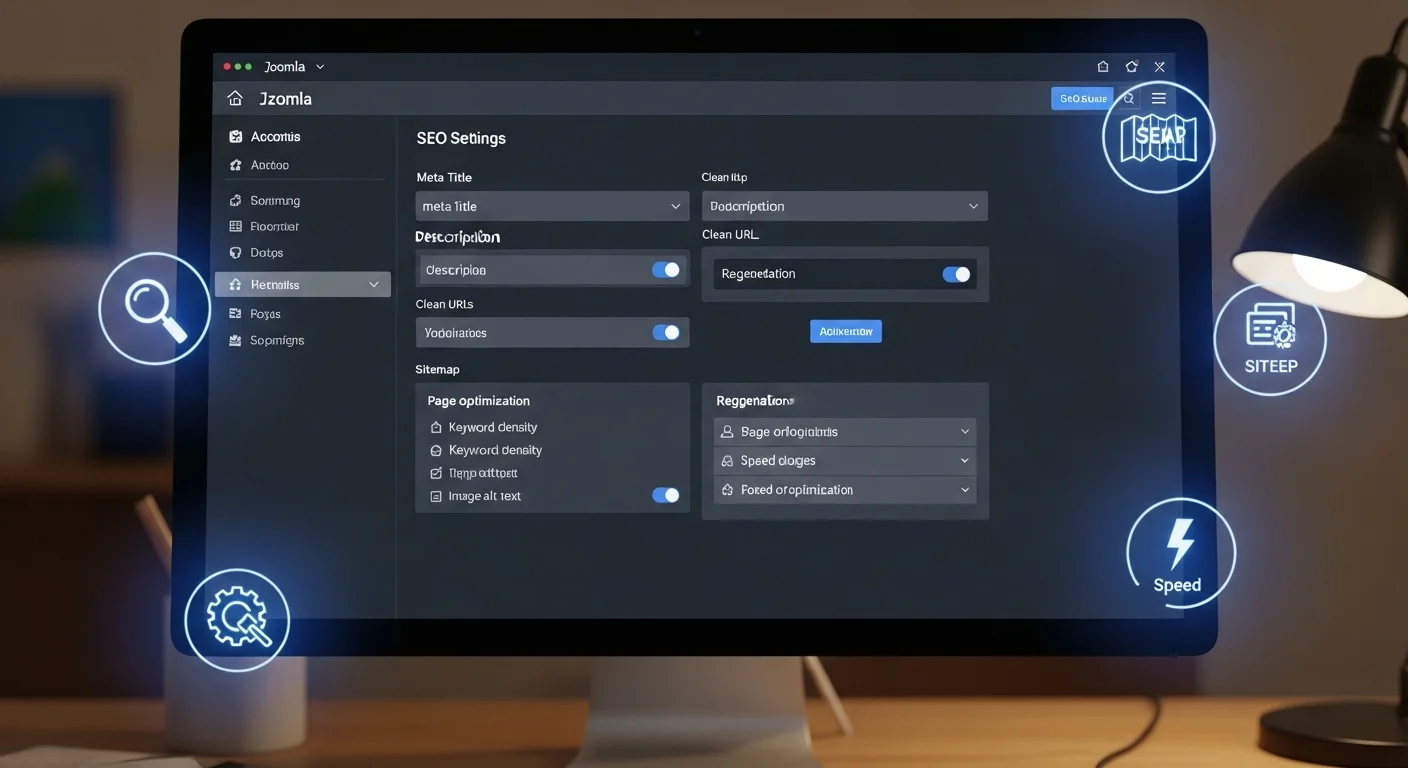
Core Global SEO Settings
| Setting | Function | SEO Benefit |
| Search Engine Friendly URLs | Converts dynamic links into readable paths | Makes URLs easier to crawl and improves keyword relevance |
| URL Rewriting | Removes “index.php” from URLs | Strengthens link authority and visual clarity |
| Unicode Aliases | Allows non-Latin characters in URLs | Essential for international and localized SEO |
| Gzip Page Compression | Compresses files from server to browser | Reduces page load time, boosting Core Web Vitals |
Metadata and Indexing Control for Each Page
Joomla gives you fine-grained control at the page or article level. You can set meta titles and descriptions while defining robots tags like Index, Noindex, Follow, and Nofollow on each page. This prevents search engines from crawling low-value pages like login screens, letting bots focus on your most important content.
How Joomla URL Structure and Routing Boost SEO
A clear, organized URL structure tells search engines what your page is about and where it sits in your hierarchy. Joomla includes a powerful routing engine that converts long, parameter-heavy URLs into clean paths.
Using Aliases to Create SEO Friendly URLs
In Joomla, every article and menu item has an alias. Combined with your menu structure, this produces logical URLs like domain.com/blog/seo/advanced-seo-strategy. This format helps with crawlability and keyword relevance.
Removing index.php from URLs
To make your links cleaner: Enable URL Rewriting in Global Configuration, rename htaccess.txt to .htaccess in your root directory, and ensure your server supports mod_rewrite. This creates professional, authoritative URLs.
Joomla 5 Improvements for Routing and Redirects
Joomla 5 has enhanced URL handling with features like automatic trailing slash management and strict handling of index.php for legacy URLs. These updates prevent duplicate content issues and consolidate link equity.
Joomla Meta Tags Canonical URLs and Indexing Control
Ensuring search engines index the right pages is essential. Joomla provides tools that let you guide indexing and optimize visibility.
How Canonical Tags Protect Your SEO
Joomla allows you to set canonical tags to tell search engines which version of a page is the primary one. This reduces the risk of duplicate content penalties and keeps your ranking signals consistent.
Using Robots.txt and Sitemaps for Indexing
- Robots.txt: Protect sensitive areas or exclude low-value pages to optimize crawl budget.
- XML Sitemaps: While not native, Joomla works seamlessly with extensions like OSMap to ensure new content is indexed quickly.
Joomla Extensions That Boost SEO
The Joomla Extension Directory (JED) offers over 8,000 add-ons to enhance your content marketing efforts, including tools for automated metadata and structured data.
Top SEO Extensions
| Extension | Primary Focus | Best For |
| 4SEO | All-in-one technical suite | Automating structured data and metadata |
| EFSEO | Metadata editing | Quick on-page adjustments from the frontend |
| Google Structured Data | Rich snippets | Boosting CTR with star ratings and FAQ blocks |
How Joomla Handles Technical SEO for Your Website
Joomla is built to prioritize speed and modern web standards, directly supporting Google’s latest performance requirements.
Core Web Vitals and Page Speed in Joomla
Joomla improves metrics like LCP and CLS through features like PHP 8.1 support, native WebP/AVIF image formats, lazy loading, and the WebAsset API for efficient CSS/JS loading.
Advanced Caching for Faster Pages
| Caching Level | How It Works | Best For |
| Conservative Caching | Stores a basic page view | Sites that update occasionally |
| System – Page Cache | Stores static rendered pages | High-traffic sites needing fast loads |
Mobile Optimization and SEO
With mobile-first indexing, Joomla integrates responsive features via Bootstrap 5. To capture more mobile search traffic, use lightweight templates and ensure buttons are easily clickable.
Joomla vs WordPress for SEO
| Metric | WordPress | Joomla |
| SEO Flexibility | High (via plugins) | Superior (via core/MVC architecture) |
| Multilingual | Paid plugins required | Built-in support |
| Security | Higher plugin risk | Strong native security |
Common Joomla SEO Mistakes
- Improper SEF Configuration: Forgetting to rename htaccess.txt causes duplicate content issues.
- Duplicate Metadata: Repeating global descriptions instead of unique snippets for each page.
- Neglecting Internal Linking: Ignoring breadcrumbs and tags makes site hierarchy harder for bots.
Joomla for Large Scale SEO Projects
Joomla excels at high-traffic, content-heavy sites. Major enterprises like IKEA and General Electric use Joomla to organize massive content volumes in a searchable, structured format while maintaining SEO integrity.
When to Choose Joomla for SEO
Choose Joomla for projects requiring complex data structures, multilingual scale without plugins, and technical precision through template overrides. It is a strong investment for a holistic digital marketing approach.
Final Verdict
Joomla is a robust, enterprise-grade CMS offering everything needed for modern SEO. While it requires a learning curve, its native tools and security make it ideal for professional marketers. For more on scaling your presence, see our latest case studies.
Frequently Asked Questions
Is Joomla good for beginners who want to learn SEO
Yes. Its native features teach fundamental SEO mechanics like URLs and metadata. Beginners will gain strong technical SEO knowledge.
How does Joomla 5 improve SEO over older versions
Joomla 5 adds native WebP support, automated Schema.org markup, and improved URL routing, enhancing performance and rich snippet capabilities.
Can I add structured data Schema to Joomla
Yes, via template overrides or extensions like Google Structured Data or 4SEO, which enable rich results like FAQs and star ratings.
Is Joomla more secure than WordPress
Generally, yes. Its fewer third-party dependencies and granular user permissions reduce attack risks.
Will switching to Joomla improve search rankings
While a CMS alone doesn’t guarantee rankings, Joomla’s clean technical foundation and speed make improvement likely when configured correctly.