Ever feel like searching online is becoming smarter, and a bit more demanding? That’s because traditional search engines that just list links are giving way to conversational “answer engines” that deliver clear, concise responses. Perplexity AI perfectly captures this shift, with its traffic skyrocketing 191.9% between 2024 and 2025, reaching 153 million monthly visits by May 2025.
For marketers and SEO pros, the rules are changing. It’s no longer enough to chase clicks. Today, visibility depends on being cited as a trusted source. Users expect answers that are direct, verifiable, and backed by real-time data. In this post-keyword digital economy, showing up as a reliable source within generative responses is what sets brands apart.
How Perplexity AI Works: A Take on AI Answers
Perplexity AI is changing how we think about generative AI. Unlike traditional large language models that rely on fixed datasets that can become outdated, Perplexity operates in real time. It merges the reasoning power of advanced models like GPT-4o, Claude 3.5 Sonnet, and its own Sonar models with a live web-crawling system to deliver the most current information.
At the core of Perplexity AI is a framework called Retrieval-Augmented Generation (RAG). This ensures that before giving an answer, the system performs a live search across the web, pulling in the latest and most relevant content.
From Query to Answer: How the Process Works
When you ask Perplexity AI a question, it doesn’t just look for matching keywords like a standard search engine. Instead, it uses natural language processing to understand your intent. Then, its retrieval pipeline kicks in.
This is where things get smart. The system combines traditional lexical search with semantic indexing and vector embeddings, allowing it to find passages that truly answer your question, not just pages that contain the right words. Once these snippets are retrieved, a large language model synthesizes them into a clear, conversational answer.
Breaking Down the Operational Layers
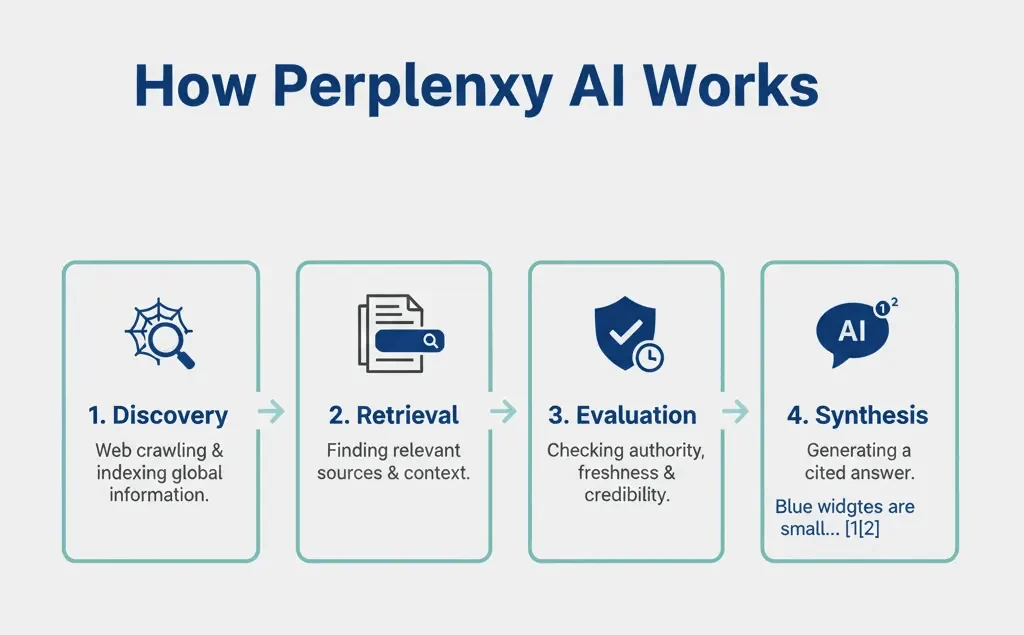
Here’s how Perplexity AI’s architecture works step by step:
| Component | Purpose |
| Discovery (PerplexityBot) | Continuously crawls the web and analyzes content for updates. |
| Retrieval (RAG Pipeline) | Finds answer-worthy passages using a mix of keyword and semantic search. |
| Evaluation (Ranking Model) | Checks source reliability, domain authority, and content freshness. |
| Synthesis (LLM Processing) | Generates conversational answers using GPT-4, Claude, or Sonar models. |
| Verification (Citation Engine) | Provides inline citations to ensure transparency and accuracy. |
Why Freshness Matters
One of the biggest advantages of Perplexity AI is that it doesn’t rely on a static index. The system values up-to-date content, evaluating sources in real time to ensure answers reflect the latest developments. This approach also changes how websites should think about SEO. Rather than hiding information in long-form text, content should be structured for high answer density, making it easy for AI to extract precise answers.
Perplexity AI isn’t just another search tool, it’s a dynamic, real-time assistant that brings together the best of AI reasoning and live web knowledge to deliver accurate, up-to-date answers.
Building Trust: How Perplexity AI Sources and Cites Information
At the core of any answer engine is credibility, and Perplexity AI takes this seriously. Every factual statement it provides is backed by a numbered footnote linking directly to the original source.
This “source-first” approach helps prevent AI “hallucinations,” where models might generate plausible-sounding but incorrect information. By relying on retrieved search results, Perplexity keeps its answers grounded in verifiable reality.
How Sources Are Chosen
Perplexity prioritizes authority over popularity. While traditional search engines often rank pages based on backlinks, Perplexity focuses on cross-source agreement and domain credibility. Studies show that roughly 60% of Perplexity’s sources overlap with Google’s top 10 results, highlighting the ongoing importance of SEO for AI visibility.
The engine also maintains a curated list of trusted domains, including Wikipedia, academic journals, and major news outlets like CNBC and MarketWatch for financial topics. This ensures answers are reliable, accurate, and aligned with recognized expertise.
Trust Indicators and SEO Impact
| Trust Factor | SEO Requirement | Why It Matters |
| Citation Persistence | Frequent mentions across credible sources | Increases chances of being the “consensus” answer |
| Domain Authority | High-quality backlinks, expert credentials (E-E-A-T) | Establishes the site as a trusted source in its niche |
| Factual Accuracy | Verified data, stats, and references | Boosts “citation-worthiness” in AI-generated summaries |
| Technical Hygiene | Structured data, crawlable URLs | Helps PerplexityBot extract information efficiently |
Why Citations Matter for Content Creators
Unlike some AI tools that deliver answers without links, Perplexity highlights citations prominently. This drives high-intent traffic, users who want to verify facts or dive deeper into a topic.
On average, visitors spend 23 minutes per session on Perplexity, far more than traditional search results. Being cited is not only a branding win but also a way to attract engaged, professional audiences who are actively researching and making decisions.
The Psychological Shift: How AI Is Changing the Way We Search
Perplexity AI is transforming how people approach search. Users are moving away from the old “keyword-matching” method, where they typed short phrases, and adopting a conversational mindset. Instead of searching for “best project management software,” someone might ask:
“I have a team of 15 remote developers and need a tool that integrates with GitHub and has a built-in time tracker; what are my best options?”
This approach requires AI to maintain contextual memory, so follow-up questions like, “Which of those has the lowest monthly cost?” can be answered without repeating the original details.
Who Is Using Conversational Search?
This shift is most noticeable among high-value users. Around 80% of Perplexity’s audience are college graduates, and 65% are high-earning professionals in office-based roles. These users treat the platform as a decision-support tool, looking for definitive answers rather than a list of links to browse.
| Behavioral Metric | Traditional Search | Perplexity AI |
| Query Length | Short, keyword-focused (1-3 words) | Long, conversational questions |
| Interaction Type | Linear (Search → Click → Exit) | Iterative (Question → Answer → Follow-up) |
| User Intent | Information discovery | Synthesis and decision support |
| Session Duration | Brief (minutes) | Extended (23+ minutes) |
The Query Fan-Out Effect
AI answers often anticipate the user’s next question. Perplexity provides a “Related” section, encouraging users to explore additional topics without leaving the platform.
From an SEO perspective, this changes the game. Success is no longer about ranking for a single keyword. Brands now need to establish authority across entire topical clusters, being cited not only for primary questions but for follow-up queries that arise naturally during a user’s research journey.
Perplexity AI vs Google Search: Understanding the Core Differences
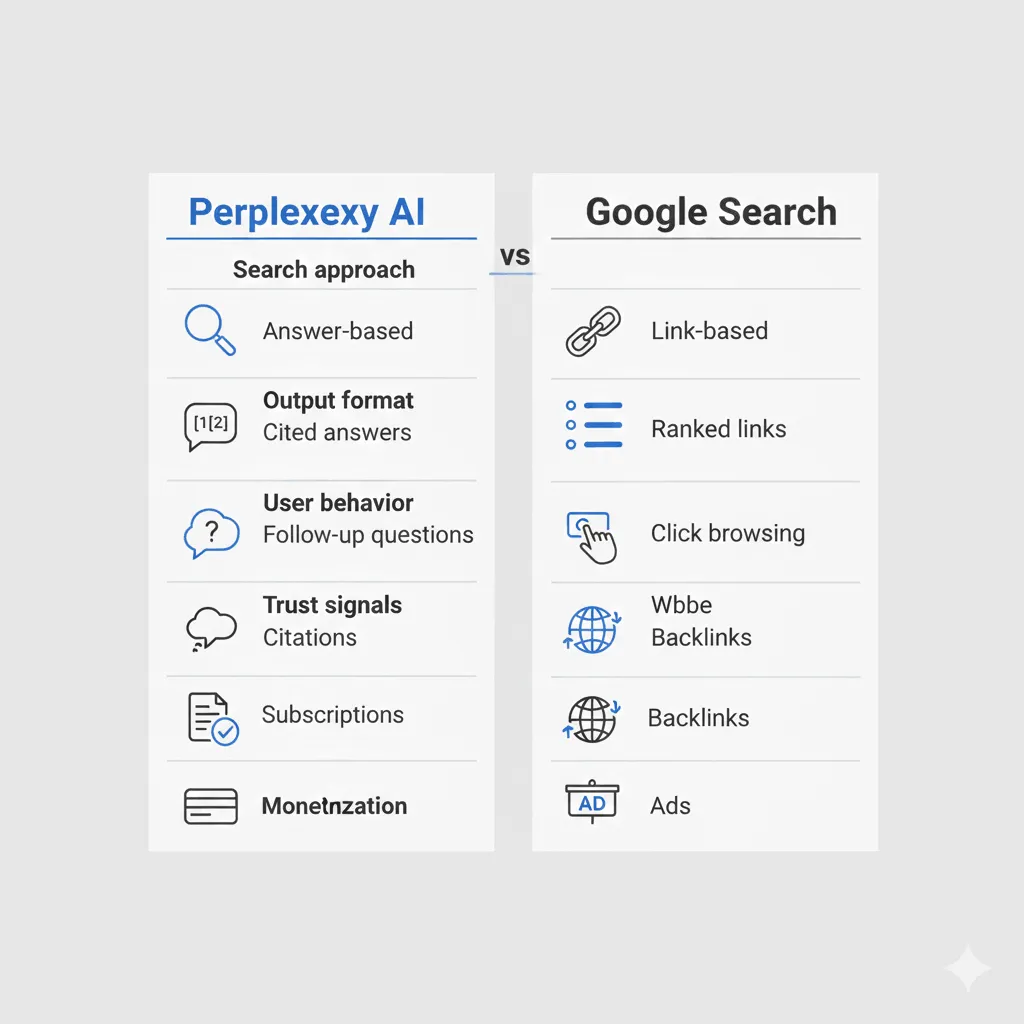
When you compare Perplexity AI with Google Search, the difference goes beyond technology, it’s a difference in philosophy. Google acts as a web directory, organizing billions of pages using algorithms like PageRank. Its goal is to provide a ranked list of links that might contain the answer.
Perplexity AI, on the other hand, is an answer engine. Instead of giving raw materials, it synthesizes information into a clear, final answer. Consider Google as delivering lumber, while Perplexity delivers a fully built house.
User Experience and Monetization
Google’s reliance on advertising shapes its interface. Many search results pages feature multiple sponsored ads before any organic links, which can make the experience feel cluttered.
Perplexity has traditionally offered an ad-free, minimalist experience, prioritizing speed, clarity, and concise answers. Its clean interface has made it popular on platforms like TikTok, where users demonstrate how quickly it outperforms Google for certain queries.
Feature Comparison: At a Glance
| Feature | Google Search | Perplexity AI |
| Core Philosophy | List-first indexing | Answer-first synthesis |
| Main Output | Ranked list of links | Concise narrative with citations |
| Primary Revenue | Pay-Per-Click Ads | Pro subscriptions & merchant fees |
| Trust Mechanism | Backlinks & E-E-A-T | Cross-source agreement & citations |
| Technical Priority | Core Web Vitals (Speed/UX) | Extraction-ready formatting |
Redefining SEO and Visibility
Despite its advantages, Google still drives far more traffic than AI platforms. However, AI search introduces zero-click behavior, where users get their answers directly without clicking through. Studies suggest organic clicks can drop 30–35% when an AI summary is shown.
For SEOs, this shifts the goal from simply earning clicks to gaining citation share within AI responses. Being cited by Perplexity is a strong signal of authority and credibility, even if the user doesn’t visit your site directly.
The Role of Perplexity in the Evolving Search Ecosystem
The search landscape is shifting toward Generative Engine Optimization (GEO). Unlike traditional search engines, AI models don’t just retrieve information, they learn, remix, and synthesize content into new outputs.
Perplexity AI is at the center of this evolution, acting as a bridge between the traditional web and the generative future. By treating the web as a dynamic knowledge base, it queries information in real time, unlike older chatbots that rely on static training data.
Content for Humans and Machines
In this new ecosystem, content has a dual purpose:
- Human-readable: Clear, engaging content that drives traditional conversions.
- Machine-readable: Structured information that AI models can parse, synthesize, and cite accurately.
Perplexity also democratizes authority. While legacy search engines often favor large domains with decades of backlinks, Perplexity rewards niche expertise and factual density. Smaller, specialized sites can now be cited as authoritative sources for precise, nuanced queries.
How Perplexity Shapes the Ecosystem
| Ecosystem Segment | Primary Function | Perplexity’s Role |
| Training Layer | LLM Foundation | Uses models as reasoning engines |
| Retrieval Layer | Live Web Access | Real-time crawling via PerplexityBot |
| Discovery Layer | User Interface | Conversational, follow-up friendly |
| Commerce Layer | Merchant Program | Direct product recommendations & checkout |
| Professional Layer | Research Mode | Automated deep-dives for business users |
Perplexity is expanding its ecosystem through partnerships and new tools:
- Shopify collaboration: Product data is shared automatically in AI-generated product cards.
- Perplexity Pages: Creators can build content directly within the AI ecosystem, optimized for AI discovery.
As search continues to fragment across multiple AI platforms, the brands that succeed will be those that manage their entity presence across the entire generative graph, ensuring they are recognized as authoritative and trustworthy sources in both traditional and AI-driven search.
Divergent SEO Strategies: Perplexity vs. Google
Optimizing for Perplexity AI requires a different approach than traditional Google SEO. While Google favors comprehensive, in-depth content covering every angle of a topic, Perplexity prefers concise, fact-based summaries that are easy for AI models to parse.
The goal is to provide the cleanest reference paragraph that directly answers a user’s question. Pages that are too promotional or cluttered with filler may be bypassed in favor of neutral, objective sources.
Shifting Focus in Technical SEO
For Google, the main priorities include:
- Core Web Vitals
- Page speed
- Mobile-friendliness
For Perplexity, the emphasis shifts to crawlability and structured clarity. This includes:
- Clear H2 and H3 headings that mirror common user questions
- Implementation of schema markup (e.g., FAQ schema) to signal the content’s purpose to AI models
Strategy Comparison: Google vs. Perplexity
| Optimization Pillar | Google Strategy | Perplexity Strategy |
| Content Focus | Authority & multimedia engagement | Extraction-ready factual density |
| Headings | Keyword-optimized | Intent-driven for answer extraction |
| Link Building | Backlink volume & authority | Trusted domain mentions & citations |
| Technical | Core Web Vitals & interactivity | Semantic HTML & schema markup |
| Format | Long-form narratives & blogs | Bullet points, tables, Q&A |
The Inverted Pyramid Approach
One highly effective tactic for Perplexity SEO is the “inverted pyramid” style:
- Top of the page: A 2–3 sentence direct answer for AI extraction.
- Below the answer: A detailed explanation to satisfy Google’s depth requirements.
This dual-track approach ensures that content is optimized for:
- Zero-click AI answers that satisfy the user immediately
- Human readers who want to dive deeper
By combining these strategies, brands can achieve visibility across both traditional search and generative AI platforms.
Beyond Keywords: Why Answer Placement Is the New SEO Goal
In the era of AI-driven search, ranking on Page 1 is no longer the ultimate measure of success. Platforms like Perplexity synthesize information from multiple sources, making the new objective “Answer Placement”, getting your content cited within the AI-generated response.
Studies show that nearly 90% of pages cited by AI models like ChatGPT rank within the top 20 on Google, but not necessarily in the top 3. This means a site doesn’t need to be #1 to achieve visibility, it just needs to be the most citation-ready source for a specific query.
From Keywords to Prompt Graph Coverage
AI engines break complex queries into sub-tasks. For instance, if someone asks for a “comparison of the top 5 CRM tools,” the AI will:
- Pull data for each tool individually
- Recombine the results into a cohesive answer
To succeed, brands need clear, objective data points, pricing, features, pros/cons, structured in machine-readable formats like tables or lists.
| Ranking Factor | Traditional SEO | AI Search (GEO) |
| Primary Objective | Link clicks | Citation mentions |
| Ranking Signal | Backlink profile | Factual agreement & reliability |
| Key Metric | SERP position | Share of voice in answers |
| Content Goal | High dwell time | High answer density |
Avoid Being “Salesy”
AI models tend to favor neutral, third-party sources like Wikipedia or community forums over marketing-heavy content. To increase the likelihood of being cited, brands should focus on:
- Data-rich research
- Original case studies
- Objective guides
By becoming the best answer on the internet, a brand can join the AI’s “default peer set,” appearing in best-of or versus queries even without holding the top Google ranking.
Balancing Depth and Brevity: Long-Form vs. Short-Form Content
AI SEO has redefined the traditional tension between long-form and short-form content. Long-form content (1,200+ words) is essential for building Topical Authority, signaling to search engines that a site is an expert on a broad subject by covering multiple subtopics in depth. This approach helps earn backlinks and strengthens domain authority.
However, for generative engines like Perplexity, content must be broken into extractable chunks. This is where the Pillar and Cluster model comes into play:
- Pillar Pages: Offer a broad overview of a topic.
- Cluster Pages: Shorter, focused pages addressing specific, intent-driven questions. These pages should feature concise paragraphs, bullet points, and a single clear message for AI extraction.
| Content Format | SEO Advantage | GEO/AI Advantage |
| Long-Form (1,200+ words) | Higher backlink potential & keyword coverage | Establishes Topical Authority for AI models |
| Short-Form (<1,000 words) | Faster consumption & social engagement | Easier for AI to parse for direct answers |
| Tables & Data Lists | Improves user experience & dwell time | Highly machine-readable for AI synthesis |
| FAQ/Q&A Formats | Targets “People Also Ask” snippets | Perfect for inline citation extraction |
The ultimate goal is to produce content with multimodal elements, videos, images, and infographics add layers of context that AI can reference. Combining long-form pillars with short-form, snippet-ready cluster content maximizes visibility across both traditional and generative search platforms.
Perplexity as a Competitive Intelligence Tool
Beyond visibility, Perplexity AI is a powerful tool for SEO research and competitive analysis. By synthesizing real-time information from authoritative sources, it acts as a distilled snapshot of the competitive landscape. Marketers can quickly:
- Identify which sources competitors are cited for
- Discover factual gaps in industry coverage
- Track trending “People Also Ask” questions
Competitive Intelligence Workflow
| Step | Perplexity Action | Strategic Outcome |
| Identify Gaps | Query topics & analyze “Related” follow-ups | Find unaddressed user questions |
| Reverse Engineer | Ask which sources the AI trusts for a niche | Target high-authority sites for link building |
| Audit Visibility | Search your brand vs. competitors | Quantify share of voice in AI results |
| Content Planning | Use Pro Search for detailed report outlines | Create high-authority content structures |
Perplexity also supports Entity Tracking, letting brands monitor how AI describes their services and products. This insight enables precise content and schema adjustments, ensuring accurate categorization and recommendations.
Platform Comparison: Perplexity vs. ChatGPT vs. Gemini
For SEO professionals, it’s important to recognize that not all AI platforms are the same. Each follows a distinct Trust Model:
| Platform | Trust Model | Primary Audience | Measurement | Update Frequency |
| Perplexity AI | Expert Authority Model | Professionals & researchers | GA4 referral clicks | Real-time web retrieval |
| ChatGPT | Internet Consensus Model | General consumers & students | Prompt testing & frequency | Training data + browsing |
| Google Gemini | Brand Authority Model | Google ecosystem loyalists | GSC AI Overviews | Real-time search integration |
- Perplexity: Ideal for B2B SaaS and technical audiences, favors research papers and technical content.
- ChatGPT: Best for consumer-focused content, emphasizes consensus and reviews.
- Gemini: Focuses on brand-owned content and shopping integration.
Perplexity’s clickable source links allow direct referral tracking in Google Analytics 4, unlike ChatGPT, which requires manual attribution. Gemini performance is monitored through Google Search Console via AI Overviews and Knowledge Graph presence.
Conclusion
The shift from traditional SEO to Generative Engine Optimization (GEO) marks a lasting change in how people find and consume information. Perplexity AI, now handling over 780 million queries per month, is leading this evolution. Success in this landscape is no longer about ranking for a single keyword, it’s about becoming the definitive answer. Perplexity is not just a gatekeeper of links; it actively synthesizes and delivers knowledge.
To thrive, businesses must focus on authoritative, accurate, and well-structured content. This means combining technical excellence, like schema markup and clean HTML hierarchies, with a content strategy centered on niche expertise and factual density, rather than generic volume.
By positioning their content to be both machine-readable for AI and valuable for human readers, brands can leverage Perplexity not just for visibility, but as a powerful competitive intelligence tool. The result is a presence at the core of the conversational search experience, where the brand becomes a trusted source and a go-to answer for users.