
Search Engine Optimization is a well-known strategy most businesses and individuals use to enhance their online visibility. However, this visibility is not always positive. Sometimes, when businesses search for themselves on Google, they find negative reviews or unfavorable blog posts ranking high in search engine results. These posts can badly affect their brand’s credibility.
This is where Reverse SEO comes into play. It addresses the situation by pushing down harmful and negative content while promoting a positive online image. In a contemporary digital world where around 65% of consumers find online search results as the most reliable source of information, it is important to understand this suppression strategy for brand survival and integrity.
What is Reverse SEO and How Does It Work?
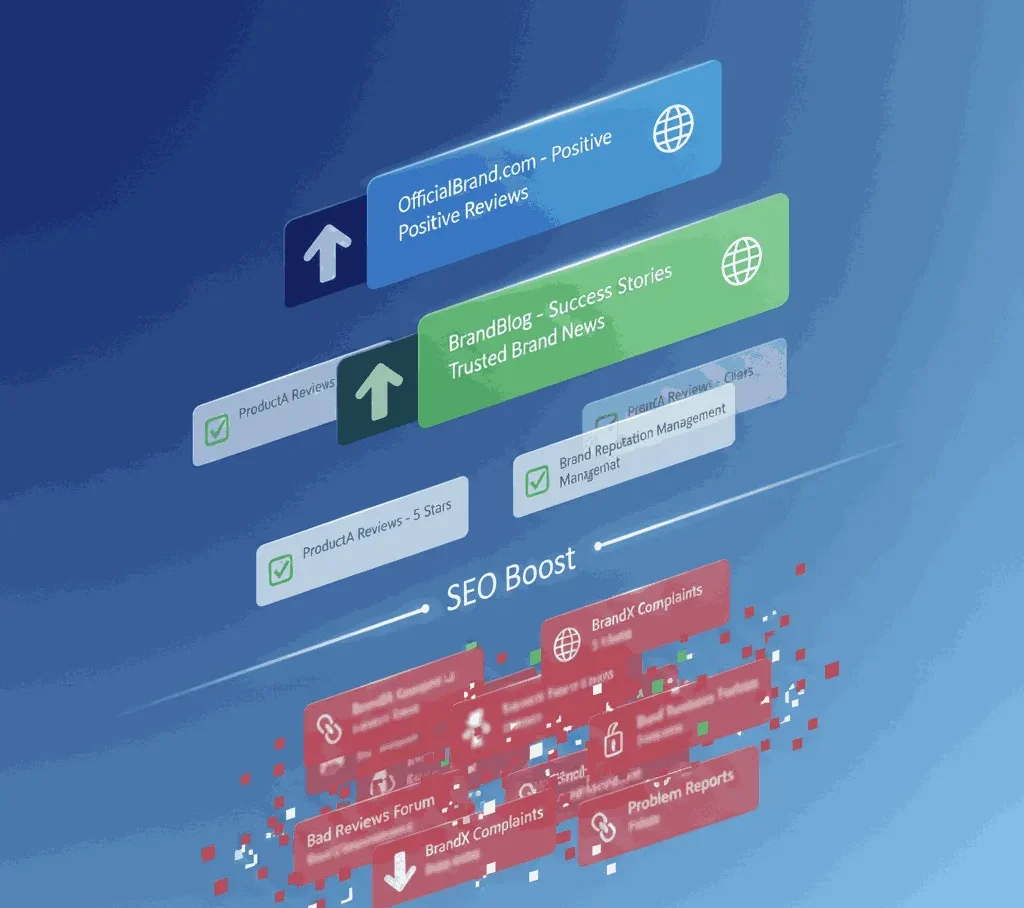
Reverse SEO or Derank SEO is a strategic approach that is used in Online Reputation Management or ORM to reduce the visibility of negative content in search engine results. Its main goal is to enhance a brand’s online image by suppressing unfavorable websites lower in rankings for important branded keywords.
How It Works:
Reverse SEO uses regular SEO tactics but with opposite goals. Instead of enhancing the visibility, it works to push down unwanted and negative content. This process usually involves several steps.
- Creating Optimized Content: The first step includes the development of high volume new, positive, and authoritative content. These include social profiles, press releases, blog posts etc.
- Using different SEO techniques to optimize and promote new content.
- Then linking trusted websites to the new positive content so it gets more authority and outranks negative pages.
In fact, the primary objective is to fill search results with positive and trustworthy information about a brand, so when people search for it, they see the good first.
Is Reverse SEO an Ethical Approach?
Use of such a technique may raise questions in one’s mind about if it is ethical? So, it is important to know that Reverse SEO is an ethical approach. The reason is, it focuses on improving your own reputation rather than harming anyone else’s. This makes it different from Negative SEO, where different black hat SEO techniques are used to suppress competitors’ content.
Reverse SEO vs. Traditional SEO: Key Differences
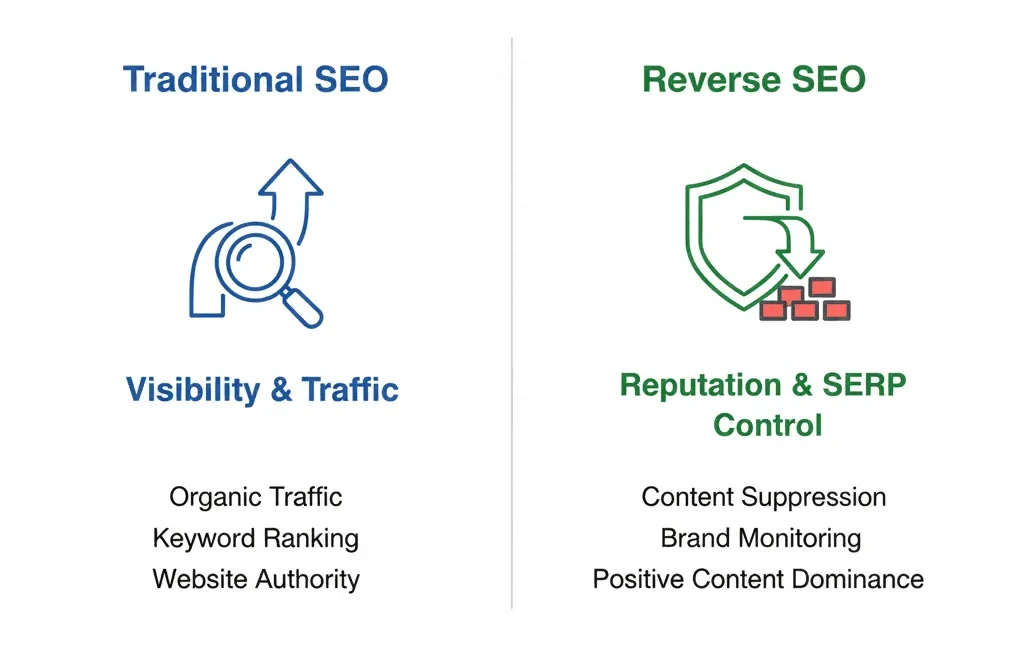
Reverse SEO combines technical SEO with online brand management. It means it uses SEO techniques to protect and improve the brand image. It requires a distinct strategic approach than the traditional SEO that usually aims for more online visibility.
Here are some key differences between traditional SEO and Reverse SEO.
| Aspect | Traditional SEO | Reverse SEO (R-SEO) |
| Goal | Increase visibility and traffic | Suppress negative content |
| Target Keywords | Product/service or industry terms | Branded terms (e.g., “Company X reviews”) |
| Focus | Rank one main site higher | Control 10–20 positive results across multiple platforms |
| Platforms Used | Brand’s own website | Third-party sites with high authority (LinkedIn, directories, media sites) |
In short, Traditional SEO builds visibility, while Reverse SEO builds control, ensuring the top search results reflect credibility, not negativity.
Reverse SEO: The Technical Arm of ORM
Online Reputations Management is an ongoing strategic process of monitoring and improving public perception of a brand or an individual. It includes everything from responding to reviews to removing harmful content.
Reverse SEO works as a technical arm of ORM. It uses SEO tools and techniques to diminish negative search results while promoting positive ones.
By integrating Reverse SEO into ORM, businesses can ensure the potential customers find correct and positive information when they search for the brand. It ultimately strengthens trust and loyalty over time.
Why Brands Need Reverse SEO
In most cases, Reverse SEO is launched during a reputation crisis, but it can be equally valuable as a preventive strategy.
1. Crisis Response
A brand’s reputation and sales can be heavily affected by negative comments or reviews. It is important to start a Reverse SEO campaign when false accusations or negative reviews appear on the first page of Google.
2. Compliance and Accuracy
Some industries need to ensure that compliant and factual information outrank misleading or old pages. Using Reverse SEO can help maintain regulatory accuracy.
3. Proactive Defense
If a brand consistently executes Reverse SEO campaigns, it becomes easier for them to dominate malicious or negative content even in future.
To lead an effective Reverse SEO campaign, brands must align their content with Google’s E-E-A-T principles. A well-researched, expert driven content can easily displace negative pages and help maintain a credible brand reputation.
Step-by-Step Guide to Reverse SEO Optimization
A successful suppression campaign is divided into two phases.
- Mapping the existing threats
- Reverse Engineering to overcome challenges
Phase I: Mapping the Threat Landscape (The Negative Audit)
The first and foremost step in a Reverse SEO campaign is to perform a full online audit of a brand’s presence. It involves tracking of all mentions of the brand, executives and the products. Tools like Google Alerts or Mention can be used for this purpose.
The next step is to identify and document all negative or unwanted URLs that appear in search results, usually the top 20 for branded keywords. Then keep a record for their ranking positions, sentiments like positive, neutral, or negative and also the keywords they appear for.
At the same time, conduct a technical audit for the positive assets such as your website, social profiles, and articles. Then, optimize them for performance by improving page speed, site structure, and loading times. This step will help enhance the ranking potential.
In the end, analyze the backlink profile of the negative URLs. With a clear understanding of the number and quality of negative backlinks, it will be easier to set a benchmark of how much and of what quality backlinks you need to outrank those negative URLs.
Phase II: Competitor Reverse Engineering (The Success Audit)
Reverse engineering plays an important role in shaping a solid content saturation strategy. It includes analyzing the websites already ranking on the first page of Google for similar authoritative or branded content. It also involves the content audit of websites that are not direct competitors. This approach will help understand which types of sites like industry blogs, interview platforms or review sites are ranking those search results and why.
For this, the content strategy of the websites will be analyzed in depth. For example, what type of content they publish. Are they blogs, videos, infographics etc. Moreover, the length of their content and how often they publish are also noted. All of these insights will reveal what kind of content performs best in the niche.
The purpose of this analysis is not to gain general visibility but keyword dominance. In fact, Reverse SEO focuses on a few high-risk branded keywords. A detailed competitive analysis helps a brand understand the tactics the competitors are using and identify the areas where the brand can use higher quality content and stronger backlinks to outperform negative results. Using this approach, you can push unfavorable pages down and strengthen your brand’s online presence.
Push Down Negative Google Results with Reverse SEO
As discussed earlier, the main goal of Reverse SEO is to push down negative content with high volume, high quality content. So, the executing phase of Reverse SEO includes the development of an overwhelming volume of positive content across a wide range of high authority platforms. It will help saturate the SERP while diluting the negative results’ prominence.
The Content Layering and Volume Strategy
The first step is to create a large amount of high quality, valuable content and publish it across multiple online platforms. This includes:
- Building and optimizing social media profiles
- Publishing in-depth blog posts on your website
- Sharing positive answers or discussions on Q&A sites like Quora or Reddit
Each content should be targeting positive and branded keywords, including long tail keywords. These should be related to the company, products, or executives. Long tail keywords help capture specific searches. By providing answers to specific queries, brands can demonstrate their expertise in the field and boost overall visibility.
At the same time, Technical SEO should also be applied carefully to ensure strong rankings.
This can be done by including schema markup such as Organization or Q&A schema. It improves chances of earning rich snippets. These can push negative results further down the page. All content should be written keeping Google’s E-E-A-T principles.
Maximizing Platform Diversity and Authority
Reverse SEO is not about ranking on one page, it is about controlling various top results on search engines. To achieve this goal, multiple high authority platforms should be included in the strategy that Google already trusts.
This includes:
- Optimizing professional profiles such as LinkedIn, Crunchbase, Medium etc
- Securing interviews or guest features on credible, industry-specific websites e.g., Idea Mensch
- Consistently posting engaging, brand-focused content on your company’s blog and social media
These high domain authority sites help ensure that your positive assets rank high faster and stronger and push negative results down.
With this multiplatform approach, you not only protect your brand from current reputation risks but also build it stronger to outrank any future negative content that appears prominently in search results.
The Role of Local SEO in Reverse SEO Strategies
When reputation issues are linked to a specific location such as negative local reviews or regional news coverage, the Reverse SEO campaign should involve local SEO techniques. This approach will help manage and suppress unfavourable results effectively.
1. Optimize Google Business Profile (GBP)
The first and the most important step is to fully optimize your Google Business Profile. It should be claimed, verified and regularly updated with correct details. For example clear mention of working hours, contact information, photos, videos. And most importantly, prompt responses to customer reviews.
With an optimized GBP, brands can improve relevance, distance and prominence in local searches. Google considers all of these factors important when ranking local results. This helps ensure that positive and accurate information about your business is showcased prominently while negative content moves down in visibility.
2. Conduct a Citation Cleanup
Inconsistent business details around the web can confuse search engines and affect your local credibility. Therefore, a citation cleanup is necessary to rank higher. It involves auditing all the online listings to fix errors, duplicate, or outdated information.
It is advised to ensure the Name, Address, and Phone Number of your business are consistent across all directories, review sites, and maps. It helps Google verify your legitimate presence and strengthens your authority in local search results.
3. Create Geo-Targeted Content
Another important factor is to develop location-specific content to further control local search visibility. To do so, create city focused blog posts, regional landing pages, or local press releases. Moreover, you can incorporate geo targeted keywords. All of these factors will help your brand rank for localized searches.
With this kind of content, you build relevance for your brand within a specific area that helps positive pages outrank negative local mentions or reviews.
Common Mistakes to Avoid in Reverse SEO Optimization
In Reverse SEO, link building serves as an engine that drives negative content down the rankings. However, the reason for the failure of several campaigns is that they overlook the importance of precision, authority, and balance in link management. Here’s what needs to be done and what to be avoided.
1. Strategic Link Building for Displacement
Backlinks are considered Google’s one of the strongest rankings signals, and in Reverse SEO, their role becomes even more important. The goal here is not just to build links but to build stronger and more authoritative links than those of the negative content.
A common mistake most people make is trying to build links everywhere without a clear plan in mind. Instead, focus on targeted backlinks for your positive assets like blog posts, social profiles, and media features.
First check the backlink strength of the negative pages before starting the campaign. Tools like Ahrefs or SEMrush can be used for this purpose. If those pages have strong backlinks then you will have to get even better quality backlinks for your positive content.
In simple words, the more credible and authoritative your backlinks are, the easier it will be to push negative results down and make your positive pages rank higher in search results.
2. Digital PR and Expert Sourcing Strategies
One of the most effective and ethical ways to build backlinks is through Digital PR. In fact, this approach focuses on positioning your brand or its representatives as credible experts within your industry.
Different platforms like Connectively, formerly HARO, connect brands with journalists looking for expert opinions. When these journalists feature your insights, they usually include contextual backlinks from trusted media outlets. This significantly increases your content’s authority as well as visibility.
At the same time, invest in creating link-worthy content. For example, original research, industry reports, or data-driven articles. These high-value resources naturally attract journalists and bloggers to your content who linkback to your site. It helps your positive content rise in rankings and effectively push negative ones down.
3. Technical Link Management and Defense
It is also important to protect your domain from harmful spammy links. You may trigger Google penalties by ignoring this important factor. It can cost your authority and credibility.
Therefore, it is advised to monitor your backlinks regularly. Moreover, you can use tools to disavow toxic links that could damage your rankings. A clean and healthy link structure helps ensure your Reverse SEO efforts are strong and long-lasting.
Conclusion
Reverse SEO is a powerful tool for digital protection. Instead of focusing on visibility alone, it uses advanced SEO techniques to push down negative search results and strengthen a brand’s online presence.
By combining strategic content creation, strong E-E-A-T signals and targeted link building, it helps brands regain control over how they appear online.
Success depends on treating search results as a dynamic environment that requires consistent effort and proactive reputation management. When businesses regularly monitor their brand presence and continue building positive authority across platforms, they can protect their digital image, maintain public trust, and protect long-term brand value.
The true measure of success in Reverse SEO is ensuring that positive, credible content dominates the first pages of search results while keeping harmful or misleading information out of sight.