
Even if your website ranks on the first page of Google, it can still get overlooked. Standard search listings often fail to grab attention, which means missed clicks and lost opportunities. Rich snippets solve this problem by showing extra information directly in search results, such as star ratings, prices, or cooking times. They provide users with more context than a standard meta description, making your listing more noticeable and appealing.
Although Google states that rich snippets do not directly influence rankings, they can have a strong impact on click-through rates. For example, the top organic result can receive nearly 40% of clicks on average. Optimizing your content for rich snippets helps maintain visibility in search results, attract more qualified traffic, and make the most of every impression, making them a highly effective tool for SEO.
What Is a Rich Snippet?
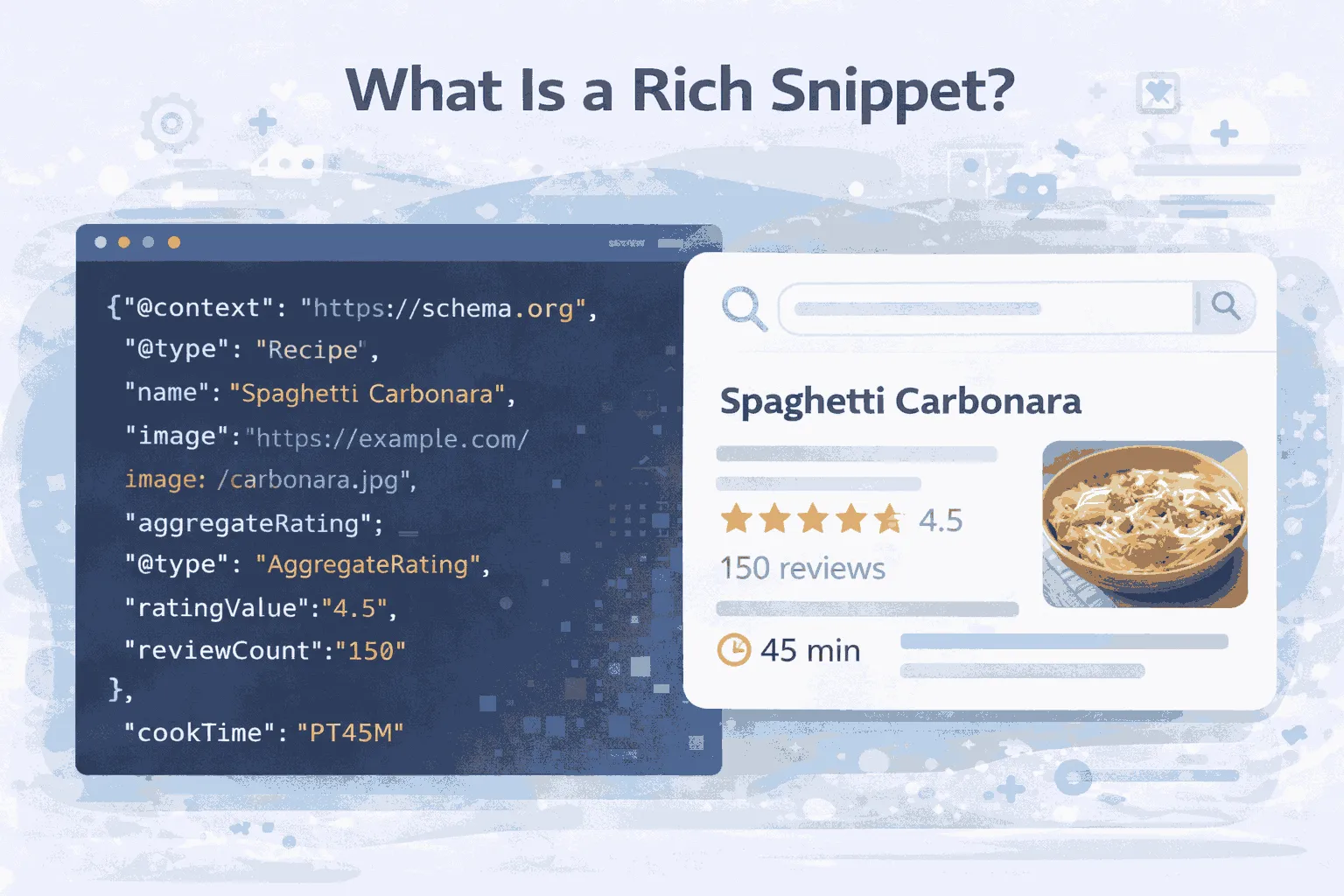
A rich snippet is an enhanced search result that adds extra context and visual elements beyond the usual title, URL, and meta description. This can include things like review stars, product prices, availability, or a recipe’s cooking time.
Rich snippets are created using structured data embedded in your website’s code, which helps search engines understand your content more clearly. The result is a listing that stands out, provides users with useful information at a glance, and encourages more clicks.
The Technical Foundation
Rich snippets rely on structured data to help search engines understand your content more accurately. By using a standardized vocabulary from Schema.org, structured data defines exactly what your content represents.
This allows Google to recognize specific elements on your pages, such as FAQs, event details, or product information, and display them as rich snippets in search results.
Rich Snippets vs. Related Features
It’s important to understand the differences between the main types of enhanced SERP features:
- Rich Snippets: These are enhanced organic results that display schema-driven information, such as ratings or event dates. They appear when structured data is correctly implemented on a page.
- Rich Results: This is a broader category that includes all advanced SERP features, including carousels, knowledge panels, and other visually distinct elements. Rich snippets are one type of rich result.
- Featured Snippets: These appear in an answer box at the top of search results (position zero). Google extracts the content directly from the page, without relying on schema markup.
The Indirect SEO Multiplier
While structured data doesn’t directly impact rankings, it has powerful benefits that boost performance:
- Higher Click-Through Rates (CTR): Listings with stars, images, or extended text stand out and attract more clicks.
- Increased SERP Real Estate: Rich snippets expand the size of your listing on the page, making it more visible while pushing competitors further down.
- Qualified Traffic Acquisition: Details like ratings or price help filter searchers upfront, bringing clicks from users who are genuinely interested.
This creates a positive cycle: schema helps search engines understand your content, rich snippets appear, users engage more (higher CTR), and this behavior sends signals that can help maintain or even improve your rankings. Adding structured data acts as a powerful multiplier, maximizing your site’s traffic potential.
Breakdown of Rich Snippet Code Values and Their Meaning
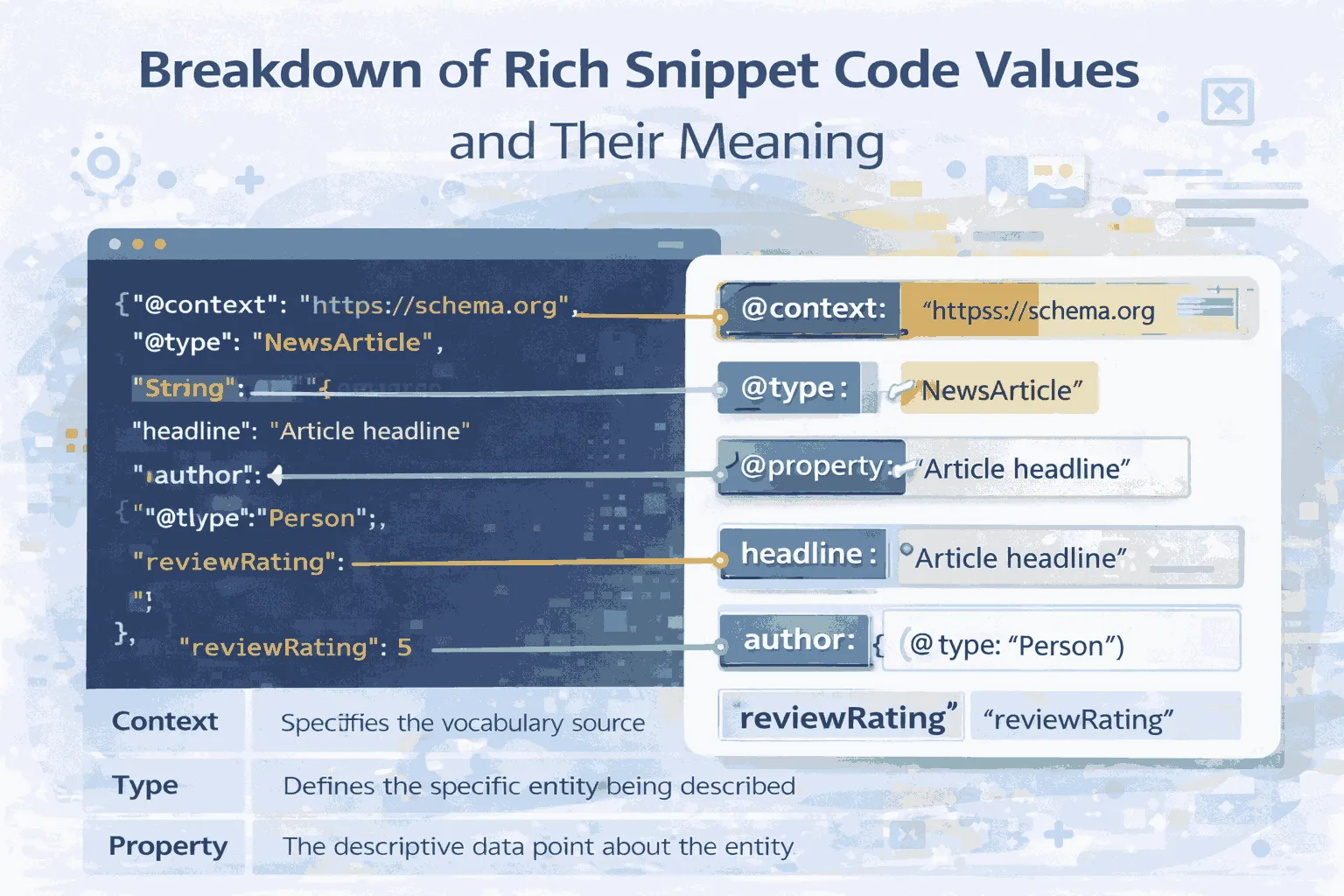
The foundation of rich snippets is schema markup, most commonly implemented using JSON-LD (JavaScript Object Notation for Linked Data). JSON-LD is preferred because it keeps structured data separate from visible HTML and is usually added inside a <script> tag in the page header.
Every structured data block must include three key components for search engines to interpret content correctly:
1. Context (@context)
This defines the vocabulary being used. For rich snippets, the context is always set to Schema.org, which ensures the data follows standardized definitions for web entities.
2. Type (@type)
The type specifies the kind of entity being described, such as NewsArticle, Product, Recipe, or Organization. Using the most specific type improves visibility and relevance. For example, marking a business as Dentist instead of the generic LocalBusiness sends a stronger relevance signal and increases the chance of eligibility for rich snippets.
3. Properties (e.g., name, url)
Properties provide descriptive details about the entity. Google divides them into two categories:
- Required Properties: Essential fields for rich snippet eligibility. For LocalBusiness, these include address, name, latitude, longitude, opens, closes, and dayOfWeek.
- Recommended Properties: Optional but useful fields that enhance the snippet. Examples include aggregateRating, priceRange, and review.
This structure ensures search engines fully understand your content, increasing the likelihood that rich snippets appear and making your listings more prominent in search results.
The table below summarizes these key components using a NewsArticle example:
| Schema Element | Technical Value | Meaning / Purpose | Example (NewsArticle) |
| Context | @context | Specifies the vocabulary source (always Schema.org) | “@context”: “https://schema.org” |
| Type | @type | Defines the specific entity being described | “@type”: “NewsArticle” |
| Property | Varies (e.g., headline) | The descriptive data point about the entity | “headline”: “Article headline” |
| Nested Object | author | Information about a sub-entity, like the author | “author”: { “@type”: “Person” }” |
| Review / Rating | reviewRating | Shows individual or aggregated user feedback | “ratingValue”: “5” |
This structure ensures search engines understand your content clearly, making rich snippets more likely to appear and helping your listings stand out in search results.
Types of Rich Snippets
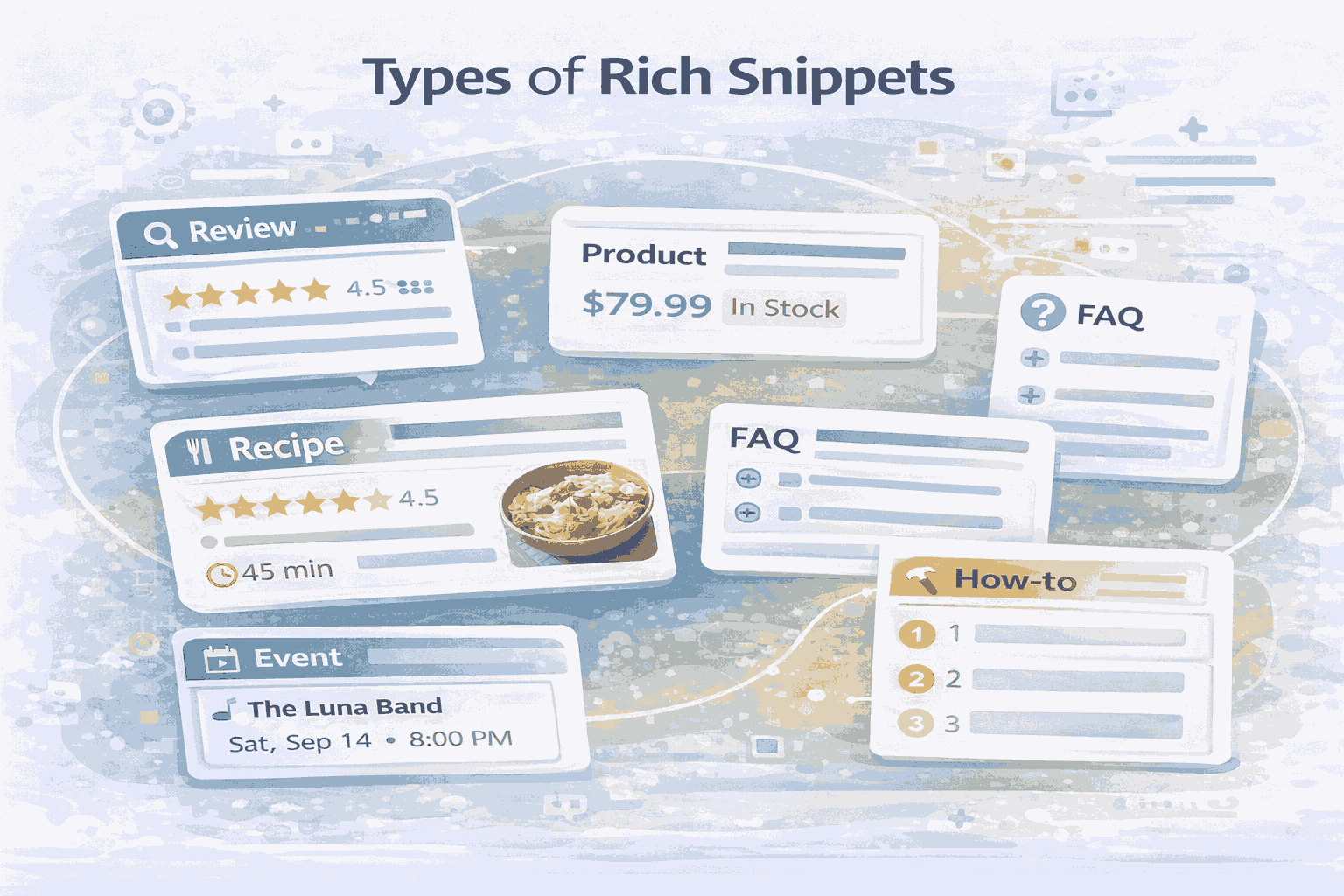
Rich snippets appear in many forms, reflecting the variety of content on the web. Choosing the right schema type is crucial for visibility and attracting clicks.
E-commerce and Product Snippets
The Product schema is widely used for businesses selling goods or services. It displays star ratings, price ranges, and stock availability directly in search results, building trust and encouraging conversions. Proper implementation often results in the familiar “star ratings” that help e-commerce listings stand out.
Review Snippets
Review snippets show short excerpts or aggregate ratings for items like books, recipes, movies, products, or local businesses. This type instantly adds credibility and social proof, giving users confidence before they click.
Informational and Instructional Snippets
These schemas help educational or how-to content stand out:
- FAQPage Schema: Displays questions and answers directly in search results, capturing more space and providing immediate value.
- HowTo Schema: Shows step-by-step instructions within the snippet, ideal for guides or tutorials.
Strategic Considerations for Snippet Types
Implement rich snippets with user context in mind. For example, HowTo snippets often appear only on mobile devices, so optimizing for mobile, structuring content clearly, and ensuring fast page loads is essential.
Rich snippets also filter traffic by showing key details like price or ratings upfront, attracting visitors who are genuinely interested. This reduces irrelevant clicks, improves conversion rates, and makes your organic traffic more efficient.
High-Value Rich Snippet Types and Benefits
| Schema Type | Content Example | Primary SERP Enhancement | Core Business Benefit |
| Product | E-commerce items, Software Apps | Star ratings, Price, Availability, Stock Levels | Drives highly qualified traffic with purchase intent |
| Review Snippet | Aggregate rating for a Book, Movie, or Local Business | Average rating score and number of reviews | Builds credibility and trust instantly |
| FAQPage | Q&A section on a policy or service page | Expandable Q&A directly in the snippet | Captures more SERP real estate |
| Recipe | Cooking sites | Cook time, calorie count, review stars | Reduces bounce rate; provides immediate value |
| HowTo | Step-by-step instruction guides | Guided steps displayed in the snippet | Maximizes engagement; mobile only |
Ways to Create a Rich Snippet (Online Generators, AI, Custom Coding)

You can create structured data in several ways, from simple automated tools to fully custom code.
Online Generators
Web-based generators make it easy to create basic schema markup. You choose the @type, such as LocalBusiness, and fill in the required fields. These tools follow Schema.org standards and help avoid formatting mistakes. They are useful when you need quick and clean starter templates.
AI Template Generation
Large Language Models, including ChatGPT, can prepare structured data quickly. An SEO professional might ask the AI to create a Product schema with fields like name, price, rating, and availability, or generate markup for a specific item such as a waterproof smartwatch. This approach saves time when working with many similar pages.
Even so, AI output should always be checked manually to confirm accuracy and alignment with Google’s rules. AI can speed up the process, but validation remains an important step.
Custom Coding and Technical Best Practices
Some projects require hand-written JSON-LD to handle unique layouts or advanced features. In these cases, following Google’s guidelines is important. The markup must match the visible content on the page. For example, if you include reviews, they must reflect the product shown on that same page.
Structured data also helps Google’s AI systems interpret content with more clarity. As AI Overviews continue to grow, clean and accurate schema improves the chance of your pages being referenced in those results.
Mandatory Testing Tools
Testing structured data is necessary before publishing. Errors can stop rich snippets from appearing, and warnings can weaken results. Google provides two main tools for validation:
- Rich Results Test: Checks eligibility for rich results and shows previews.
- Schema Markup Validator: Confirms that your structured data follows Schema.org standards.
Testing and correcting errors is crucial because rich snippets are a conditional privilege. Submitting inaccurate or misleading schema breaks trust with the search engine, and the Rich Results Test ensures that risk is minimized.
Implementing Rich Snippets (Custom, WordPress, Yoast SEO, All In One SEO)
How you implement rich snippets depends on your Content Management System (CMS) and available technical expertise.
Custom CMS Implementation
In non-WordPress or custom environments, implementation usually involves inserting JSON-LD code directly into the HTML, typically within the <head> or <body> tags. This method gives maximum control over the markup but requires ongoing maintenance and a strong technical understanding to manage changes and scale across many pages.
WordPress Plugin Implementation
For WordPress sites, plugins offer an efficient, scalable solution, automating schema management and eliminating the need for manual coding. Choosing between the top plugins, Yoast SEO and All In One SEO (AIOSEO), depends on content volume and diversity.
Yoast SEO: Automation and Integrated Standards
Yoast SEO provides a seamless, automatic structured data framework. Standard content types, like blog posts, automatically receive correct Article schema without user input.
- Strength: User-friendly and ideal for beginners or sites focused on standardized content like articles or organizational profiles.
- Limitation: Specialized schemas (e.g., Local Business hours or Video details) often require premium add-ons to avoid manual coding.
All In One SEO (AIOSEO): The Visual Schema Generator
AIOSEO shines with its visual Schema Generator and Schema Catalog, allowing users to add complex schema types without coding.
- Implementation: While editing a post or page, users open the Generate Schema tab, select the type (e.g., Course, Event, Recipe), and fill in descriptive fields. The plugin then creates accurate JSON-LD automatically.
- Strength: Flexible and customizable, suitable for sites with diverse content types.
The choice between these plugins depends on content diversity and technical resources. Sites with standardized content benefit from Yoast’s automation, while businesses with unique, varied content gain more from AIOSEO’s flexibility, avoiding extra costs for add-ons or developer support.
Yoast SEO vs. AIOSEO for Structured Data
| Implementation Aspect | Yoast SEO Approach | AIOSEO Approach |
| Primary Method | Automatic, integrated standard schema framework | Next-generation Schema Generator & Catalog |
| Ease of Customization | Requires specialized, often paid add-ons for niche types (Video, Local SEO) | Easy selection and configuration for virtually any schema type via a visual UI |
| Best For | Standardized content (blogs, articles), core SEO, maximum automation | Sites with diverse or complex content (Courses, Events, Products) |
| Setup Barrier | Low for core functions; moderate for extensions | Extremely low; no coding needed for advanced schema |
Conclusion
Rich snippets play an important role in SEO because they help search engines understand your content in a clear, structured way. They don’t directly move rankings, but they convert your content into signals that Google and AI systems can read without confusion. This clarity helps your pages stand out and often brings more qualified traffic through higher CTR and better visibility in search results.
With stronger competition from Featured Snippets and AI Overviews, rich snippets work as a smart way to protect your visibility and get more value from every search impression. Both Yoast SEO and AIOSEO make implementation easy in their own ways, but the goal remains the same. Clean and accurate structured data supports stronger visibility and more efficient traffic across your site.