
How does a website stand out when more than a billion others are fighting for attention?
The digital space keeps growing fast, with around 1.2 billion websites already live and a new one launching every three seconds. At the same time, Google handles over 8.5 billion searches each day, which makes technical decisions far more than a backend task. The way a domain is structured plays a direct role in search visibility and user experience.
One of the most important choices is between subdomains and subdirectories, since this structure controls how search engines pass authority and how users move across a brand’s online presence.
When planned as a long-term strategy, the right setup can deliver returns as high as 700 percent, which makes understanding subdomain behavior critical for steady web growth.
What a Subdomain Means in SEO Today
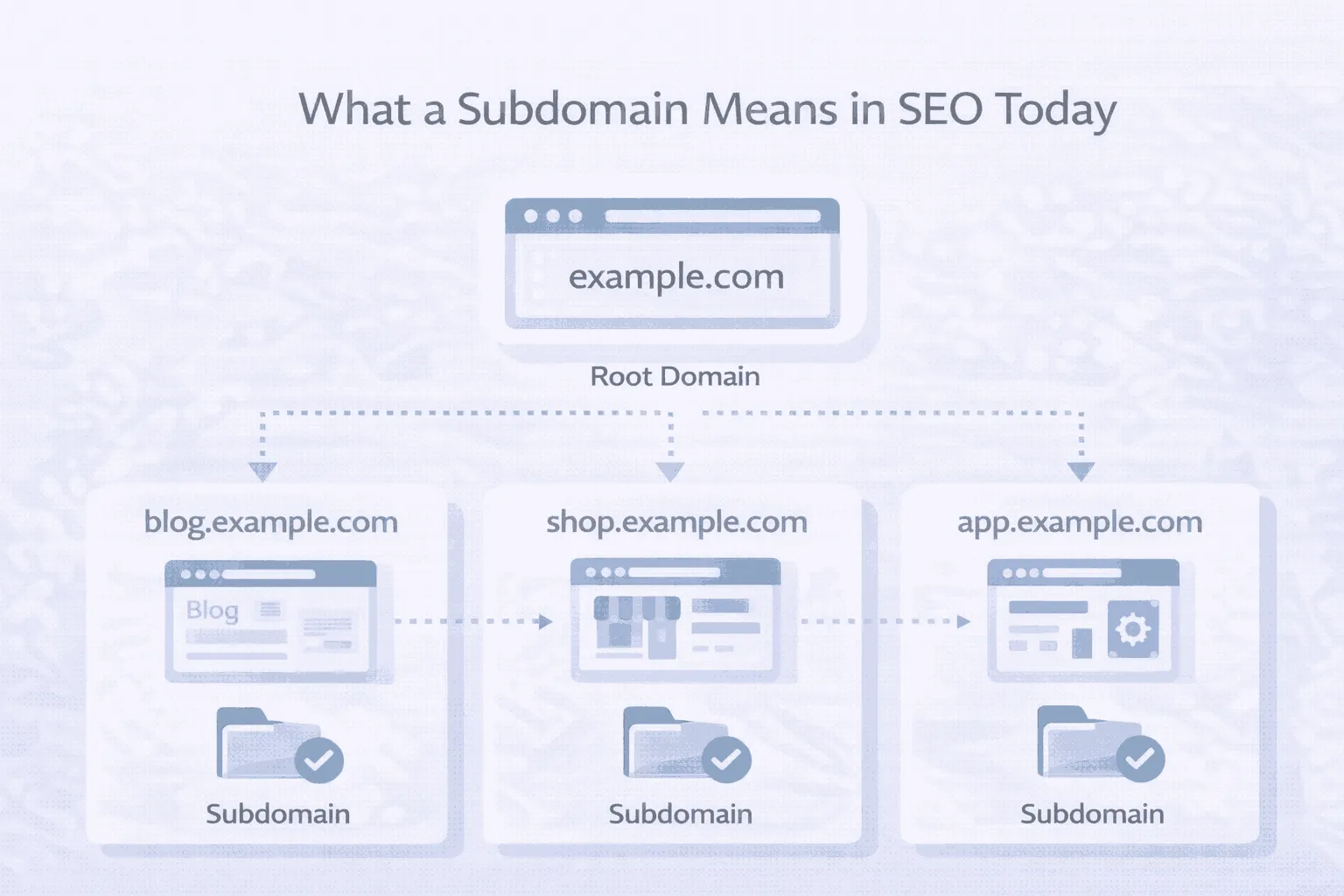
A subdomain is a prefix added to a main domain that creates a separate section of a website. For example, example.com is the main domain, while blog.example.com or shop.example.com operates as its own space under the same brand. In SEO, a subdomain is treated as a distinct area that can be managed separately.
From a technical perspective, DNS standards defined in RFC 1034 describe a subdomain as any domain that exists within another domain. This definition helps explain why search engines may handle subdomains differently from folders inside the main site.
How subdomains are structured technically
The Domain Name System works like a tree, where each level represents a domain. Subdomains sit below the root domain and are commonly third level domains. Each subdomain has its own zone file and a Start of Authority record. This tells search engines and servers that the subdomain can be managed independently.
This structure is especially useful for businesses that run different services, content types, or business units under one brand while keeping technical control separate.
Key technical limits and specifications
| Subdomain Component | Technical Constraint / Specification |
| Character Limit per Label | 63 octets |
| Total Domain Name Length | 253 ASCII characters |
| Common Prefix Examples | www, blog, shop, app, dev, staging |
| DNS Hierarchy Level | Third-level domain (typically) |
| Structural Purpose | Content organization, technical separation |
Why subdomains are used in real projects
Subdomains offer more than basic organization. Because each subdomain acts as a separate host, it can use a different content management system, run on a separate server, and apply its own security rules. This flexibility makes subdomains a practical choice for large platforms, enterprise tools, and third party integrations that cannot be placed inside a standard subdirectory.
For brands managing complex digital setups, subdomains provide a clear way to scale while keeping systems structured and manageable.
How Search Engines Process Subdomains
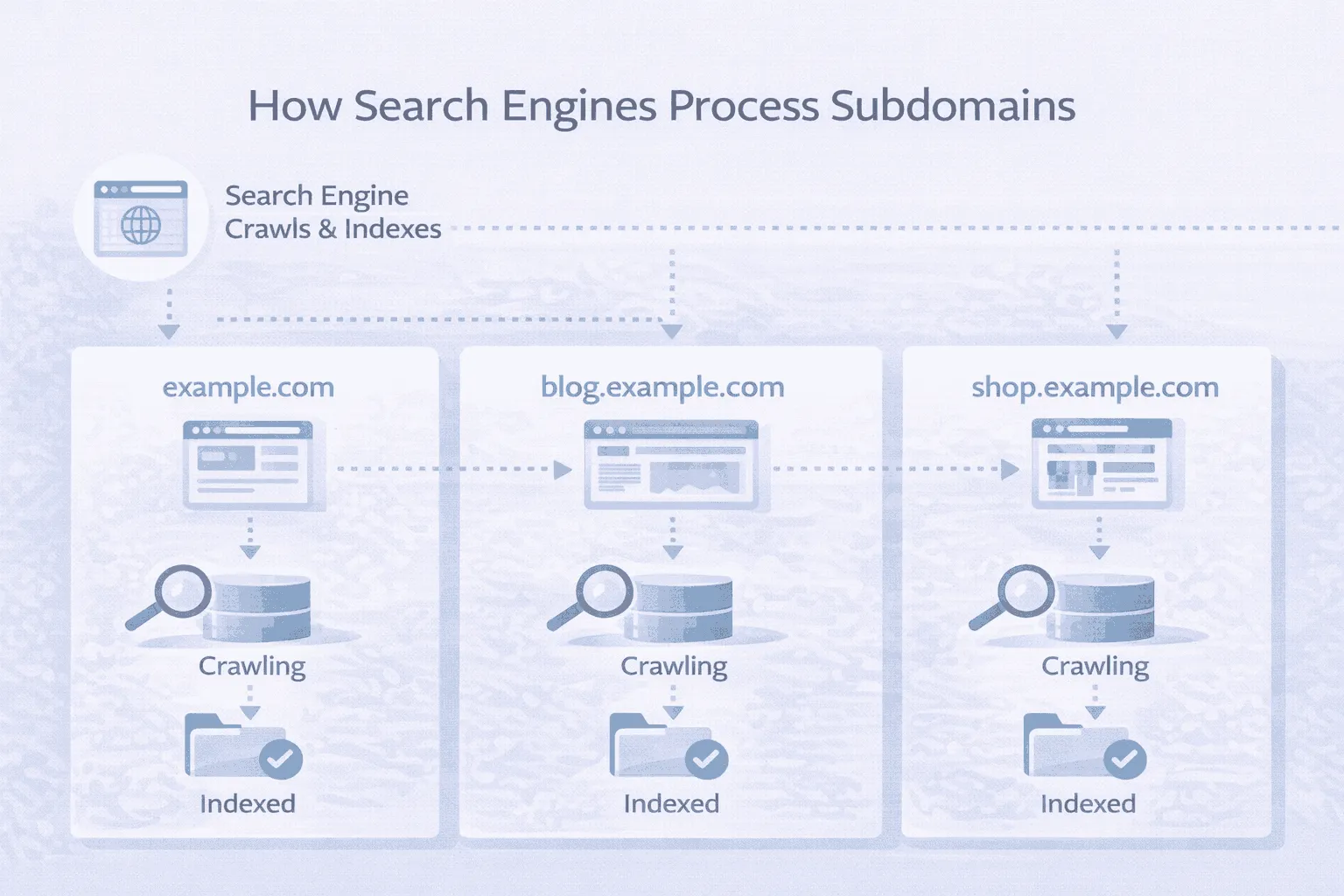
Search engines and subdomains have a long and sometimes confusing relationship. Google has repeatedly stated that its ranking systems can understand subdomains as part of the same main website when the connection is clear. According to official guidance, subdomains and subdirectories are treated the same, and neither structure receives an automatic ranking advantage.
Real world behavior, however, tells a more detailed story. Search engines often handle subdomains as separate properties during crawling and indexing. This is why subdomains must be verified individually in tools such as Google Search Console. While the algorithm can link them to the parent brand, each subdomain is usually evaluated on its own signals first. As a result, backlinks and authority are not automatically shared across the domain structure.
Crawling and indexing in practice
When a search engine discovers a subdomain, it typically catalogs it as a standalone host. This means crawling, indexing, and early ranking decisions are based on the subdomain’s own content quality, links, and technical health. Strong internal linking can help reinforce the relationship with the main domain, but it does not remove the need for independent authority building.
AI search and structural clarity
Search behavior has shifted with the growth of AI driven indexing and zero click searches, which now make up close to 60 percent of Google queries. These systems rely heavily on clear structure to retrieve and summarize information accurately. Subdirectories often offer a clearer contextual path for AI models, while subdomains add an extra layer of separation. To maintain the same level of association, subdomains usually need stronger internal signals and external links.
How algorithms typically treat subdomains
| SEO Factor | Subdomain Algorithmic Treatment |
| Crawling Efficiency | May receive a separate crawl budget per host |
| Indexing Classification | Often indexed as separate websites |
| Entity Association | Needs strong internal linking to reinforce brand ties |
| Ranking Potential | Equal in theory, but requires its own authority |
| Search Console Status | Requires separate property verification |
The role of crawl budget
Search engines use a crawl budget to decide how often and how deeply they explore a site. With a subdirectory structure, this budget is shared across the entire site, allowing crawlers to move smoothly through related pages. Subdomains, on the other hand, are treated as separate hosts. If the architecture is complex or linking is weak, this can spread crawling efforts thin and slow down indexation across the site.
Subdomains vs Subdirectories: A Clear Structural Comparison
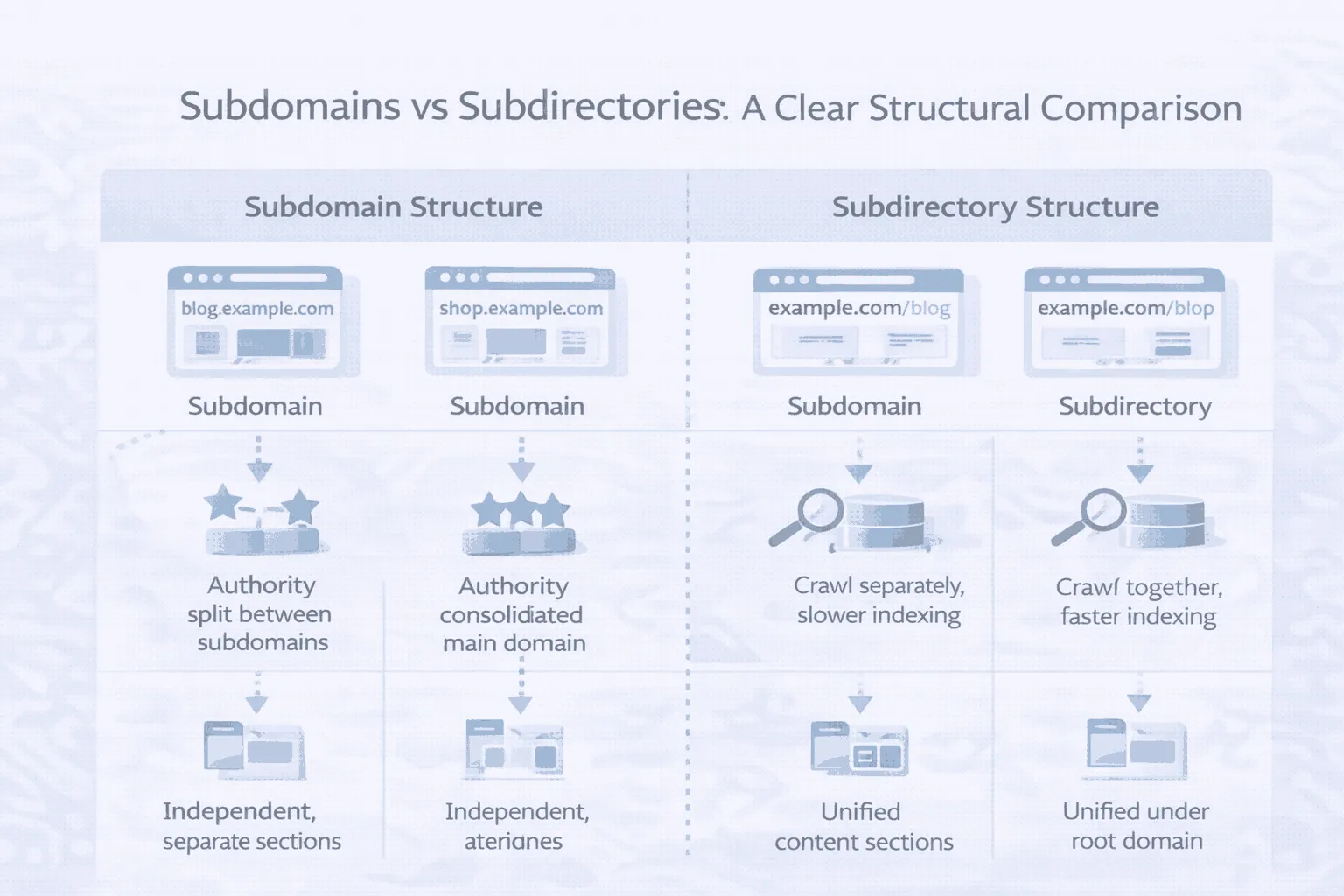
The choice between subdomains and subdirectories sits at the core of technical SEO because it shapes how authority is built and shared. A subdirectory is a folder within the main domain, such as site.com/blog, and is treated as part of the same website. A subdomain, like blog.site.com, sits outside the main folder structure and acts as a separate host.
This structural difference directly affects how search engines crawl, index, and assign value to content.
Why subdirectories often perform better for SEO
One of the biggest strengths of subdirectories is authority consolidation. When a page inside a subfolder earns a strong backlink, that value flows straight to the root domain. This strengthens the entire site and helps new content rank faster because it benefits from the trust the domain has already earned.
For content driven strategies, this shared authority often leads to quicker visibility and more consistent performance across pages.
Side by side structural comparison
| Feature | Subdomain (blog.site.com) | Subdirectory (site.com/blog) |
| Authority | Built independently | Shared with root domain |
| Setup | High technical flexibility | Moderate, tied to main CMS |
| Management | More complex, multiple properties | Simple, single dashboard |
| Index Speed | Slower for new hosts | Faster due to existing trust |
| User Flow | Can feel like a separate site | Seamless and unified |
When subdomains make more sense
Although subdomains are harder to grow from an SEO standpoint, they offer strong technical freedom. They work well for projects that need a different technology stack, such as custom web apps or third party platforms like hosted eCommerce systems.
This separation also reduces risk. Changes made to a subdomain do not affect the main marketing site, which is especially important for large organizations that manage multiple products or services under one brand.
Link Equity and How Authority Is Shared
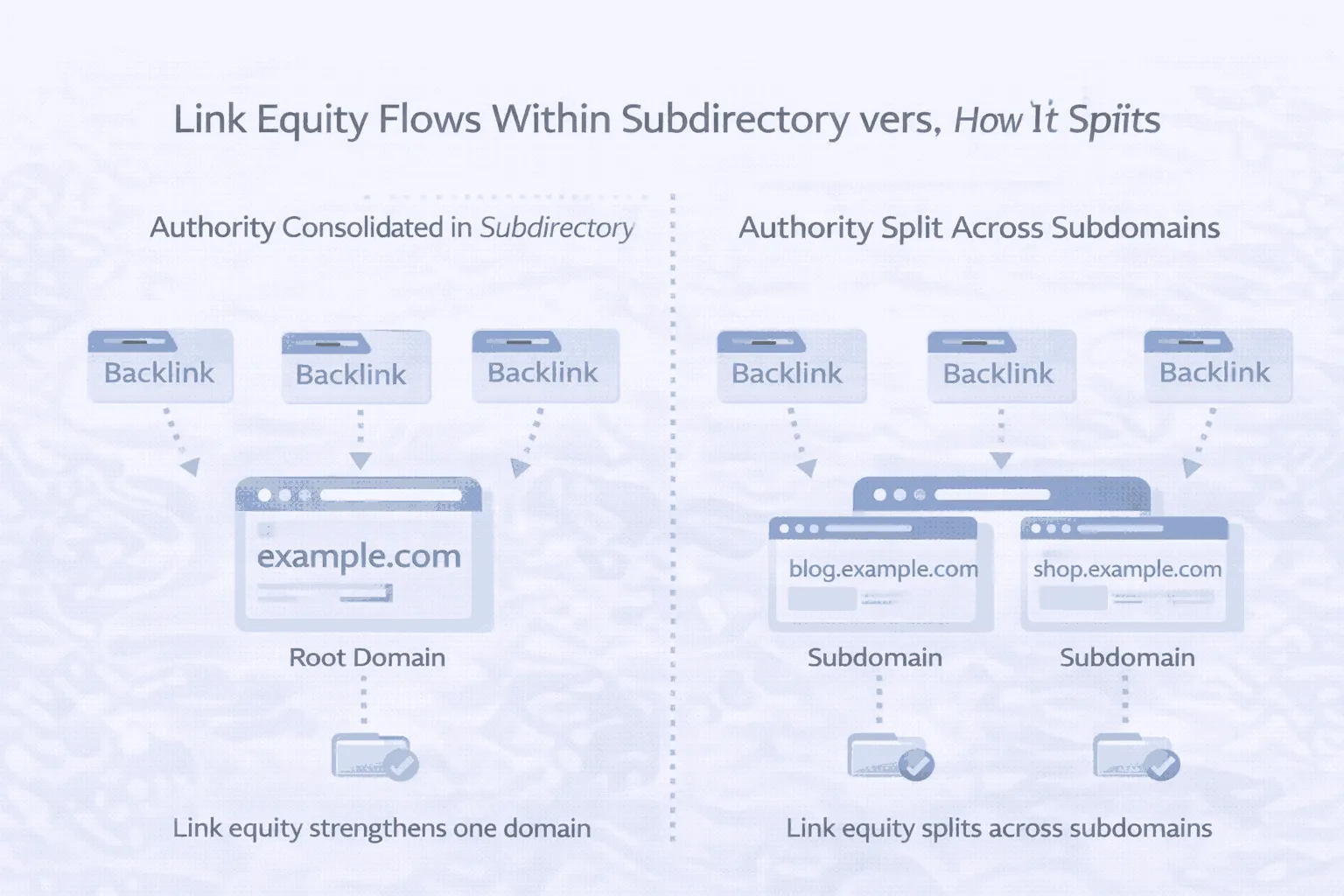
One of the main reasons SEO teams prefer subdirectories comes down to link equity, often called link juice. Backlinks continue to be a major ranking factor, and pages that rank at the top have nearly four times more backlinks than those lower on the page. Subdomains do not inherit this authority by default. Each one is treated as a separate property that must earn trust and links on its own.
How subdomains split authority
When a blog lives on a subdomain, it needs its own backlink strategy, outreach, and content promotion to build credibility. Internal links from the main domain can pass some value, but the impact is far weaker than publishing content inside a subdirectory. This setup often leads to split authority, where a brand’s overall SEO strength is spread across multiple properties instead of being concentrated in one strong domain.
What real case studies show
Several well known brands have tested this in practice, and the results are consistent. Moving content from a subdomain into a subdirectory has led to strong gains in organic traffic and visibility. The reverse move has often caused sharp declines.
| Brand Migration Case Study | Movement Type | SEO Outcome |
| Salesforce | Subdomain to Subdirectory | Traffic doubled overnight |
| HotPads | Subdomain to Subdirectory | Major organic traffic growth |
| Monster.com | Subdomain to Subdirectory | Improved search visibility |
| IWantMyName | Subdirectory to Subdomain | Sharp drop in organic traffic |
What this means for growing websites
For most businesses, especially small to mid sized sites with limited resources, subdirectories offer a faster and more efficient path to growth. Splitting effort across subdomains often slows progress and weakens brand presence in search. Keeping content under one domain helps focus authority, strengthen rankings, and build momentum over time.
When Subdomains Make Sense: Strategic Use Cases
While subdomains can split authority, they are valuable tools for certain business needs. They allow for segmentation, technical isolation, and tailored user experiences that a single domain structure might not support.
Creating content silos for specific audiences
Subdomains work well when targeting a distinct audience or industry. For example, academy.example.com can act as a dedicated learning hub, separate from a sales-focused main site. This lets the business design navigation, content, and messaging specifically for learners without cluttering the main brand site.
Supporting international expansion and localization
For brands operating globally, subdomains help with geo-targeting. Country-specific subdomains like es.example.com can signal regional relevance more clearly than folders like example.com/es/. They also allow hosting regional content on local servers, improving load speed and enabling keyword strategies tailored to local markets.
Staging, development, and testing environments
Subdomains are essential for isolated testing. Staging.example.com can host new features or design updates in a secure, password-protected, and “noindex” environment. This ensures testing does not interfere with SEO while maintaining the same technical setup as the live site for accurate results.
Isolating technical and experimental risk
Complex JavaScript apps or experimental features can hurt page speed and Core Web Vitals. By isolating these on subdomains, companies protect the main site’s performance and rankings. This is crucial because only 43.4% of websites currently meet all Core Web Vitals standards on mobile.
Examples of strategic subdomain use
| Use Case | Architectural Choice | Reason for Selection |
| Global Sites | Subdomain (fr.site.com) | Stronger regional targeting |
| Client Portals | Subdomain (portal.site.com) | Enhanced security and data isolation |
| Testing/Beta | Subdomain (dev.site.com) | Risk isolation for main domain |
| Storefronts | Subdomain (shop.site.com) | Compatibility with third-party platforms |
| Corporate Blog | Subfolder (site.com/blog) | Maximum authority consolidation |
By using subdomains strategically, businesses can segment audiences, expand globally, test safely, and manage complex technical setups without sacrificing SEO for the main domain.
How Subdomains Can Boost SEO Performance
When planned carefully, subdomains can strengthen an SEO strategy. They allow for focused keyword targeting and protect the main site from potential algorithm shifts.
Building niche authority
Subdomains are ideal for branching into topics that differ from a brand’s core focus. For example, if a mechanic starts publishing content about birdwatching, placing it on a separate subdomain prevents search engines from confusing the site’s main purpose. This approach also lets the new content build a backlink profile specific to its niche without diluting the authority of the main domain.
Handling high-volume technical demands
Websites with large data sets, developer portals, or extensive knowledge bases can benefit from subdomains for performance reasons. Hosting content across multiple servers helps manage traffic spikes and ensures one section does not affect the entire site. Faster load times improve rankings and can reduce bounce rates by up to 24% for sites that meet speed standards.
By using subdomains strategically, companies can explore new niches, maintain technical stability, and enhance overall SEO performance without compromising their main domain’s authority.
The Risks: How Subdomains Can Hurt SEO

The primary danger of using subdomains is the unintentional fragmentation of a brand’s digital influence. For smaller businesses, the increased workload and diluted authority often outweigh any organizational benefits.
Fragmented authority and extra workload
The main risk with subdomains is splitting a brand’s SEO influence. Because subdomains act as separate entities, each one needs its own SEO strategy, keyword research, content, and link-building campaigns. For smaller businesses, this often means more work for less payoff, creating multiple weak properties instead of a single strong domain.
Keyword cannibalization and internal competition
If a subdomain and the main domain target the same keywords, they may compete against each other in search results. This cannibalization can prevent either page from reaching the top spot, which is significant because the second position on Google receives just 18.7% of clicks compared to nearly 40% for the first result.
Higher technical maintenance and costs
Subdomains increase complexity across several areas:
- Security Certificates: Each subdomain may need its own SSL, or a wildcard SSL, which can be expensive
- Search Console: Each subdomain must be verified separately, making it harder to monitor site health
- Indexation Management: Sitemaps and robots.txt files must be handled individually to ensure proper crawling
| Operational Challenge | Impact on SEO Performance |
| Fragmented Link Profile | Links on subdomains don’t boost root domain |
| Technical Debt | Higher risk of broken redirects or links |
| Analytics Complexity | Self-referrals and session breaks in GA4 |
| Maintenance Overhead | Updates must be managed across multiple tech stacks |
Best Practices by Site Type
Choosing the correct architecture for specific site sections is a strategic decision that depends on business goals and technical constraints.
Blogs: Stick to subdirectories
For content marketing, blogs should remain in subdirectories (example.com/blog) whenever possible. Authority from blog posts supports the main site, whereas a subdomain isolates link equity and diminishes its SEO value.
E-commerce stores: Subdomains may be necessary
Stores often live on subdomains (shop.example.com) due to platform constraints, like Shopify for the store and WordPress for marketing. While subdirectories would be better for SEO authority, subdomains offer operational flexibility. Strong internal linking is key to passing authority to the store.
International sites: Keep architecture consistent
For global sites, consistency matters. Subdomains (uk.example.com) or subdirectories (example.com/uk/) must use correct hreflang tags to direct users to the right version. Subdomains are often preferred for large-scale international expansion, especially when different teams or server locations manage each market.
This approach ensures technical efficiency without unnecessarily harming search performance.
Common Technical Mistakes with Subdomains
Implementation errors can lead to devastating loss of search visibility and traffic. Avoiding these common pitfalls is essential for maintaining a healthy domain.
Accidentally indexing staging environments
A frequent error is letting search engines crawl a staging subdomain. This can flood Google with duplicate pages, dilute authority, and hurt rankings. To prevent this, staging sites should be blocked in robots.txt and protected behind a login or IP whitelist.
Misusing canonical tags
Canonical tags tell search engines which version of a page is the “master.” If identical content exists on a subdomain without a proper canonical pointing to the main domain, both versions may be penalized for duplicate content.
Fragmented analytics and self-referrals
In GA4, moving from a main domain to a subdomain can trigger self-referrals, breaking user tracking and conversion data. Proper configuration avoids this problem:
| Analytics Setting | Correct Action |
| Measurement ID | Use the same “G-” ID across all subdomains |
| Cookie Domain | Set to root domain (e.g., .site.com) |
| Referral Exclusion | Add own domain to “Unwanted Referrals” |
| Cross-Domain Linker | Not needed for subdomains; only for TLD changes |
Best Practices for Subdomain SEO
For organizations that must use subdomains, following a rigorous technical checklist ensures that search visibility remains high.
Unified monitoring with Google Search Console
Use Domain Properties to track all subdomains and protocols in one view. Individual URL Prefix Properties are also useful for granular troubleshooting or legacy tools like the Disavow Tool.
Strategic internal linking
Subdomains don’t inherit authority automatically. Include links from the main site—such as in global navigation or the footer, to signal the relationship and encourage authority flow.
Consistent branding and user experience
Maintain the same design and navigation across subdomains. A consistent UX builds trust, reduces bounce rates, and strengthens SEO, as user signals increasingly impact rankings.
Final Thoughts
Choosing between a subdomain and a subdirectory is a balance between technical flexibility and SEO consolidation.
- Subdirectories are ideal for most businesses focused on building a unified brand and ranking informational content. They pool link equity and simplify management, creating a “rising tide” effect that lifts all pages.
- Subdomains are essential for complex setups, international targeting, or third-party integrations. They require more effort to optimize and maintain, but provide the technical freedom needed for enterprise scaling and risk management.
The real key to success is not just the structure itself, but how well it is executed. Every subdomain should meet the same standards of technical excellence and content quality as the main domain to maximize SEO potential.